

Key Takeaways
- Predictive maintenance ai identifies risk—but prescriptive agents determine the exact action and timing needed to prevent disruption.
- Operational context matters as much as technical condition; maintenance decisions must account for production schedules, resources, and business impact.
- Prescriptive agents close the gap between insight and execution by coordinating work orders, spare parts, and technician availability automatically.
- The real value isn’t predicting failure—it’s ensuring the right intervention happens at the right time with minimal operational disruption.
- Organizations that move from predictive alerts to prescriptive execution achieve higher reliability, lower downtime, and more efficient maintenance operations.
For years, people have viewed predictive maintenance as the ultimate solution. Detect failures before they happen, schedule maintenance accordingly, and avoid downtime. It sounded definitive—almost surgical in its precision. And to be fair, it was a major step forward. Moving from reactive firefighting to probabilistic foresight fundamentally changed how manufacturers approached asset reliability.
But there’s an uncomfortable truth that most reliability engineers quietly acknowledge: knowing something will fail doesn’t automatically tell you what to do about it.
A prediction without an action is just an alert. And alerts, as anyone who has worked in plant operations knows, are cheap.
What operations teams actually need isn’t just predictive maintenance ai. They need systems that decide, recommend, and coordinate the response. Systems that answer two questions simultaneously:
- What action should be taken
- When exactly it should happen
This is where prescriptive agents enter—not as a refinement of predictive models, but as a fundamentally different operational layer.
The Gap Between Prediction and Action
Predictive maintenance AI has become reasonably good at detecting patterns. Vibration anomalies. Temperature drift. Pressure instability. Motor current irregularities.
You’ll see outputs like:
- “Bearing failure probability: 72% within 14 days”
- “Pump efficiency degradation detected”
- “An anomaly score exceeds the threshold.”
Useful? Yes. Actionable? Not always. The real decision involves more than just determining the likelihood of failure. The real decision lives in a web of operational constraints:
- Production schedule commitments
- Spare parts availability
- Technician workload and skill availability
- Asset criticality in the production chain
- Cost of downtime versus cost of intervention
- Risk of secondary damage
Prediction alone doesn’t resolve those variables.
Also read: Leveraging Generative AI for Predictive Maintenance in Manufacturing Equipment”
Prediction Without Prescription Creates Operational Paralysis
Consider a simple example: a critical conveyor motor shows early-stage bearing degradation.
Predictive maintenance AI flags it.
Now what?
Options include:
- Replace immediately
- Monitor closely and wait
- Reduce load temporarily
- Schedule replacement during planned downtime next week
- Increase inspection frequency
- Ignore (yes, this happens more than anyone admits)
Each option has different costs, risks, and operational impacts. Predictive systems don’t resolve this decision space. Humans still have to interpret, prioritize, and act. And humans—especially under production pressure—don’t always choose optimally.
This issue isn’t due to a lack of competence. This is due to the absence of a comprehensive decision context.
This condition is where prescriptive agents fundamentally change the equation.
Prescriptive Agents: Moving from Detection to Decision
Prescriptive agents don’t stop at identifying failure probability. They determine the optimal course of action based on operational realities.
They evaluate:
- Failure likelihood
- Failure impact severity
- Production dependencies
- Spare parts inventory
- Maintenance crew availability
- Current production priorities
- Safety implications
And then recommend—or initiate—the best response. Not abstract recommendations. Concrete operational instructions.
For example:
- Schedule bearing replacement during planned downtime on Thursday at 02:00 AM
- Reduce motor load by 15% until replacement
- Automatically reserve replacement part from inventory
- Assign technician based on skill match and shift schedule
This closes the loop between insight and execution. Prediction becomes decision. Decision becomes action.
What Action to Take—and When—Is the Real Optimization Problem
Maintenance isn’t binary. It’s not simply repair or ignore. Timing matters enormously.
Replace too early, and you waste asset life and increase maintenance cost.
Replace too late, and you risk catastrophic failure.
Replace at the wrong time, and you disrupt production unnecessarily.
Prescriptive agents optimize across multiple dimensions simultaneously:
1. Economic Optimization
Prescriptive agents balance the cost of intervention against the risk of failure. Sometimes the optimal decision is to wait. This procedure should not be done indefinitely, but rather until a natural pause in production occurs.
2. Operational Feasibility
Maintenance isn’t performed in isolation. It competes with production priorities. Prescriptive systems align maintenance timing with operational reality.
3. Risk Containment
Not all failures are equal. Failure of an isolated pump might be tolerable. Failure of a bottleneck machine can halt entire production lines. Prescriptive agents factor asset criticality into decisions automatically.
4. Resource Availability
Maintenance requires technicians, tools, and parts. Agents coordinate availability rather than assuming ideal conditions. Prediction alone doesn’t address any of this.
Real-World Example: Aviation Engines and Action Timing
Aircraft engine manufacturers like Rolls‑Royce have used predictive models for years. Their engines stream operational telemetry continuously.
Predictive systems can identify early-stage turbine degradation. But replacing an engine immediately isn’t practical. Aircraft scheduling, airport availability, and maintenance bay capacity—all impose constraints.
Prescriptive systems determine:
- Which airport to route the aircraft to
- When replacement should occur
- Whether load adjustments can extend safe operation
- How to coordinate maintenance logistics
The decision isn’t simply technical—it’s operational orchestration. Without prescriptive intelligence, predictive insight alone would create constant disruption.
Why Predictive Maintenance AI Alone Plateaus in Value
Many organizations deploy predictive maintenance AI and experience early gains. Reduced unexpected failures. Improved visibility.
Then improvement plateaus. The reason isn’t model accuracy. It’s action inefficiency.
Common issues include:
- Alerts ignored because teams lack capacity
- Manual interpretation delays
- Maintenance scheduled conservatively rather than optimally
- Production teams overriding maintenance recommendations
- Coordination gaps between planning and execution
The system predicts, but humans still coordinate everything manually. This becomes the bottleneck. Prescriptive agents remove that bottleneck by coordinating responses directly.
The Hidden Problem: Maintenance Decisions Are Distributed, Not Centralized
Maintenance decisions aren’t made by one person.
They involve:
- Reliability engineers
- Maintenance planners
- Production supervisors
- Operations managers
- Inventory controllers
Each has different priorities. Production wants uptime. Maintenance wants risk reduction. Finance wants cost control. Prescriptive agents unify these perspectives algorithmically. They don’t replace human authority—but they provide optimal decision pathways. This reduces negotiation overhead and improves consistency.
What Prescriptive Agents Do Differently
Prescriptive agents don’t just predict failure—they coordinate response.
Some examples from real deployments:
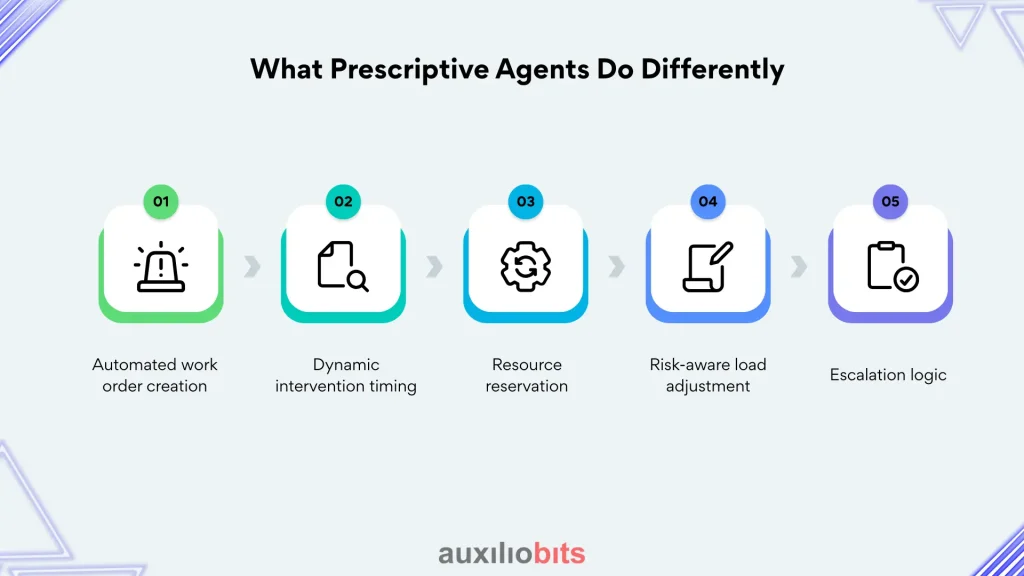
- Automated work order creation: Not when failure is predicted—but when intervention timing becomes optimal.
- Dynamic intervention timing: Adjusting maintenance schedules continuously as production conditions evolve.
- Resource reservation: Spare parts, technician assignment, maintenance bay allocation.
- Risk-aware load adjustment: Reducing stress on degrading equipment automatically when safe to do so.
- Escalation logic: Triggering human review when risk crosses defined thresholds.
These actions transform predictive insight into operational execution.
When Predictive Maintenance AI Alone Still Makes Sense
To be fair, predictive maintenance AI isn’t obsolete. It remains essential. Prescriptive systems depend on predictive insights as input.
Predictive maintenance alone may still be sufficient in environments with:
- Low equipment criticality
- Flexible production schedules
- Limited operational interdependencies
- Smaller-scale operations
But as operational complexity increases, prediction-only approaches start to break down. Human coordination doesn’t scale efficiently. That’s where prescriptive agents deliver disproportionate value.
Predictive Maintenance AI Was the First Step, Not the Destination
Predictive maintenance AI solved the visibility problem. Prescriptive agents solve the action problem.
And in industrial environments, action is what ultimately determines outcomes. Knowing something will fail is useful. Knowing exactly what to do—and when—is transformational.
Most reliability programs stall not because they lack data, but because they lack decision orchestration.
Prescriptive agents close that gap.
They transform maintenance from reactive repair to predictive awareness to autonomous operational coordination.
And once organizations experience that shift, going back to prediction-only systems feels strangely incomplete.