







Key Takeaways
- Shift-level decisions drive disproportionate financial impact. Optimizing performance within each shift reduces variability more effectively than focusing only on plant-level averages.
- Shop floor AI reduces decision latency. It transforms raw operational data into contextual, real-time recommendations supervisors can act on immediately.
- AI agents act as co-pilots, not controllers. The most successful deployments enhance human judgment rather than override it.
- Stability beats peak performance. Continuous, small improvements across shifts outperform occasional productivity spikes.
- Implementation maturity determines success. Data quality, explainability, and supervisor inclusion are critical to making shop floor AI sustainable and trusted.
At 7:05 a.m., just after the first shift starts, the same ritual occurs in every factory. Supervisors reviewing yesterday’s numbers. The maintenance team glances at the pending work orders. Operators are exchanging notes about a machine that malfunctioned during the night. Decisions are being made constantly—some deliberate, most reactive.
Now layer in volatile demand, tight labor availability, energy cost spikes, and quality pressures. Suddenly those “small” shift-level decisions carry disproportionate financial impact.
This is precisely where shop floor AI is changing the conversation. Not in abstract dashboards. Not in corporate boardrooms. But inside the shift itself—where throughput is either gained quietly or lost irreversibly.
And shift-wise optimization is the most under-discussed frontier of AI deployment in manufacturing.
Also read: AI Agents in Strategic Scenario Simulation for Executive Decisioning
The Problem Isn’t Data. It’s decision latency.
Most plants today are already instrumented. PLCs stream data. MES platforms log events. Maintenance systems record downtime codes. ERP captures production confirmations. The issue isn’t the absence of information.
It’s this: by the time someone interprets the data, the shift is over.
Traditional reporting works on a daily or weekly cadence. But shop-floor performance unfolds minute by minute. A 20-minute micro-stoppage that isn’t escalated during the shift becomes:
- Missed takt targets
- Overtime cost
- Delayed downstream processes
- Quality variation from rushed changeovers
Shift supervisors rely heavily on experience. And that experience matters. But human judgment, especially under noise and pressure, has limits. Fatigue sets in. Priorities conflict. Maintenance blames production; manufacturing blames materials. It’s familiar territory.
Shop floor AI reduces that decision latency. This is achieved not by displacing supervisors, but by providing them with structured foresight during the shift, rather than relying on forensic hindsight after the fact.
What AI Agents Do on the Shop Floor
There’s a misconception that AI deployment means installing predictive models and calling it transformation. That’s only partially accurate.
An AI agent, in a manufacturing context, isn’t just a predictive engine. It’s an autonomous or semi-autonomous decision-support layer that:
- Monitors live production signals
- Detects emerging patterns
- Evaluates alternative actions
- Recommends—or triggers—corrective responses
It’s less about static prediction and more about context-aware intervention.
For shift-wise optimization, AI agents typically operate across three domains:
- Production performance
- Maintenance and reliability
- Labor and resource allocation
Each domain interacts with the others. That interdependency is where real gains—or chaos—occur.
Shift-Wise Optimization: Where the Margins Hide
One shift runs at 92% OEE. Another at 84%. The weekly report shows 88%, and leadership shrugs. But the financial delta between shifts compounds quickly.
Here’s what usually drives shift variance:
- Operator skill differences
- Maintenance coverage availability
- Material staging gaps
- Changeover sequencing decisions
- Real-time escalation behavior
Traditional KPIs don’t explain why shifts diverge. They just record the outcome.
Shop floor AI introduces pattern recognition at the shift layer.
For example:
- The system detects an increase in breakdown probability when Line 3 runs a specific product mix during the second shift.
- The system detects a spike in scrap during the final 90 minutes prior to the shift change.
- The system consistently detects a higher energy consumption per unit during the night shift, which is often attributed to idle machine states.
These aren’t theoretical. Plants routinely discover such patterns after months of data mining. AI agents surface them continuously, in context.
Real-Time Decision Guidance: Not Just Alerts
Basic analytics generate alerts. AI agents prioritize, contextualize, and recommend.
There’s a meaningful difference.
An alert might say:
“Temperature variance detected.”
An AI agent might say:
“Temperature variance correlates with the last two quality escapes. Recommend reducing speed by 5% and scheduling inspection within 30 minutes.”
The nuance is critical. On the shop floor, alerts are noise unless they’re actionable.
Effective shop floor AI systems:
- Rank issues by production impact
- Estimate cost-of-inaction
- Suggest optimal timing for intervention
- Coordinate across systems (MES, CMMS, scheduling tools)
Shift supervisors don’t need more dashboards. They need structured trade-off analysis in real time.
Maintenance Decisions During a Shift: The Balancing Act
One of the hardest decisions in a plant is whether to stop production for preventive maintenance mid-shift.
Stop too early, and you lose throughput unnecessarily. Wait too long, and you risk catastrophic failure.
Historically, this decision has been judgement-driven. Sometimes rightly so.
AI agents improve their abilities by evaluating:
- Historical failure patterns
- Current vibration and thermal trends
- Production backlog status
- Labor availability
- Downstream buffer capacity
Then they simulate potential scenarios. Continue running for 3 hours? Estimated failure risk: 28%. Estimated downtime if failure occurs: 4.5 hours.
Pause for a 40-minute intervention now? Immediate loss: 0.7% shift capacity. Reduced failure probability: 3%.
These scenario-based recommendations bring quantitative clarity to decisions that were previously intuition-heavy.
That said, it’s not infallible. If sensor data quality is poor—or if the process has changed recently—the model’s reliability drops. AI needs calibration. It’s not magic.
Labor Allocation: The Human Variable
Shift performance is deeply human.
Operators differ in speed, accuracy, and adaptability. Some troubleshoot instinctively. Others escalate faster.
Advanced shop floor AI systems integrate workforce data:
- Skill matrices
- Certification levels
- Historical performance trends
- Fatigue indicators (where available)
This enables:
- marter task assignments during shift start
- Dynamic reassignment when bottlenecks emerge
- Balanced distribution of complex changeovers
Micro-Optimization vs. Systemic Stability
There’s a temptation to optimize everything constantly. AI agents can recommend dozens of small adjustments per shift.
But too much intervention creates instability.
Operators need rhythm. Frequent parameter changes increase cognitive load. Not every fluctuation warrants correction.
This is where maturity in deployment becomes essential.
Good shop floor AI systems incorporate:
- Threshold-based recommendation gating
- Confidence scoring
- Stability bias (avoiding overreaction to minor noise)
In other words, they know when not to intervene.
That restraint is often what separates successful implementations from over-engineered ones.
A Practical Example: Packaging Line Throughput
Consider a high-speed packaging line running three shifts.
Recurring issue: the third shift consistently underperforms by 6–8%.
Investigation reveals:
- Slightly longer changeovers
- Higher jam frequency in first hour
- Slower ramp-up after minor stops
An AI agent monitors line telemetry and identifies that jam probability increases when humidity exceeds a threshold—more common overnight.
Instead of waiting for downtime to accumulate, the system:
- Adjusts machine sensitivity parameters preemptively
- Recommends earlier lubrication checks
- Suggests staggered startup sequencing
Within weeks, third-shift performance narrows the gap to within 2% of other shifts.
No capital investment. Just better decision timing.
That’s shift-wise optimization in practice.
When Shop Floor AI Fails
It’s worth addressing this plainly.
AI initiatives fail when:
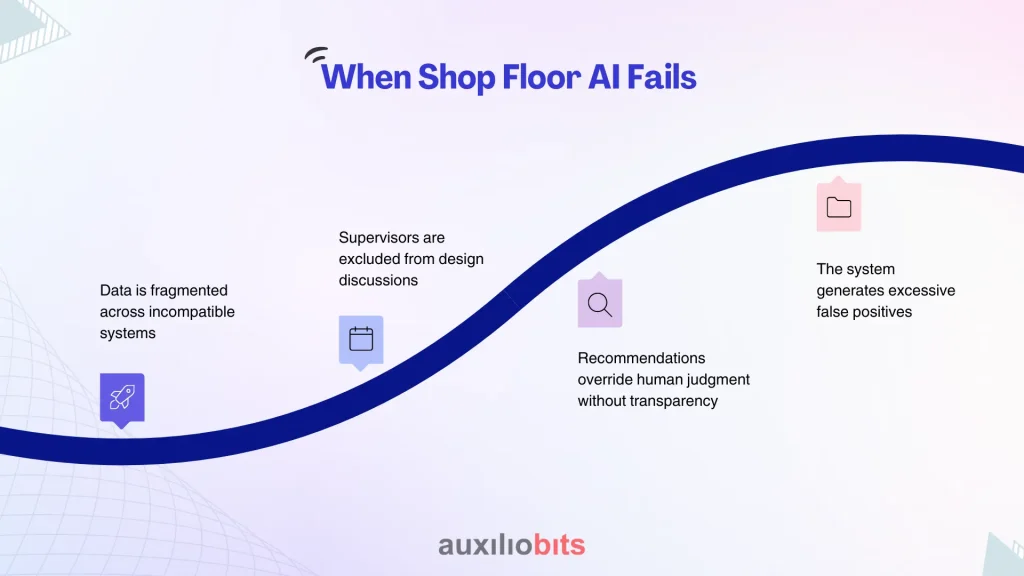
- Data is fragmented across incompatible systems
- Supervisors are excluded from design discussions
- Recommendations override human judgment without transparency
- The system generates excessive false positives
There’s also the cultural resistance factor. Some supervisors see AI as an encroachment. That reaction isn’t irrational. Change always feels disruptive.
Successful deployments position AI agents as co-pilots—not controllers.
The shift lead retains authority. The AI enhances visibility.
Why This Matters Strategically
Shift-wise optimization impacts more than daily KPIs.
It affects:
- OEE stability
- On-time delivery performance
- Maintenance backlog growth
- Workforce morale
- Energy cost exposure
Most plants focus on capital upgrades to improve performance. But often, there’s latent capacity hiding in decision quality.
Shop floor AI surfaces that capacity.
It reduces variability more than it increases peak output. And in manufacturing, stability often generates more value than short bursts of high performance.
Final Thought
Manufacturing has always been about precision. Yet decision-making on the shop floor has remained surprisingly informal.
Experience will always matter. Instinct won’t disappear. Nor should it.
But in environments where margins are thin and volatility is high, relying solely on human interpretation of complex data streams is increasingly unrealistic.
Shift-wise optimization, powered by well-designed shop floor ai agents, doesn’t remove human control. It refines it. It shortens feedback loops. It exposes patterns invisible to intuition alone.
And if there’s one lesson plants learn repeatedly, it’s this: small improvements sustained every shift outperform occasional heroic recoveries.
AI agents simply make those small improvements systematic.