







Key Takeaways
- Global AP automation requires more than replicating a successful domestic deployment; regional tax regulations, currencies, languages, banking systems, and compliance requirements introduce unique complexities.
- A phased rollout strategy that prioritizes data standardization, ERP integration, intelligent automation, and continuous optimization delivers more sustainable results than large-scale global deployments.
- Clean vendor master data and standardized financial structures are critical foundations for reducing exceptions and improving straight-through processing rates across regions.
- The most effective operating models balance centralized governance with regional flexibility, enabling consistent standards while meeting local regulatory and business requirements.
- Long-term success depends on continuous compliance monitoring, regional stakeholder engagement, and change management initiatives that drive adoption across global finance teams.
Your AP automation works beautifully in North America. But the moment you try to roll it out to Germany, Brazil, or Singapore – it fractures. Multi-currency, divergent tax regimes, language barriers, and fragmented ERP instances make global AP automation one of the most underestimated transformation challenges in enterprise finance. This guide breaks down exactly why that happens and how leading teams architect solutions that actually scale.
Why “copy-paste” rollouts fail
Most global AP automation failures stem from a deceptively simple mistake: treating international expansion as a replication exercise. Finance leaders take a working domestic deployment, hand it to regional teams, and expect identical results. The data shows a different picture.

The core problem is that global AP automation isn’t one problem — it’s a constellation of interconnected challenges that interact differently in each region. What fixes a bottleneck in one country can create a compliance gap in another.
The five dimensions of global AP complexity
Before selecting a platform or planning a rollout, finance teams need to map every dimension of complexity they’ll face. Here’s where most enterprise deployments get blindsided:
- Tax & e-invoicing mandates: Brazil’s SPED, Italy’s SDI, India’s GST e-invoicing, and Mexico’s CFDI all require country-specific XML structures that don’t map cleanly to generic AP workflows.
- Multi-currency & FX exposure: Real-time FX rate ingestion, hedge accounting integration, and triangular currency conversions require logic layers that most out-of-box solutions skip.
- Banking & payment rails: SEPA, ACH, BACS, and regional wire protocols each carry different settlement timelines, cut-off windows, and reconciliation file formats.
- Data residency & privacy law: GDPR, China’s PIPL, and Brazil’s LGPD impose different data localization requirements that affect where invoice data can be stored and processed.
- Language & supplier onboarding: Supplier portals in a single language create onboarding friction that increases exception rates by 2–3× in non-English-speaking markets.
- Fragmented ERP landscape: Multinationals typically run 3–5 ERP instances acquired through M&A, creating integration and data-normalization overhead that multiplies with every region added.
The four-phase scaling architecture
The teams that achieve sustainable global AP automation follow a phased architecture — not a big-bang deployment. Each phase builds institutional muscle before adding the next layer of complexity.
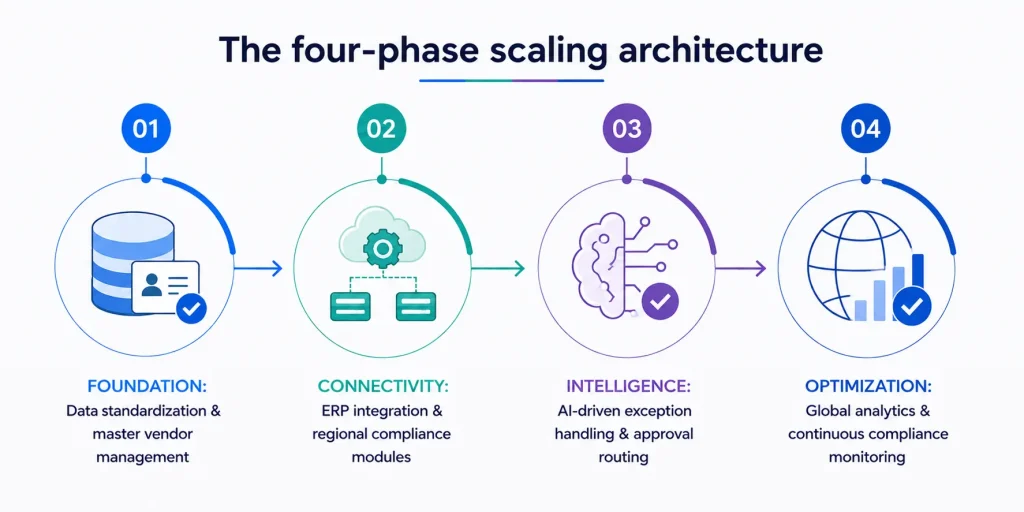
1. Foundation: Data standardization & master vendor management
Before automating anything cross-border, consolidate your vendor master into a single source of truth. Deduplicate supplier records, establish workflows for verifying IBAN and bank accounts, and define a global chart-of-accounts taxonomy. Teams that skip this step spend 30–40% of their Phase 2 time untangling data inconsistencies.
2. Connectivity: ERP integration & regional compliance modules
Deploy pre-built connectors for your core ERP instances (SAP, Oracle, and NetSuite) alongside country-specific compliance modules for e-invoicing mandates. The goal is a unified processing engine with region-specific rule sets sitting on top — not separate systems per country.
3. Intelligence: AI-driven exception handling & approval routing
Once clean data flows consistently, layer AI-powered OCR and intelligent document processing to handle non-standard invoice formats. Configure dynamic approval routing that accounts for regional delegation-of-authority matrices and local approval thresholds.
4. Optimization: Global analytics & continuous compliance monitoring
Centralize reporting into a global AP dashboard with regional drilldown. Implement automated compliance monitoring that flags regulatory changes (new e-invoicing mandates and updated tax rates) and triggers workflow updates before they become audit findings.
Key insight: The most successful global AP automation programs treat Phase 1 as a 60–90 day non-negotiable investment. Organizations that rush to Phase 3 without clean data foundations report 4× higher exception volumes and 50% longer straight-through processing (STP) cycles in Year 1.
Centralized vs. federated operating model: choosing the right structure
depends on your M&A history, regulatory environment, and the degree to which regional finance teams have autonomous authority. Here’s how the two primary models compare:
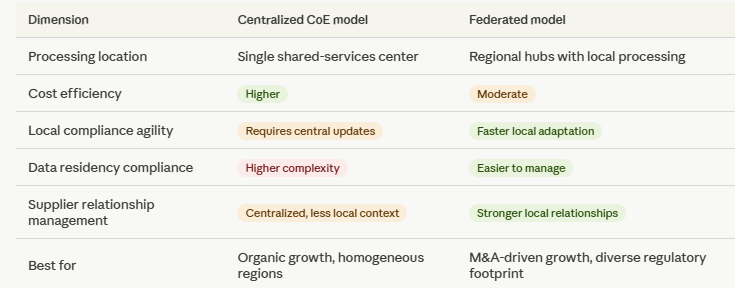
Many enterprises adopt a hybrid: a centralized Center of Excellence (CoE) that owns governance, vendor contracts, and technology standards, while regional hubs handle local supplier onboarding, exception resolution, and regulatory reporting. This gives finance leaders the cost benefits of centralization without sacrificing the compliance agility that complex markets like Brazil, India, and China demand.
Technology evaluation criteria for global AP platforms
When evaluating global AP automation platforms, the feature checklist that served you well for a domestic deployment needs to expand significantly. Prioritize vendors who can demonstrate — not just claim — capabilities across these dimensions:
- Pre-built country compliance packs — Not a roadmap item. Live, maintained e-invoicing integrations for your top-10 markets, with documented update SLAs tied to regulatory change cycles.
- Multi-entity, multi-currency ledger support — True multi-entity processing with real-time FX rate feeds, not post-hoc currency conversion.
- Data residency architecture options — Regional cloud instances or data-localization controls that satisfy GDPR, PIPL, and LGPD requirements without fragmented deployments.
- Supplier portal with multilingual support — Self-service supplier onboarding in local languages reduces exception rates and accelerates time-to-compliance in new markets.
- API-first ERP connectivity — Certified connectors for SAP S/4HANA, Oracle Fusion, and Microsoft Dynamics 365, with documented field-level mapping for cross-entity transactions.
- Audit trail and reporting by entity — Granular audit logs that satisfy entity-level reporting requirements for internal audit, external auditors, and local tax authorities.
Measuring success: the metrics that matter at scale
Global AP programs require a tiered measurement framework — global KPIs for executive visibility, and regional KPIs for operational accountability. Here are the metrics leading finance teams track:
Global KPIs
- Straight-through processing (STP) rate, by region and invoice type
- Days payable outstanding (DPO), by entity and currency
- Invoice exception rate, with root-cause categorization
- Early payment discount capture rate
Regional compliance KPIs
- e-Invoicing submission success rate (where mandated)
- Regulatory filing on-time percentage
- Supplier onboarding cycle time, by country
- Cross-border payment settlement accuracy
Benchmark: Best-in-class global AP teams achieve STP rates of 85–92% across all regions within 24 months of a phased global rollout. For mid-market multinationals starting from a manual baseline, the 18-month target should be 70%+ STP with a sub-3% exception rate.
Change management: the factor most teams underinvest in
Technology solves perhaps 60% of the global AP automation challenge. The remaining 40% is change management — and it’s where projects stall, get descoped, or quietly fail after launch.
Regional finance teams often experience global AP automation as something that is done to them, not with them. This manifests as low platform adoption, workarounds that bypass automated workflows, and exception queues that grow rather than shrink.
Successful programs build a regional champion network early — finance leads in each market who are involved in requirements gathering, pilot design, and post-launch governance. These champions become the bridge between global IT and local business realities, and they’re often the reason a pilot succeeds or fails.
Conclusion: building for adaptability, not just scale
The goal of global AP automation isn’t just processing more invoices faster across more countries — it’s building a finance infrastructure that adapts as your business grows, as regulations evolve, and as your supplier base diversifies.
The teams that succeed treat global AP automation as an ongoing program, not a project with an end date. They invest in data quality before technology, choose platforms with strong compliance roadmaps, and build operating models that balance central efficiency with regional autonomy.