







- Finance transformation succeeds when organizations deliberately redirect the capacity created by automation toward strategic work instead of allowing it to return to transactional tasks.
- Advancing from transactional finance to a strategic business partner requires changes in ownership, accountability, talent, and operating models—not just new technology.
- Measuring automation success through efficiency alone can be misleading if finance teams are not spending more time on forecasting, planning, and business decision support.
- Leading finance organizations consistently combine automation with process redesign, data governance, workforce upskilling, and organizational change to maximize long-term value.
- Conducting a redirection audit of recent automation initiatives helps identify where freed capacity has been lost and creates a practical roadmap for achieving meaningful finance transformation.
Here’s an uncomfortable truth most finance transformation content won’t say out loud: buying an EPM platform doesn’t make your finance function strategic. Neither does hiring an FP&A director with “strategic” in their title or rebranding the monthly business review as a “strategic planning session.” “We’ve watched a lot of finance transformation efforts and money get spent on the visible layer of strategic finance while the actual constraint sat untouched underneath.”
The constraint is almost never technology. The constraint is authority: whether finance has been mandated to shape decisions before they’re made and whether the team has been resourced to earn that mandate. Everything else is downstream of that one variable. This piece lays out why that distinction matters, a way to diagnose which constraint you’re actually facing, and what the fix looks like depending on the answer.
The Diagnosis Most Teams Get Wrong
When a finance function feels stuck in transactional mode, the instinct is almost always to treat it as a tooling problem: better systems, faster close, cleaner data. Tooling problems are appealing because they’re solvable with a purchase order. Authority problems are harder to name because they’re organizational and political, not technical.
We call the two failure modes Capacity-Constrained and Mandate-Constrained, and they require almost opposite interventions.
Capacity-constrained finance genuinely doesn’t have the hours. The team is buried in manual reconciliation, fragmented ERPs, and a close process that eats three weeks of every month. Here, more automation and better data infrastructure are the right first moves there’s no amount of organizational redesign that creates strategic output from a team with zero slack.
Mandate-constrained finance can contribute, but it lacks a role in decision-making. The close is reasonably efficient, and the data is reasonably clean, and yet finance is still only in the room after decisions are made — asked to model the impact of a pricing change that’s already been decided rather than to help decide the price. Buying this team a better forecasting tool doesn’t fix anything. The forecasts get more accurate; finance’s seat at the table doesn’t move an inch.
The uncomfortable part: most finance leaders diagnose themselves as Capacity-Constrained because it’s the flattering answer — “we’d be strategic if we just had more time” is a more comfortable story than “we haven’t been invited in, and haven’t yet forced the issue.” In our experience, teams that have done real automation work and are *still* stuck are almost always Mandate-Constrained, and no further tooling investment will move them.
How to Tell Which One You’re Actually Facing
Run this test. It takes five minutes, and it’s more diagnostic than most maturity assessments because it isolates cause from symptom.
Pick the last three material business decisions your company made — a pricing change, a headcount decision, a vendor renegotiation, a market entry, or anything with real dollars behind it. For each one, answer one question: did finance’s analysis exist before the decision was made, or was it produced to justify a decision already made? If the honest answer is “after” for most or all three, you are Mandate-Constrained, regardless of how good your tooling is.
If finance genuinely couldn’t have produced the analysis in time because the data wasn’t accessible or the team was underwater, you are Capacity-Constrained. The mandate problem is likely to disappear once the capacity problem is solved, because a team that can produce fast, trustworthy scenario analysis tends to get invited in naturally.
This test is worth running before you scope any transformation initiative, because it determines whether you’re buying the right thing.
Fixing Capacity: The Boring Work That Has to Happen First
Finance transformation is only as effective as the operational foundation it is built on. Before finance teams can spend more time on forecasting, planning, and strategic decision-making, they must first eliminate the manual work that consumes their capacity. The most successful organizations follow a structured sequence rather than trying to implement advanced capabilities all at once.
- Eliminate manual reconciliation: Remove manual reconciliation wherever possible to unlock meaningful time savings and accelerate the financial close. Partial automation often leaves the most time-consuming exceptions untouched, limiting the overall impact.
- Establish a single source of truth: Consolidate financial data across systems before investing in forecasting models or advanced analytics. Reliable, reconciled data is essential for accurate planning and confident decision-making.
- Redesign finance roles around strategic work: Once capacity has been created, redefine job responsibilities and performance metrics to prioritize forecasting, business partnering, and value-added analysis instead of transactional reporting.
- Redirect freed capacity with intention: Automation alone does not change how finance operates. Organizations must deliberately allocate the time saved toward higher-value activities to prevent it from being absorbed back into routine operational work.
Fixing Mandate: The Work That Actually Changes Finance’s Role
A finance function’s role does not change simply because new technology is introduced. When the real challenge is organizational mandate, the solution lies in changing how finance participates in business decisions. The following actions help finance move from a reporting function to a trusted strategic partner:
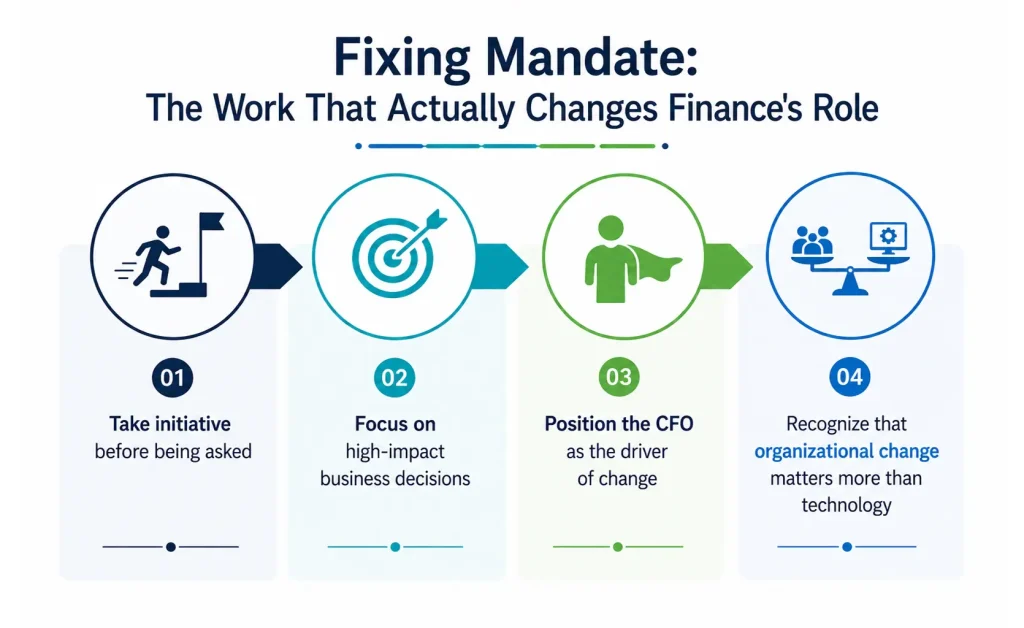
- Take initiative before being asked: Finance earns a strategic role by proactively delivering valuable insights—such as pricing scenarios, profitability analysis, or customer churn assessments—that influence important business decisions before stakeholders request them.
- Focus on high-impact business decisions: Instead of starting with minor process improvements, finance should contribute to strategic initiatives that leadership already prioritizes. Meaningful input on critical decisions builds credibility far more effectively than small operational wins.
- Position the CFO as the driver of change: Technology investments alone won’t shift finance’s role. The CFO must actively champion finance’s involvement in strategic discussions, ensuring the team is included early in key business decisions rather than only after plans are finalized.
- Recognize that organizational change matters more than technology: When the real barrier is a lack of strategic mandate, automation has limited impact. Success depends on changing how finance participates in decision-making, not simply implementing new tools.
Where This Actually Goes Wrong
The single most common failure pattern we see isn’t a bad platform choice or a skills gap. It’s diagnosing Mandate-Constrained finance as Capacity-Constrained, buying the tooling fix, and then being confused eighteen months later when the close is faster, the dashboards are better, and finance is still hearing about major decisions after the fact. The technology delivered exactly what it promised. It just wasn’t the constraint.
Where to Go From Here
Every finance transformation starts with understanding the real challenge. Whether your goal is to improve operational efficiency, strengthen financial decision-making, or position finance as a strategic business partner, having the right transformation approach makes all the difference.
Ready to move your finance function beyond transactional work? Contact our experts to see how intelligent automation and AI can help speed up your finance transformation strategy.
.