







Key Takeaways
- Sustainable finance cost reduction goes beyond cutting headcount—it requires eliminating process complexity, improving data quality, and redesigning finance operations from end to end.
- Organizations achieve greater cost savings when they simplify workflows before automating them, ensuring technology removes unnecessary work instead of accelerating inefficient processes.
- AI-powered intelligent automation delivers stronger long-term results than rule-based automation by reducing exceptions, improving decision-making, and automating entire finance workflows rather than isolated tasks.
- Measuring success through business outcomes—such as finance cost per transaction, month-end close time, exception rates, and audit readiness—provides a more accurate picture of operational efficiency than tracking hours saved alone.
- Finance leaders can maximize the return on transformation initiatives by adopting a structured maturity approach, avoiding common implementation mistakes, and focusing on continuous operational improvement instead of one-time cost-cutting exercises.
Finance leaders are under growing pressure to deliver more with fewer resources. Rising operational expenses, increasing regulatory requirements, talent shortages, and the demand for faster financial insights have made cost optimization a strategic priority rather than an annual budgeting exercise. Yet despite significant investments in digital transformation, many organizations continue to struggle with high finance operating costs.
The challenge isn’t a lack of technology. Most finance departments already use ERP systems, workflow tools, robotic process automation (RPA), and reporting platforms. The real issue is that these technologies often automate isolated tasks instead of transforming the end-to-end finance operation. As a result, organizations reduce effort in one area while new inefficiencies emerge elsewhere.
Sustainable finance cost reduction requires a different perspective. Instead of asking, “Which activities can we automate?” finance leaders need to ask, “Which operational costs should no longer exist?”
That shift—from reducing effort to redesigning operations—is what separates organizations that achieve lasting cost improvements from those that experience only temporary savings.
Why Finance Operational Costs Continue to Rise
Many organizations assume finance costs increase because transaction volumes grow. While volume plays a role, process complexity more commonly drives operational expenses.
Over time, finance teams inherit additional approvals, manual validations, disconnected systems, exception handling, and reporting requests. Each new requirement appears reasonable in isolation, but collectively they create an expensive operating model.
Several hidden cost drivers often receive less attention than they deserve:
- Manual reconciliation between disconnected systems
- Excessive exception handling caused by inconsistent data
- Multiple approval layers that slow decision-making
- Rework resulting from inaccurate master data
- Time spent gathering information instead of analyzing it
- Duplicate activities performed across finance, procurement, and operations
These inefficiencies rarely appear as individual line items in financial statements. Instead, they manifest as increasing headcount requirements, delayed month-end close cycles, audit challenges, and declining productivity.
Organizations focused solely on reducing labor costs often overlook these structural inefficiencies, limiting the long-term impact of their cost initiatives.
The Shift from Cost Cutting to Cost Engineering
Traditional cost reduction programs focus on doing the same work with fewer resources. While this approach can generate short-term savings, it often increases employee workload and introduces operational risk.
A more sustainable strategy is cost engineering.
Cost engineering examines how work flows through the finance organization and identifies opportunities to eliminate unnecessary effort altogether. Instead of simply accelerating existing processes, it questions whether each activity adds measurable business value.
For example, rather than automating multiple approval steps, organizations may discover that certain approvals no longer provide meaningful control. Instead of speeding up reconciliations, they may eliminate reconciliation requirements by improving upstream data quality.
This distinction is critical because the greatest opportunities for finance cost reduction often come from removing complexity rather than processing it faster.
A Framework for Sustainable Finance Cost Reduction
Organizations that consistently lower finance operating costs typically evaluate opportunities across four dimensions rather than pursuing isolated automation projects.
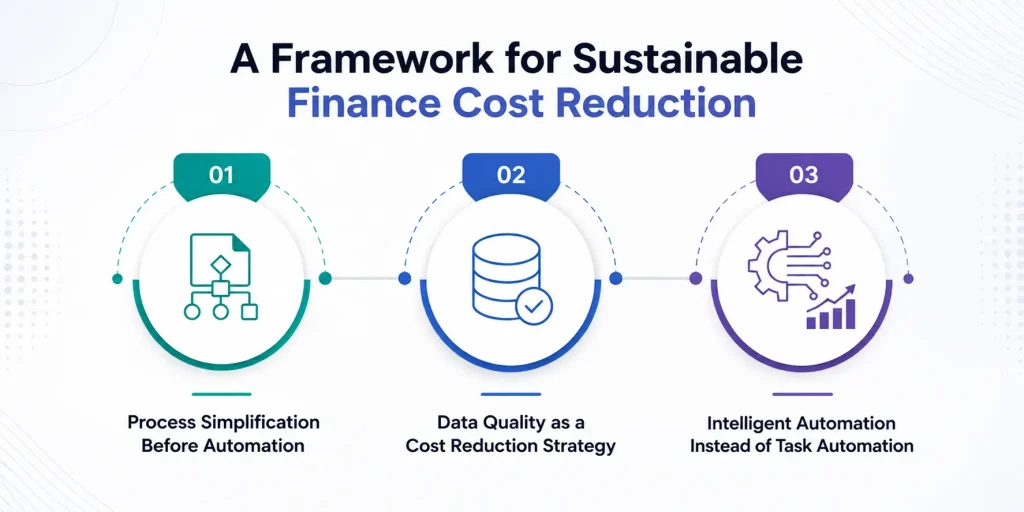
1. Process Simplification Before Automation
Automating inefficient processes simply allows organizations to perform inefficient work more quickly.
Before introducing automation, finance leaders should evaluate:
- Which approvals are no longer necessary?
- Which reports are rarely used?
- Which reconciliations exist only because of legacy processes?
- Which manual controls are duplicates of automated system controls?
Simplification frequently delivers immediate savings while increasing the effectiveness of future automation initiatives.
2. Data Quality as a Cost Reduction Strategy
Poor data quality is one of the largest hidden contributors to finance operational expenses.
Incorrect vendor information, inconsistent customer records, duplicate invoices, and incomplete master data generate downstream costs throughout accounts payable, receivables, reconciliation, reporting, and compliance.
Organizations often invest heavily in automation while overlooking the quality of the information flowing into those systems.
Improving data governance reduces exceptions, minimizes manual intervention, and enables automation to operate at significantly higher accuracy levels.
3. Intelligent Automation Instead of Task Automation
Many automation initiatives focus on repetitive activities such as invoice entry or report generation.
While these projects create value, they rarely transform finance operations on their own.
Modern intelligent automation combines technologies such as AI, machine learning, workflow orchestration, and process intelligence to automate entire decision flows rather than individual tasks.
For example, instead of automatically entering invoice data, an intelligent process can:
- Validate supplier information
- Detect duplicate invoices
- Route exceptions to the correct stakeholder
- Recommend payment prioritization
- Generate audit documentation automatically
This broader approach reduces operational effort across multiple stages of the process rather than improving only one activity.
Measuring What Actually Matters
One reason many cost initiatives underperform is that organizations measure automation success using activity-based metrics rather than business outcomes.
Tracking the number of automated processes or hours saved provides limited insight into operational performance.
Instead, finance leaders should evaluate improvements using measures such as:
| Operational Objective | Meaningful Performance Indicator |
| Lower operating costs | Finance cost as a percentage of revenue |
| Higher efficiency | Cost per finance transaction |
| Faster reporting | Month-end close duration |
| Better productivity | Transactions processed per full-time employee |
| Improved quality | Exception rates and first-pass accuracy |
| Stronger governance | Compliance findings and audit readiness |
These metrics provide a clearer picture of whether finance cost reduction initiatives are improving the overall operating model rather than simply increasing automation activity.
Why AI Is Changing the Economics of Finance Operations
The conversation around automation has evolved significantly over the past few years. Traditional automation focused on reducing manual effort by replicating repetitive tasks. While this approach delivered measurable productivity gains, it still relied heavily on human intervention whenever exceptions occurred.
Artificial intelligence is reshaping this model.
AI-powered finance operations can interpret unstructured documents, identify anomalies, predict potential issues before they occur, and recommend the next best action based on historical data. Rather than simply executing predefined rules, AI continuously improves decision-making by learning from patterns across finance processes.
Consider the accounts payable function. A conventional automation solution may extract invoice details and route documents for approval. An AI-enabled solution, however, can identify duplicate invoices, detect unusual payment requests, prioritize invoices based on supplier terms, flag potential fraud indicators, and recommend approval paths—all before a finance professional reviews the transaction.
The result is not merely faster processing but a significant reduction in manual effort, operational risk, and process variability. Over time, these improvements contribute to sustainable finance cost reduction because fewer resources are required to manage exceptions, corrections, and compliance activities.
The organizations realizing the greatest value from AI are not replacing finance professionals. They are enabling finance teams to spend less time on transactional work and more time on forecasting, business partnering, and strategic decision-making.
Common Mistakes That Limit Finance Cost Reduction
Many finance transformation initiatives fail to achieve expected returns because they focus on technology implementation rather than operational redesign. Recognizing these pitfalls early can help organizations maximize the value of their investments.
1. Automating Inefficient Processes
Automation accelerates execution, but it does not eliminate unnecessary work. Organizations that automate outdated workflows often create faster versions of inefficient processes rather than meaningful operational improvements.
2. Measuring Success Only by Labor Savings
Reducing headcount is only one component of operational efficiency. Sustainable finance cost reduction also comes from improving data quality, reducing errors, shortening close cycles, minimizing compliance risks, and increasing decision speed.
3. Treating Automation as an IT Initiative
Finance transformation delivers the strongest results when finance, operations, and technology teams collaborate. Process owners understand business challenges, while technology teams provide the capabilities needed to redesign workflows effectively.
4. Ignoring Change Management
Even well-designed automation programs struggle when employees do not prepare for new ways of working. Clear communication, training, and governance help organizations realize the full value of transformation initiatives.
5. Optimizing Individual Functions Instead of End-to-End Processes
Finance does not operate in isolation. Processes such as procure-to-pay, order-to-cash, and record-to-report span multiple departments. Improving only one function often shifts inefficiencies elsewhere instead of eliminating them.
A Finance Cost Reduction Maturity Model
Organizations typically progress through four stages as they improve operational efficiency. Understanding where the finance function currently sits can help leaders prioritize the next set of improvements.
| Maturity Stage | Operational Characteristics | Cost Impact |
| Reactive | Manual processes, spreadsheets, disconnected systems, frequent errors | High operating costs and inconsistent performance |
| Standardized | Documented processes, ERP adoption, consistent governance | Improved control but limited efficiency gains |
| Automated | Workflow automation, RPA, digital approvals, integrated reporting | Lower processing costs and faster execution |
| Intelligent | AI-driven decision support, predictive analytics, continuous optimization, end-to-end orchestration | Sustainable finance cost reduction with higher scalability and resilience |
Organizations often plateau between the standardized and automated stages because they focus on isolated automation projects rather than redesigning the entire finance operating model. Advancing to the intelligent stage requires combining process simplification, high-quality data, and AI-powered decision support.
Questions Finance Leaders Should Ask Before Investing in Cost Reduction Initiatives
Before launching another automation or transformation project, finance leaders should evaluate whether the initiative addresses the root causes of operational costs.
Consider asking the following questions:
- Which finance processes generate the highest volume of manual intervention?
- Where do exceptions occur most frequently, and what causes them?
- Are multiple teams performing duplicate activities because systems are disconnected?
- Which approvals and controls still create value, and which exist because of legacy practices?
- How much time is spent correcting errors instead of preventing them?
- Are current automation investments improving business outcomes or simply increasing processing speed?
- Which processes would benefit most from AI-driven decision support rather than rule-based automation?
These questions shift the discussion from technology selection to operational strategy, helping organizations invest in initiatives that deliver measurable long-term value.
Sustainable Cost Reduction Is an Operational Strategy
Reducing finance operational cost is no longer about finding isolated efficiencies or implementing automation for its own sake. Finance leaders are expected to build agile, scalable operations that support business growth while maintaining strong governance and financial control.
Organizations that achieve meaningful finance cost reduction recognize that technology is only one part of the solution. The greatest gains come from simplifying processes, improving data quality, redesigning workflows, and using AI to support faster, more informed decisions across the finance function.
Rather than asking how to automate existing work, leading organizations are rethinking how finance should operate in an increasingly digital environment. That mindset creates an operating model that not only costs less to manage but also delivers greater resilience, better insights, and stronger business outcomes.
As finance continues to evolve from a transactional function to a strategic business partner, sustainable cost reduction will belong to organizations that optimize the entire operating model—not just individual tasks.