







Key Takeaways
- Measuring finance automation ROI requires evaluating both process-level returns and the overall program investment, including technology, implementation, governance, and ongoing maintenance costs.
- Establishing baseline metrics such as cost per transaction, processing time, error rates, and straight-through processing is essential for accurately measuring automation success.
- A comprehensive ROI assessment should track multiple performance indicators, including operational efficiency, financial savings, compliance improvements, and faster financial close cycles.
- Avoiding common mistakes—such as overlooking implementation costs, relying solely on labor savings, or failing to establish baseline metrics—results in more accurate ROI calculations and stronger business cases.
- Continuous performance monitoring, standardized KPIs, and enterprise-wide automation strategies help organizations maximize long-term value and improve the return on finance automation investments.
Finance automation has become a strategic priority for organizations looking to improve efficiency, reduce operational costs, and strengthen financial decision-making. Yet, many finance leaders struggle to answer a simple question: Is our automation investment actually delivering measurable value?
The answer isn’t always straightforward. While automation often delivers quick improvements in processing speed and accuracy, measuring its financial impact requires looking beyond isolated productivity gains. Many organizations celebrate a successful invoice automation project or faster month-end close without evaluating the total investment required to achieve those outcomes. As a result, reported returns can provide an incomplete view of the actual business value.
This is why finance automation ROI should be measured at both the process level and the program level. A single automated workflow may recover its implementation cost within months, while the broader automation initiative—including technology, implementation, governance, training, and ongoing maintenance—may take considerably longer to reach full payback.
A structured approach to measuring finance automation ROI helps organizations justify investments, prioritize future automation opportunities, and ensure that every initiative contributes to long-term business performance rather than short-term operational improvements.
Why Measuring Finance Automation ROI Matters
Finance teams have traditionally evaluated automation by tracking operational improvements such as reduced manual effort or faster processing times. While these indicators are valuable, they don’t provide a complete financial picture.
A comprehensive ROI assessment answers critical business questions such as:
- How much has automation reduced the cost of each transaction?
- How quickly will the investment pay for itself?
- Which processes generate the highest returns?
- Are savings sustainable over time?
- Is the automation program creating measurable business value beyond operational efficiency?
Without these answers, finance leaders may struggle to secure executive buy-in for future automation investments or accurately compare competing technology proposals.
More importantly, measuring finance automation ROI enables organizations to shift automation from isolated tactical projects to a strategic business capability that continuously delivers value.
Step 1: Establish Your Automation Baseline
Before calculating ROI, organizations need a clear understanding of their current operating performance. Measuring improvement is impossible without first establishing a baseline.
Begin by documenting the key metrics for your existing finance processes, including:
| Metric | Why It Matters |
| Cost per transaction | Measures direct operational savings |
| Processing time | Quantifies efficiency improvements |
| Error rate | Indicates quality improvements and rework reduction |
| Straight-through processing rate | Measures the percentage of transactions completed without manual intervention |
| Employee effort | Identifies opportunities to redeploy resources toward higher-value work |
For example, invoice processing currently costs $14 per invoice and requires eight minutes of manual effort, establishing these as the baseline metrics for measuring automation performance.
Organizations should also assess their overall automation maturity. Businesses with limited automation typically experience larger percentage improvements than organizations that have already automated a significant portion of their finance operations. Understanding your starting point ensures ROI projections remain realistic rather than overly optimistic.
Step 2: Measure the Full Cost of Automation
One of the biggest mistakes organizations make when calculating finance automation ROI is underestimating the total investment required.
Technology licensing is only one component of the overall cost. A complete ROI calculation should include both one-time implementation expenses and recurring operational costs.
Typical investment categories include:
- Automation software licensing
- AI capabilities where applicable
- Implementation and integration services
- Process assessment and redesign
- Employee training and change management
- Governance and compliance activities
- Ongoing maintenance and platform support
Ignoring these costs often results in inflated ROI figures that fail to reflect the true economics of an automation initiative.
For example, automating accounts payable may require an initial software investment, implementation support, process redesign, and employee training before the first invoice is processed automatically. While each cost contributes to long-term value, they should all be included in the overall investment calculation.
Finance leaders should also distinguish between one-time implementation expenses and recurring annual costs. This distinction makes it easier to forecast long-term returns and compare multiple automation initiatives using consistent financial assumptions.
Step 3: Define the Right ROI Metrics
Once organisations have established both the baseline and investment costs, they can begin measuring the financial outcomes that matter most.
Instead of relying on a single ROI percentage, finance leaders should monitor a balanced set of performance indicators that demonstrate both operational and financial improvements.
The most valuable metrics include:
- Reduction in cost per transaction
- Time saved per process
- Reduction in manual exceptions
- Improvement in straight-through processing rates
- Reduction in overtime and temporary staffing costs
- Compliance improvements through standardized workflows
- Faster financial close cycles
- Overall return on automation investment
Together, these metrics provide a comprehensive view of whether automation is creating measurable business value rather than simply increasing activity.
Step 4: Calculate Process ROI and Program ROI
One of the most common reasons automation business cases fail is that they measure only the return from an individual process rather than the overall automation program.
Process ROI focuses on the direct financial impact of automating a specific workflow. For example, automating invoice processing may reduce the cost per invoice from $14 to $5 while significantly shortening processing time. These savings often become visible within the first few months after implementation.
Program ROI, however, measures the return on the entire automation initiative. In addition to process-level savings, it considers technology licensing, implementation costs, governance, maintenance, employee training, and ongoing support. This provides a far more realistic picture of the long-term financial performance of the automation program.
For instance, an automated accounts payable process may recover its implementation costs within six months. However, when the broader investment in platforms, governance, and change management is included, the complete automation program may take 18 to 24 months to achieve cumulative breakeven.
Both metrics are important. Process ROI demonstrates the value of individual automation initiatives, while program ROI helps finance leaders evaluate whether their overall automation strategy is delivering sustainable business returns.
What Drives Finance Automation ROI?
While every organization has different priorities, the strongest contributors to finance automation ROI are generally consistent across industries.
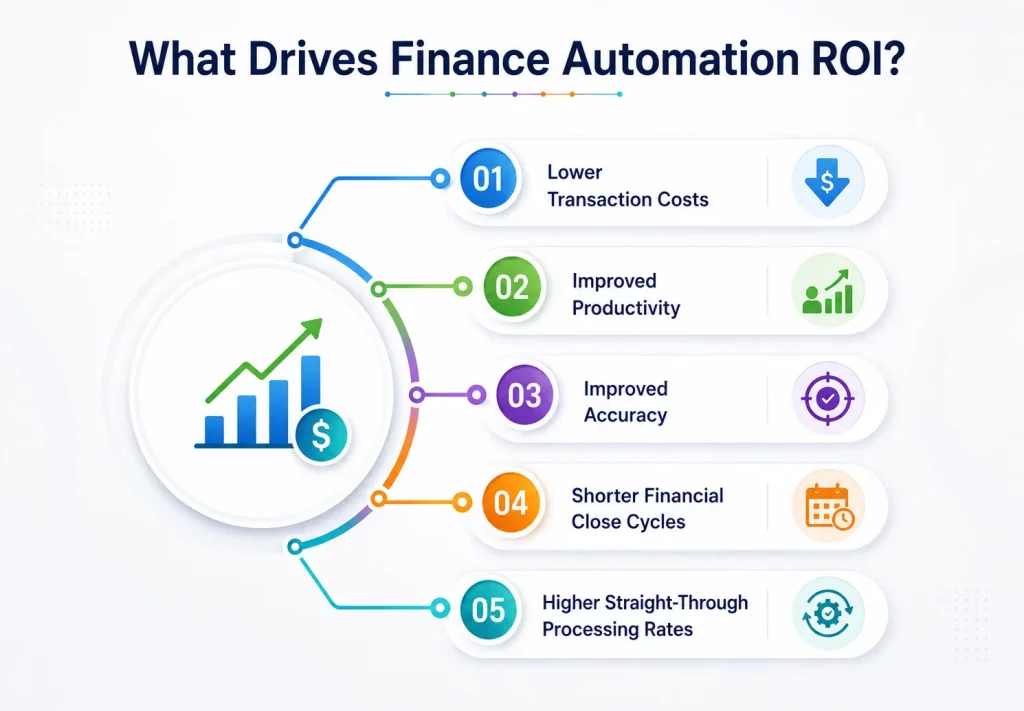
- The first driver is lower transaction costs. Automating repetitive finance activities such as invoice processing, reconciliations, journal entries, and report generation significantly reduces manual effort, enabling teams to process higher volumes without increasing headcount.
- The second driver is improved productivity. Rather than spending hours on repetitive administrative work, finance professionals can focus on forecasting, financial analysis, exception management, and strategic planning. Although finance professionals often classify these productivity gains as soft savings, they create meaningful long-term business value.
- Automation also improves accuracy. Standardized workflows reduce human error, minimize duplicate payments, and strengthen compliance with internal controls. Fewer exceptions translate into lower rework costs and faster financial operations.
- Another important contributor is shorter financial close cycles. Faster access to accurate financial data enables better decision-making and improves organizational agility, particularly during budgeting, forecasting, and regulatory reporting periods.
- Finally, higher straight-through processing rates indicate that more transactions are completed without manual intervention. As this percentage increases, organizations typically experience greater efficiency, lower operating costs, and stronger overall returns.
Common Mistakes When Measuring Finance Automation ROI
Even well-planned automation programs can produce misleading ROI figures if the measurement approach is incomplete.
Some of the most common mistakes include:
- Measuring only labor savings while ignoring software licensing, maintenance, and implementation costs.
- Treating productivity improvements as direct financial savings without validating whether those savings translate into actual cost reductions.
- Failing to establish baseline performance metrics before automation begins.
- Calculating ROI for a single process while overlooking the total investment required for the automation program.
- Using unrealistic adoption timelines or assuming immediate business-wide deployment without accounting for change management.
Avoiding these mistakes results in more accurate business cases and builds greater confidence among finance leaders and executive stakeholders.
Best Practices for Measuring Finance Automation ROI
Organizations that consistently achieve strong automation outcomes follow a structured approach to ROI measurement.
- Begin by defining clear business objectives before selecting technology. Automation should solve measurable business challenges rather than automate processes simply because they are repetitive.
- Track performance continuously instead of treating ROI as a one-time calculation. Monitoring key performance indicators on a quarterly basis allows organizations to identify optimization opportunities and demonstrate ongoing value.
- Use standardized metrics across all finance processes so different automation initiatives can be compared consistently. This also helps prioritize future investments based on measurable business impact.
- Finally, consider automation as part of a broader digital transformation strategy. Combining intelligent automation with AI-powered decision support enables finance teams to move beyond task automation toward predictive insights, continuous improvement, and more strategic financial operations.Organizations looking to accelerate this journey can benefit from solutions such as agentic process automation, which combines AI agents with workflow automation to streamline complex finance operations, and intelligent enterprise automation, which connects automation initiatives across finance, operations, and business functions to maximize enterprise-wide value.
Conclusion
Measuring finance automation ROI is about far more than calculating cost savings. It requires understanding your current performance, capturing the full investment required, measuring both process-level and program-level returns, and continuously tracking outcomes against clearly defined business objectives.
Organizations that adopt this disciplined approach gain a clearer understanding of where automation creates the highest value, make more informed investment decisions, and build a stronger foundation for long-term digital transformation.
Measuring ROI accurately ensures that every investment contributes to improved financial performance, operational resilience, and sustainable business growth, whether you’re evaluating your first automation initiative or expanding an enterprise-wide automation strategy