






Key Takeaways
- CoEs centralize knowledge and expertise, enabling consistent practices, governance, and innovation across the enterprise to drive strategic alignment and deliver high-quality results faster.
- Automation, AI, Cloud, and data coEs help organizations effectively adopt emerging technologies while reducing duplication, improving ROI, and fostering continuous learning among teams.
- Standardization and quality assurance are core CoE benefits. They ensure uniform frameworks, minimize errors, and enhance deliverables throughout the organization.
- Common challenges, such as siloed efforts and resistance to change, can be overcome through leadership buy-in, collaboration, communication, and transparent metrics.
- A successful CoE empowers business units, promotes innovation, builds internal capabilities, and becomes a long-term catalyst for enterprise-wide transformation and competitive advantage.
Many enterprises face pressure to improve their business performance and adapt to changing market conditions. Some firms have failed to find a feasible solution. If you are one of them, one effective strategy that can allow you to achieve these goals is the creation of a Center of Excellence (CoE). A CoE team of experienced and skilled professionals consolidates expert knowledge, governance frameworks, and best practices. They help promote excellence in specific areas, such as AI, cloud computing, or data analytics.
A CoE also serves as the primary body that supports company units by providing reusable assets and proven frameworks. It allows enterprises to discard old technologies and adopt new ones for advantageous perks.
Beyond technical skills, a Center of Excellence (CoE) fosters strategic alignment by ensuring all related projects support overarching organizational goals. By monitoring performance metrics and establishing transparent governance, the CoE promotes accountability and transparency.
Why Do You Need a Center of Excellence (CoE)?
As companies expand, they consider what’s working for them better. They leave no stone unturned to maintain consistency, drive innovation, and deliver the best results. However, some firms fall behind and face numerous challenges while fulfilling these goals. This is where a CoE can be of assistance. They serve as a structured approach to utilizing the best techniques, allowing firms to stay aligned with their goals.
Here are more reasons why firms should build CoEs:
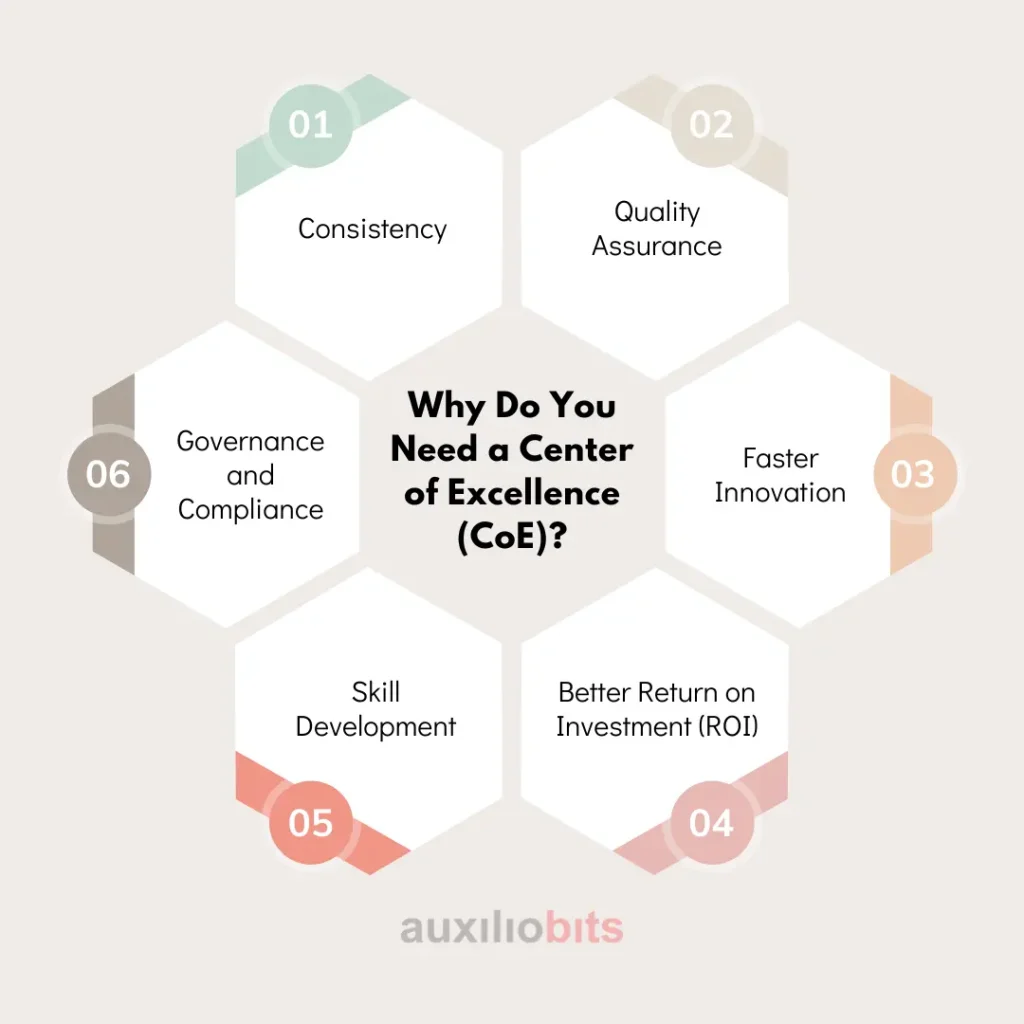
1. Consistency:
One of the biggest challenges in large organizations is maintaining consistency across departments and teams. A CoE standardizes tools, frameworks, and methodologies to ensure that processes are implemented consistently throughout the enterprise. This removes ambiguity, minimizes misalignment, and encourages a single approach to addressing business issues.
2. Quality Assurance:
A CoE enforces high-quality standards by developing best practices, templates, and review mechanisms. It ensures that all projects achieve a standard of excellence, thus minimizing errors, enhancing deliverables, and improving customer satisfaction. The CoE is a quality gatekeeper, ensuring teams deliver confidently and reliably.
3. Faster Innovation:
Innovation can be slow and fragmented without a structured environment. A CoE accelerates innovation by scouting emerging technologies, running pilot projects, and rapidly disseminating successful solutions across teams. It breaks down silos and encourages experimentation, making it easier to bring new ideas to life across the organization.
4. Better Return on Investment (ROI):
A CoE optimizes resource utilization by reducing duplication of effort and enabling the reuse of assets like code libraries, workflows, and templates. Teams spend less time reinventing the wheel and more time on value-driven work, leading to faster results and a better return on technology and talent investments.
5. Skill Development:
A CoE plays a critical role in building internal capability. Training programs, certifications, workshops, and mentoring empower employees to upskill and stay current with industry trends. This fosters a culture of continuous learning and helps create a competent, self-sufficient workforce.
6. Governance and Compliance:
A CoE defines governance structures that help manage risk, enforce policies, and ensure compliance with internal and external standards. Whether data privacy, security, or regulatory mandates, the CoE oversees and ensures all initiatives meet necessary compliance requirements.
Types of Centers of Excellence
Organizations may establish various CoEs tailored to their specific strategic needs.
| CoE Type | Focus Area |
| Automation CoE | Drives RPA and AI agent implementations |
| AI/ML CoE | Promotes data science, AI models, and ML practices |
| Cloud CoE | Supports cloud adoption, security, and scalability |
| DevOps CoE | Guides CI/CD, automation pipelines, and agile practices |
| Data CoE | Ensures data governance, data quality, and business intelligence |
| Customer Experience (CX) CoE | Improves customer journeys using insights and automation |
Challenges to Watch For When Building a Center of Excellence (CoE)
While a Center of Excellence can deliver significant value, establishing and sustaining one presents challenges. Organizations must proactively address these obstacles to ensure long-term success and adoption. Below are some common challenges and practical solutions to overcome them:
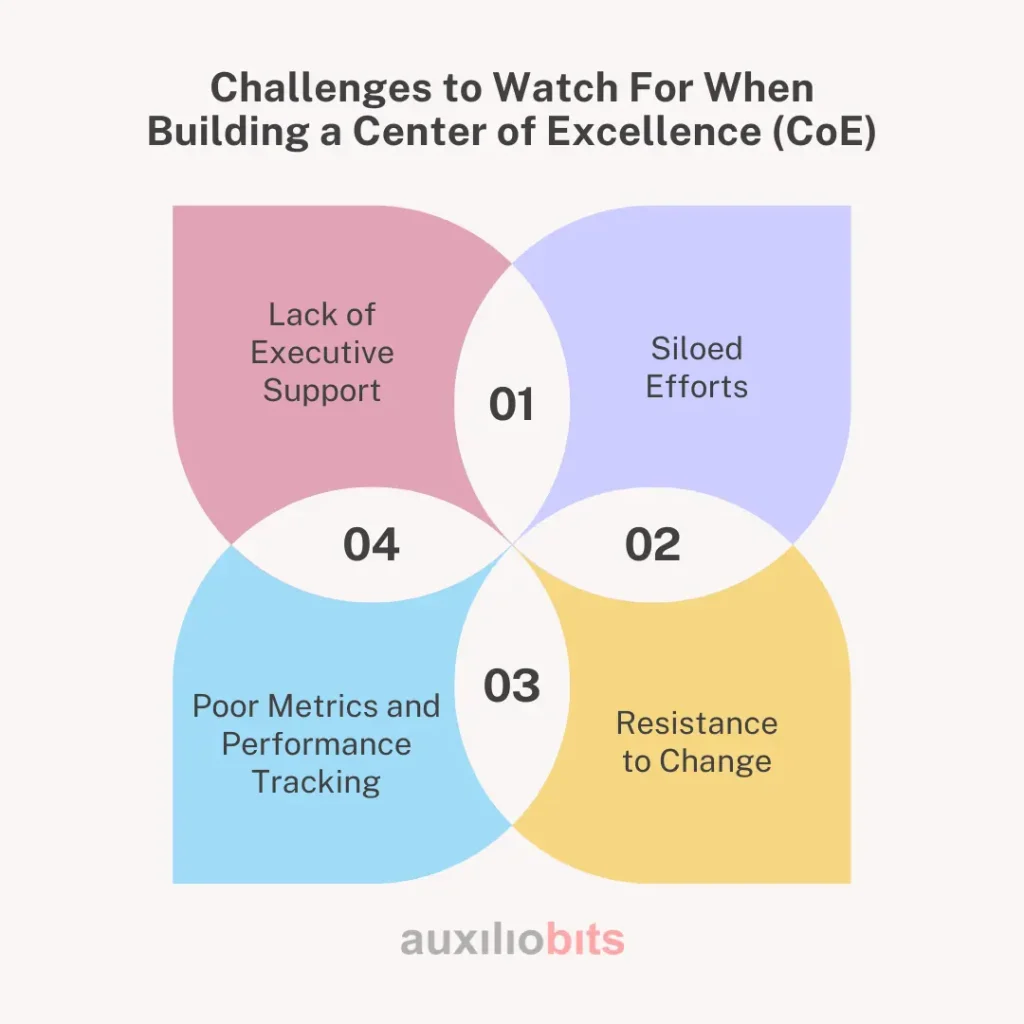
1. Lack of Executive Support
Challenge: Without leadership buy-in, the CoE may struggle to gain traction, secure funding, or influence organizational change.
Solution: Align the CoE’s objectives with the company’s broader strategic goals. Demonstrate the CoE’s value early on by delivering quick wins—small, measurable successes that build credibility and showcase impact. Present clear ROI cases and involve leadership in governance to reinforce their commitment.
2. Siloed Efforts
Challenge: CoEs often risk operating in isolation, becoming disconnected from business units or teams that they’re meant to support. This can lead to duplication, misalignment, or lack of adoption.
Solution: Foster cross-functional collaboration by including representatives from key departments in CoE activities. Encourage open communication, shared goals, and regular feedback loops to keep all stakeholders engaged and aligned. Position the CoE as a collaborative enabler, not just a centralized authority.
3. Resistance to Change
Challenge: Change can be uncomfortable, especially when adopting new tools, processes, or governance structures. Teams may resist perceived disruption or fear increased oversight.
Solution: Actively communicate the CoE’s benefits and how it helps teams achieve their goals faster and more effectively. Provide hands-on training, role-based enablement, and success stories highlighting the positive outcomes of CoE-led initiatives. Build trust through transparency and ongoing support.
4. Poor Metrics and Performance Tracking
Challenge: Without proper metrics, measuring the CoE’s impact or identifying areas for improvement is difficult. This can undermine credibility and limit its ability to scale.
Solution: Define clear Key Performance Indicators (KPIs) and success criteria from the start—track metrics such as time savings, adoption rates, cost reductions, or quality improvements. Use dashboards and regular reporting to communicate progress and make data-driven decisions for continuous enhancement.
By addressing these challenges head-on, organizations can unlock a CoE’s full potential and establish it as a key driver of transformation, efficiency, and innovation.
Final Thoughts
A Center of Excellence (CoE) is more than just a group of specialists. It represents a strategic mindset and a structured approach to driving consistent, high-quality outcomes across the enterprise. In an age where organizations are racing to innovate and adapt, a CoE provides the clarity, governance, and enablement needed to scale change effectively.
Whether you’re establishing an Automation CoE to scale intelligent process automation, a Cloud CoE to ensure secure and cost-effective cloud adoption, or a Data CoE to improve data governance, every CoE shares common goals:
- Centralize knowledge and best practices
- Empower and support business units
- Drive continuous improvement and innovation
Ready to Build Your CoE?
Don’t wait for change to catch up with you—lead it. Whether starting from scratch or scaling an existing function, now is the time to invest in a Center of Excellence that empowers your people and drives enterprise-wide success.
Contact us today to learn how Auxiliobits can help you build, scale, or optimize your CoE—and turn your strategic goals into measurable outcomes.