






Key Takeaways
- Autonomous procurement is best understood as a maturity spectrum, with different procurement categories requiring different levels of automation based on risk, data quality, and business context.
- Organizations achieve better outcomes by strengthening data foundations and process maturity before introducing higher levels of procurement autonomy.
- Successful autonomous procurement programs rely on category-specific guardrails, transparent decision-making, and continuous oversight rather than replacing human judgment entirely.
- Readiness should be evaluated across data quality, process standardization, governance, risk controls, and stakeholder trust to identify the right candidates for increased autonomy.
- A phased, evidence-based roadmap that expands automation incrementally delivers greater long-term value than attempting enterprise-wide autonomous procurement in a single initiative.
Every procurement software category eventually collects a buzzword that outruns its definition. Right now, that word is “autonomous.” Vendors use it to describe everything from a chatbot that drafts a PO to a system that can source, negotiate, and reorder without a human ever opening a screen. That range is the problem. If you’re evaluating what autonomous procurement actually means for your organization — not the marketing version, but the operational one — you need a clearer map than “AI-powered” slide decks tend to offer.
This piece is that map. We’ll define autonomous procurement as a spectrum rather than a switch, name the two adoption traps that derail most teams before they get real value, give you a scorecard to place your organization honestly, and walk through what a realistic roadmap — and its ROI — looks like.
What “Autonomous Procurement” Actually Means
The phrase gets used as if autonomy were binary: either a system is autonomous or it isn’t. In practice, procurement autonomy is a spectrum, and where a given process sits on it determines what kind of oversight, risk, and value you should expect.
Level 0 — Manual. A human initiates, evaluates, and executes every step. Software exists mainly as a system of record.
Level 1 — Assisted. The system surfaces information — spend patterns, supplier risk flags, and contract terms — but every decision and action is still human-initiated.
Level 2 — Partial Automation. Rules-based automation handles defined, low-variance tasks (routing a PO for approval or matching a three-way invoice), but anything outside the rule set escalates to a person.
Level 3 — Conditional Autonomy. The system can complete an entire transaction cycle for a bounded category — say, reordering standard MRO items under a pre-negotiated contract — without human initiation, but a person can intervene at any point and is notified of every action.
Level 4 — High Autonomy. The system makes and executes sourcing or negotiation decisions across a broader category using learned patterns and defined guardrails, with humans reviewing outcomes in aggregate rather than approving each transaction.
Level 5 — Full Autonomy. The system manages an entire category — sourcing, negotiating, contracting, reordering, and supplier performance management — with human involvement limited to setting strategy and periodically auditing the results.limited to setting strategy and periodically auditing the results.
Almost no procurement organization today operates anywhere near Level 5, and for most categories, that’s appropriate — not a failure. Direct materials with safety implications, strategic supplier relationships, and anything involving significant contract risk will likely stay at Level 2 or 3 by design for years to come. The realistic opportunity in 2026 and beyond isn’t “full autonomy everywhere”. It’s matching the right autonomy level to the right category and moving deliberately up that ladder where the data and risk profile support it.
Two Traps That Derail Autonomous Procurement Programs
Before the framework and scorecard, it’s worth naming the two failure patterns that show up most often when organizations chase autonomous procurement without a clear-eyed view of readiness.
The Premature Autonomy Trap. This happens when a team deploys Level 3 or 4 automation on top of Level 0 data hygiene — inconsistent supplier records, unmapped spend categories, contract terms that live in PDFs rather than structured fields. The automation doesn’t fail loudly; it fails quietly, executing confidently on bad inputs. A reorder engine that reorders from a supplier whose contract expired last quarter is a textbook example. The fix isn’t slower technology adoption — it’s sequencing: data and process maturity have to lead automation maturity, not follow it.
The Autonomy Ceiling Trap. This scenario is the opposite failure. Teams get real value from Level 2 automation — invoice matching and PO routing — and then assume the next step is a wholesale leap to Level 4 or 5. It isn’t. Each level up the spectrum requires new guardrails, new audit mechanisms, and new stakeholder trust, category by category. Organizations that try to compress that progression usually end up rolling back autonomy after a visible error, which is far more damaging to internal buy-in than a slower, deliberate climb would have been.
Both traps point to the same underlying discipline: autonomy should be earned by category, based on evidence, not deployed uniformly based on what a vendor’s roadmap slide promises.
Where Does Your Organization Actually Sit? A Readiness Scorecard
Use this scorecard honestly, category by category (don’t average across your whole procurement function — a mature indirect-spend program and an immature direct-materials program will score very differently).
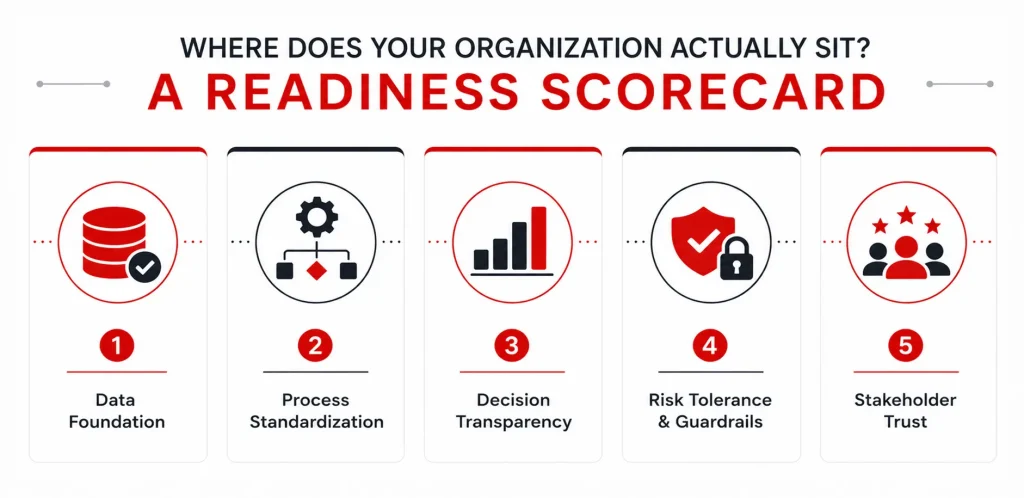
1. Data Foundation
- Foundational: Supplier and item data lives across spreadsheets, email, and disconnected systems; no single source of truth.
- Progressing: Core data is centralized and mostly clean, but category taxonomies and supplier records still need manual reconciliation.
- Advanced: Structured, continuously validated data with clear ownership and automated quality checks.
2. Process Standardization
- Foundational: Buying behavior varies significantly by requester or business unit; maverick spend is common.
- Progressing: Standard workflows exist for major categories but exceptions are frequent and handled ad hoc.
- Advanced: Workflows are codified, exception paths are defined, and compliance is measurable in near real time.
3. Decision Transparency
- Foundational: Sourcing and approval decisions aren’t documented in a way that could be reconstructed or audited later.
- Progressing: Decisions are logged but the reasoning behind them (why this supplier, this price, this term) often isn’t captured.
- Advanced: Every automated or human decision has a traceable rationale, reviewable by anyone in the chain.
4. Risk Tolerance & Guardrails
- Foundational: No defined thresholds for what a system is allowed to decide versus escalate.
- Progressing: Thresholds exist for some categories but aren’t consistently enforced or reviewed.
- Advanced: Explicit, category-specific guardrails with regular review cycles and clear escalation logic..
5. Stakeholder Trust
- Foundational: Finance, legal, and category owners are skeptical of automated decisions and routinely override them.
- Progressing: Trust exists for lower-risk categories but strategic sourcing remains firmly human-led by preference.
- Advanced: Stakeholders actively rely on system-generated recommendations and reserve manual review for genuine exceptions.
If most of your answers land in “Foundational”, your near-term opportunity is Level 1–2 automation with a deliberate data cleanup track — not a Level 4 pilot. If you’re mostly “Progressing,” you likely have one or two categories genuinely ready for Level 3. “Advanced” across the board is rare, and if you’re there, the constraint usually isn’t technology — it’s organizational appetite for delegating decisions.
What’s Actually Making Higher Levels of Autonomy Possible Now
This conversation is happening now, rather than five years ago, because of a specific technical shift: procurement systems can increasingly reason over unstructured context — contract language, supplier correspondence, and historical negotiation outcomes — rather than only executing against rigid rules. That’s what separates Level 2 rules-based automation from Level 3+ conditional autonomy: the system can handle a wider range of “normal” variation without every edge case requiring a new rule to be hand-coded.
This matters for evaluation purposes because it changes what to ask a vendor. The relevant question isn’t “can your system automate POs?” — most systems at Level 2 already can. It’s “how does your system decide what falls inside its guardrails versus what it escalates, and can I see that logic, category by category, before I trust it with real transactions? ” A vendor that can’t answer that concretely is likely still selling Level 2 automation with autonomous-sounding language
A Realistic Roadmap
- Audit by category, not by function. Run the scorecard above against your top 10–15 spend categories individually. You’ll likely find a wide spread.
- Fix data foundations for your best candidates first. Pick the 2–3 categories with the strongest data and process maturity and invest there before touching lower-maturity categories.
- Pilot Level 3 with full visibility, not blind trust. Every automated action should be logged and reviewable during the pilot phase, even if it’s not gated for approval.
- Expand guardrails based on evidence, not calendar time. Move a category to the next autonomy level when the audit log shows consistent, correct decisions — not because a quarter has passed.
- Revisit stakeholder trust deliberately. Autonomy adoption is as much a change-management exercise as a technical one; build in regular reviews where finance, legal, and category owners see the system’s track record, not just its capabilities.
The Honest Takeaway
The future of autonomous procurement isn’t a single system that eventually runs everything. It’s a portfolio of categories, each sitting at the autonomy level its data, process maturity, and risk tolerance actually support — moving up that ladder deliberately, with evidence, rather than all at once because a vendor promised it could. Organizations that evaluate solutions through that lens — asking not “how autonomous is this?” but “how autonomous is this for my categories, given my current maturity?” — are the ones that will get real value out of this next phase, rather than a rollback story eighteen months from now.