






Key Takeaways
- Most organizations confuse AP automation with AP autonomy. Automation follows predefined rules, while autonomy enables systems to make context-aware decisions and learn from real-world scenarios.
- Vendor-reported touchless processing rates often reflect ideal invoice conditions. Evaluating performance across your actual invoice mix is critical before making technology investments.
- Genuine autonomous AP platforms continuously learn from organizational data, intelligently manage exceptions, and improve decision quality over time without extensive rule maintenance.
- Reaching true AP autonomy requires more than technology implementation. Data quality, vendor master governance, supplier onboarding, and continuous exception analysis are equally important.
- The future of accounts payable will be driven by AI-powered decision-making, supplier network intelligence, cross-entity financial operations, and conversational interfaces that transform AP from a transactional function into a strategic finance capability.
The pitch for autonomous accounts payable is compelling: invoices are captured instantly, matched automatically, approved without friction, and paid on time, every time — with finance teams freed from transaction processing to focus on what actually matters. It’s a vision that sells itself.
The problem is that most organizations buying into that vision are buying the wrong thing. They’re investing in automation — workflow tools, OCR, rule-based routing — but they call it “autonomy”. Then, two years in, they’re still processing a significant portion of invoices manually, still fighting duplicate payments, and still unable to answer “what do we owe, to whom, and when?” in real time.
This isn’t a technology failure. It’s a framing failure. And if your organization is currently evaluating autonomous AP solutions, understanding the difference is the most important thing you can do before you spend a dollar.
Our position
Automation solves for volume. Autonomy solves for judgment. Most AP platforms on the market today are sophisticated automation tools with an AI label. Genuine autonomous AP systems — systems that handle exceptions intelligently, learn from your specific data, and make context-aware decisions without human configuration at every edge case — is rarer than the market suggests.
The autonomy gap: what most vendors won’t tell you
Here’s a number worth interrogating: most AP automation vendors advertise touchless processing rates in the range of 70–85%. What they don’t advertise is that those numbers are measured on their best-case invoice mix — structured, digital, domestic, from known vendors. Your invoice reality is probably messier.
The moment you introduce handwritten supplier invoices from emerging markets, invoices in non-Latin scripts, or multi-line POs with partial deliveries, many “autonomous” systems quietly fall back to manual queues. The touchless rate you bought isn’t the touchless rate you get.
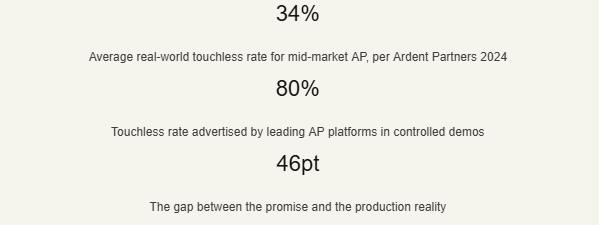
This gap exists because automation and autonomy require fundamentally different architectures. Knowing which architecture you are actually evaluating changes the nature of every vendor conversation you have.
Automation vs. autonomy: a precise distinction
Automation is deterministic: it follows rules you write. If the invoice amount exceeds $10,000, route it to the CFO. If a PO line matches within 2%, auto-approve. Rules work beautifully — until reality presents a scenario the rule-writer didn’t anticipate. Then the invoice sits in a queue.
Autonomy is probabilistic: the system makes judgements under uncertainty, using patterns learned from your own historical data. It doesn’t just follow your rules — it understands the intent behind them. When a vendor submits an invoice with a line item that doesn’t exist on the original PO, an autonomous system can assess: Is this vendor reliable? Is this overage within normal range for this category? Has this issue happened before, and how was it resolved? Then it acts — or escalates with a specific recommendation — rather than simply stopping.
“The difference between AP automation and AP autonomy is the difference between a traffic light and a self-driving car. One follows fixed rules; the other navigates ambiguity.”
For organizations processing high invoice volumes with complex vendor bases, the distinction determines whether AP transformation delivers a 40% efficiency gain or a 400% one.
The four questions that separate genuine autonomy from sophisticated automation
Use these in every vendor conversation. The answers will reveal more than any feature demonstration.
| Question | Automation answer | Autonomy answer |
| “What happens when an invoice doesn’t match any existing PO?” | Routes to exception queue | Assesses vendor history, suggests resolution, escalates with context |
| “How does your system improve over time with our data?” | We update rules based on your feedback | Models retrain continuously on your invoice patterns without manual configuration |
| “What’s the touchless rate for invoices outside your demo set?” | Demo numbers not qualified by invoice type | Provides segmented touchless rates by invoice complexity and source |
| “How does the system handle a vendor’s invoice in a new format it hasn’t seen?” | Falls back to manual until template is built | Generalizes extraction to new formats using foundational model training |
If a vendor gives you the left-column answers, you’re looking at automation with a compelling interface. That’s not necessarily wrong — automation has real value. But don’t pay for autonomy and receive automation.
What genuine autonomous AP actually looks like at scale
To make this concrete: here’s how the same invoice is handled by an automated system versus a truly autonomous one.
Scenario: a vendor submits an invoice 8% above the agreed PO price, citing a raw materials surcharge not referenced in the original contract.
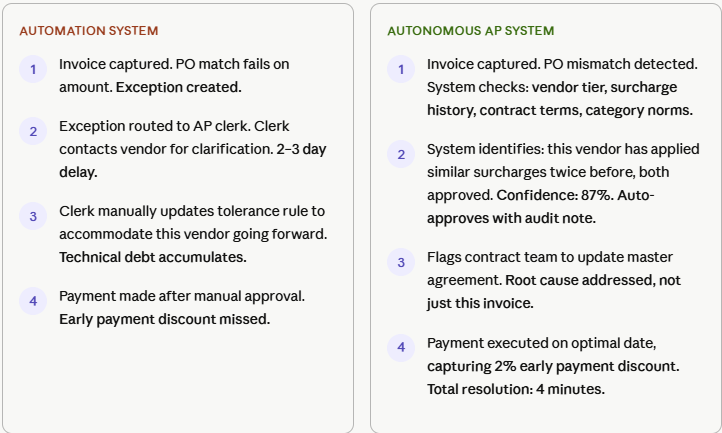
The difference isn’t just efficiency. The autonomous system caught something the automation system didn’t: the root cause of the exception. That’s the organizational intelligence gain that compounds over time.
The maturity model most vendors use – and a more honest version
The standard AP maturity model runs from “manual” to “fully automated” in four stages. It’s useful, but it obscures the most important question: at what stage does the system actually start getting smarter?
In a rules-based automation model, the answer is that it doesn’t. You add more rules, more templates, more configurations. The system becomes more complex, not more intelligent. A better maturity model distinguishes between complexity and capability:
- Stage 1 — Manual processing: High cost ($10–15/invoice), long cycles, significant error and fraud exposure.
- Stage 2 — Workflow automation: Routing and approvals digitized. Cost drops to $5–8/invoice. But you’re now dependent on rule maintenance — any change to your business creates a backlog of rule updates.
- Stage 3 — AI-assisted processing: Machine learning augments matching and extraction. Touchless rates reach 50–70% on clean invoices. Exceptions still require significant human handling. This is where most “AI-powered AP” platforms actually sit today.
- Stage 4 — Genuine autonomy: The system handles exceptions intelligently, learns from your data continuously, and surfaces insights (not just alerts) to finance leadership. Touchless rates exceed 85% across your real invoice mix — not just your structured subset. Cost-per-invoice falls below $2. Finance teams shift from transaction processing to strategic financial management.
Honest take:
Most vendors claim stage 4 and deliver stage 3. The easiest test: ask for a 90-day pilot on your actual invoice data, not a curated demo dataset. A vendor confident in their autonomy claims will agree. A vendor that redirects you to reference customers with different invoice profiles is signaling something worth noting.
The implementation failure mode nobody talks about
Even with the right platform, autonomous AP implementations fail in a predictable way: organizations treat it as a technology project rather than a finance transformation.
The symptoms are familiar: the platform goes live, the touchless rate climbs from 30% to 60%, and then it plateaus. The exception queue shrinks but never disappears. Finance leadership declares success and moves on. Three years later, the touchless rate is still 60% because nobody invested in the data quality, vendor master hygiene, and change management that autonomous systems require to keep improving.
The organizations that reach and sustain stage 4 autonomy share three practices that distinguish them from the majority:
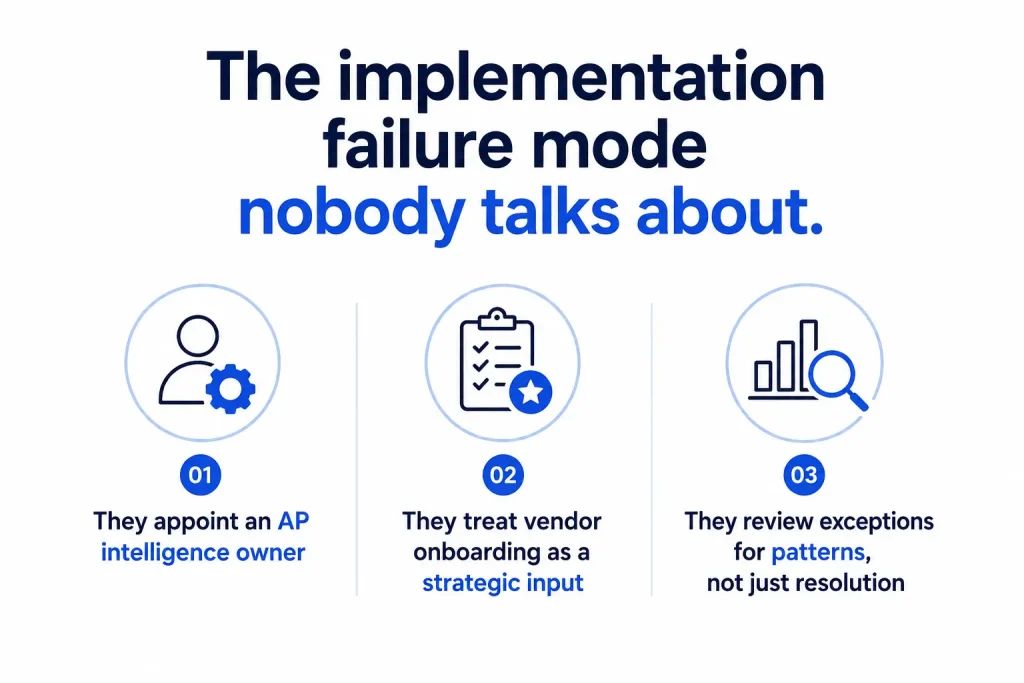
- They appoint an AP intelligence owner — not an IT resource, but a finance professional who owns the quality of the system’s decisions and is accountable for touchless rate improvement over time.
- They treat vendor onboarding as a strategic input — clean vendor master data, standardized invoice formats agreed upfront with key suppliers, and proactive supplier enablement are the upstream inputs that determine downstream touchless rates.
- They review exceptions for patterns, not just resolution — every exception is a signal. High-performing AP teams run monthly exception analysis to identify systemic issues (contract gaps, vendor behavior patterns, and ERP data quality) rather than just clearing the queue.
What to demand from any autonomous AP evaluation
Pre-purchase evaluation checklist
- Request touchless rate data segmented by invoice type, source format, and vendor complexity — not a single blended number.
- Ask for a 90-day proof-of-concept on your actual invoice data, with agreed success metrics defined in advance.
- Require a demo of exception handling — specifically: how does the system handle an invoice type it has never seen before?
- Get references from companies with comparable ERP environments and invoice complexity, not just comparable revenue.
- Confirm the audit trail captures AI decision logic, not just outcomes – critical for SOX compliance and internal audits.
- Ask: What is the touchless rate trajectory for customers 12, 24, and 36 months post-implementation? It should be rising, not flat.
- Establish contractual touchless rate commitments with financial consequences — if the vendor won’t commit, ask why
The AP function of 2027: what’s actually coming
The near-term trajectory of autonomous accounts payable is less about any single breakthrough and more about the compounding effect of three trends converging:
- Supplier network intelligence. The next generation of autonomous AP won’t just process invoices — it will participate in supplier financing decisions, dynamically adjust payment timing to optimize working capital across the supply chain, and flag supply chain risk signals embedded in invoice patterns before procurement or treasury sees them.
- Cross-entity autonomy. Multi-entity organizations running parallel AP instances across subsidiaries will consolidate into unified autonomous platforms that handle intercompany eliminations, transfer pricing compliance, and multi-currency payments as default capabilities, not implementation projects.
- Conversational finance operations. The interface layer is changing. Finance teams at leading organizations are already querying AP status, requesting exception summaries, and initiating payment runs through natural language interfaces — the ERP screen as a primary AP tool is becoming a legacy assumption faster than most finance leaders realize.
What this means for your decision now:
The platform you select today needs to be evaluated not just for what it does in year one but also for the architecture it puts you on. A best-of-breed automation tool that doesn’t integrate cleanly with an AI layer will need to be replaced — not upgraded — as your requirements evolve. The integration story and roadmap commitment matter as much as current feature parity.
Where to go from here
If you’ve read this far, you’re past the awareness stage on autonomous AP — you’re in evaluation mode. The question isn’t whether to pursue AP autonomy; the efficiency, control, and working capital case is well-established. The question is which path gets you there without the two-year plateau that derails most implementations.
The organizations that get this right start with an honest assessment of where they actually sit on the maturity curve — not where they wish they were — and build their vendor requirements from that baseline, not from vendor marketing materials.
Find out where you actually sit on the AP maturity curve. Contact us today and book an AP assessment now.