







Key takeways
- In a rapidly changing marketplace, digital transformation is no longer a choice but a must for businesses to thrive.
- At the core of a successful digital transition is the customer experience. Digital technologies analyze the customer experience to find problems and potential improvements.
- Digital transformation is important for a business to keep going and maintain a competitive edge. It also helps businesses to keep pace with shifting customer expectations and respond to fluctuations in the marketplace.
- The cultural shift should be the foremost step in the digital transformation journey to ensure that all the employees work cohesively towards this goal.
- Cutting-edge innovations like big data analytics, AI, cyber security, cloud computing, AR/VR, IoT, and more are vital technologies for digital transformation.
- Partnerships with consultants, specialists, and technology providers are frequently necessary for seamless digital transformation.
Digital transformation has experienced a great thrust during the pandemic and it continues to disrupt businesses in the post-COVID era. Data shows that the digital transformation market is expected to grow to a staggering $ 1009.8 billion in 2025 from $468.9 billion in 2020. (Source: Quixy)
In a rapidly changing marketplace, digital transformation is no longer a choice but a must for businesses to thrive. The pandemic has made us realize the importance of agility and resilience in the face of change. It has also shown that businesses that had a digital-first approach were better equipped to manage the crisis. This further substantiates the fact that digital technologies make businesses more resilient.
Why is Digital Transformation Important?
Digital transformation entails realigning the existing business model with a focus on customer experience.
At the core of a successful digital transition is the customer experience. Digital technologies analyze the customer experience to identify problems and potential solutions.
Digital tools and technologies can be leveraged to offer seamless, personalized experiences across various touch points. Using customer relationship management (CRM) systems, automation technologies, and data analytics to gather insights and improve customer interactions. You can enhance customer experience, loyalty, and business success by putting the customer at the heart of your digital transformation activities.
Digital transformation depends on data to function. Data analytics provides insights about consumer behavior, industry trends, and operational effectiveness. These insights help businesses make well-informed decisions to customize their services to meet client needs. Data also helps spot opportunities for improvement with data-driven decision-making.
Digital transformation is important for a business to keep going and maintain a competitive edge. It also helps businesses to keep pace with shifting customer expectations.
According to McKinsey, 20%-50% of economic gains and 20%-30% increase in client satisfaction can be achieved with the help of digital transformation. (Source: Qentelli)
The journey toward digitalization is not a one-time task but an ever-revolutionizing one. It is an ongoing process with several elements.
However, businesses can encounter several difficulties in this process of digitalization. Forbes showcased a study by BCG that found that a staggering 70% of digital transformation projects fall short of their goals despite leadership being aligned. (Source: Quixy). A successful plan of action or a well-defined strategy is, therefore, essential for succeeding.
A digital transformation strategy is a detailed roadmap of the processes you aim to adopt to digitally transform your business.
Key Strategies for a Seamless Journey through Digital Transformation
Some of the key strategies for a seamless journey through digital transformation are as follows.
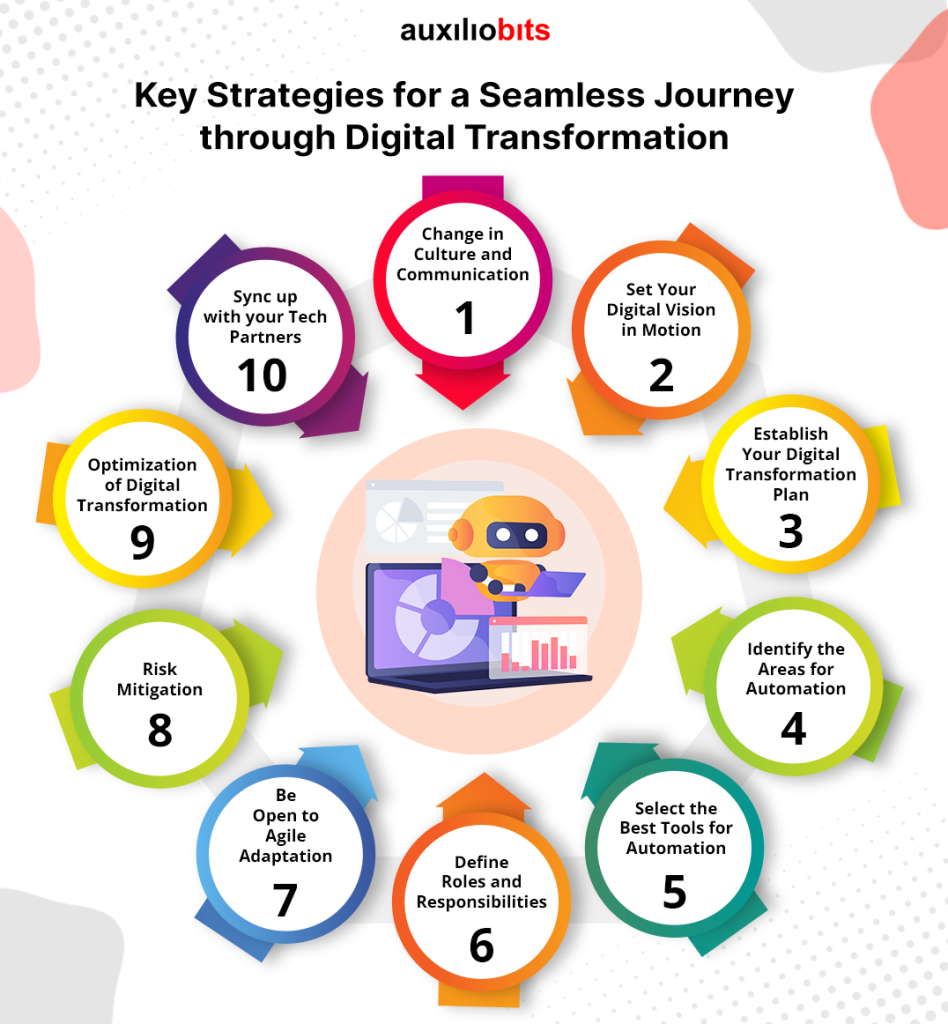
Change in Culture and Communication
Although technology plays a vital role in digital transformation, it is not the only factor. A shift in organizational culture is equally important for seamless digitalization.
Digital transformation initiatives of an organization are successful only if all the members are ready to embrace them. Although most business leaders have realized the benefits of automation, many are skeptical about this transition. Many employees resist this change because of the fear of losing jobs to bots. There are instances when decision-makers might not be convinced if it is worth the investment.
Therefore, digitalization requires a significant culture change in your business. Sadly, employees and customers frequently resist big changes, which could make your company’s digital transformation strategy challenging. According to McKinsey, 70% of digital transformations fail most often due to resistance from employees. (Source: Quixy)
The cultural shift should be the foremost step in the digital transformation journey to ensure that all the employees work cohesively towards this goal. Given this, it is essential to adequately prepare your staff and clients for this in advance. Taking your staff with you in this digitalization process is super important.
Change begins by changing the mindset of the top management. Hold discussions and educational sessions with the top leaders to convince them about the value automation will add to their business. According to McKinsey companies with an engaged Chief Digital Officer are 1.6 times more likely to report a successful digital transformation. (Source: Quixy)
Conducting discussions and training sessions for all the members will them more agreeable to technology. The only way to implement the plan correctly is to have complete transparency by communicating it clearly with the team members.
Encourage collaboration, open-mindedness, and ongoing learning to support an innovative and changing culture. Develop a culture where employees can experiment with novel concepts and technologies. Ensure that the staff is aware of the advantages and goals of the digital transformation by providing training and resources to improve digital literacy. Stress the importance of flexibility and agility in navigating the rapidly changing digital landscape.
Set Your Digital Vision in Motion
The organization must have a clear idea of the digital transformation goals it wants to achieve before starting the journey. You must have a well-defined digital vision, regardless of the goal that you wish to fulfill. Organized discussions can lead to a better use of time and resources.
Allocate a budget based on your digitalization goals. This will ensure that you maintain your expenses under control.
Establish Your Digital Transformation Plan
It’s time to develop your digital transformation strategy now that you’ve evaluated your organization’s digital maturity level. Make sure your vision aligns with your organization’s mission and goals. Set objectives considering important factors like customer happiness, revenue growth, and cost reduction.
The logical next step is to use key performance indicators (KPIs) to monitor progress. Create a roadmap that lists important deadlines, projects, activities, resources, budget projections, and risk mitigation techniques. In today’s fast-paced corporate environment, it’s important to remember that adaptive and agile tactics are essential to stay ahead of changing market dynamics, client expectations, and technological breakthroughs.
Identify the Areas for Automation
The next stage of your digital transformation journey is evaluating your organization’s technological capabilities. Detect your strengths find your weaknesses, and look for growth opportunities. Examine the efficiency, flexibility, security, and user experience of your current technologies, procedures, and culture. While you’re doing it, consider aspects such as resource usage, accuracy, and speed. For outstanding results, find bottlenecks, and duplications, and identify areas that could profit from automation or optimization.
Determine the processes and workflows that will benefit from automation. Also, ascertain the extent of automation you wish to adopt. You could automate specific processes/workflows or consider enterprise-level automation.
Automation experts at Auxiliobits can help you identify specific areas that can be automated to boost efficacy.
Select the Best Tools for Automation
Technology has emerged as the indisputably crucial element in developing a plan for digital transformation. Businesses must review existing systems and deploy new-age technology to create seamless, integrated, and native customer and employee experiences.
Cutting-edge innovations like big data analytics, AI, cyber security, cloud computing, AR/VR, IoT, and more are vital technologies for digital transformation. After all, a well-rounded framework for digital transformation considers an organization’s present and future requirements. Additionally, it ensures flexibility, scalability, and smooth integration with the current systems. Embracing new technologies will aid in the smooth transition of your firm through the digital transformation process.
There is a plethora of automation tools available in the market today. Each tool uses different technologies. Robotic Process Automation (RPA), Artificial Intelligence (AI), and Machine Learning (ML) are some of the technologies that are spearheading digital transformation. IDC asserts that AI technology will be inserted into processes and products of at least 90% of new enterprise apps. (Source: Quixy). These technologies work with Big Data, Cloud Computing, IoT, etc. to enhance business outcomes.
Each of these technologies has its specific features and its limitations. For instance, RPA automates rule-based processes to eliminate human errors and enhance speed and productivity. However, it cannot work with unstructured data. Data analytics and forecasting abilities of AI provide valuable insights for better decision-making.
Therefore, you have the option of choosing RPA bots that can take over routine tasks, or the more advanced hyper-automation bots that integrate AI with RPA, etc. Each of these tools has different cost implications.
Automation tools have a specific set of features. Hence, it is imperative that you compare different tools and select the ones that best meet your goals.
Selection of the best tool can be a daunting task. The professional team at Auxiliobits can suggest cost-effective automation solutions for your enterprise.
Define Roles and Responsibilities
When an organization deploys automation technologies, bots will take over several tasks. Therefore roles and responsibilities will need to be redefined.
The goal of digital transformation is to enhance human talents rather than replace them.
Based on the technologies that are deployed and the processes/workflows that are automated, you will need to clearly redefine the roles and responsibilities of your workforce.
One of the critical aspects of digital transformation is managing talent and developing digital competencies. You will also need to create plans for developing the digital skills of their employees in data science and human-centered design.
Be Open to Agile Adaptation
The digital environment is always changing. Therefore, you need to build an ongoing learning and development culture. An agile framework for implementing digital transformation facilitates remaining ahead of the pivot curve and staying in line with the rapidly changing digital landscape.
An agile approach helps in responding quickly to changing customer demands and keeping pace with the dynamics of the marketplace.
Risk Mitigation
You must be conscious of potential risks as you lead your digital transformation journey. These dangers could hinder your technological, operational, financial, or even cultural success. Creating a backup plan for each of these dangers is critical to reduce the risks. This strategy outlines the methods to deal with probable problems and lessen their effects. You may easily handle obstacles during your digital transformation journey by being proactive and having a sound risk mitigation strategy.
Optimization of Digital Transformation
Owners of businesses should optimize all aspects of their operations, including digital transformation plans. The transformation strategy must be executed precisely and successfully to maximize corporate yield. With maximal production in mind, all businesses should cover the digital optimization framework. More importantly, using vital information gathered over the years to make wise selections would be beneficial.
Sync up with your Tech Partners
The organization’s internal resources and experience could be more frequently insufficient to handle the demands of digital transformation. Working with vendors and partners in technology who are experts in digital solutions and have a thorough understanding of your sector is beneficial.
It is a good idea to form strategic alliances to discover their knowledge and access cutting-edge technology. Seek assistance in choosing and implementing the appropriate digital tools and platforms that support your company’s goals.
Partnerships with consultants, specialists, and technology providers are frequently necessary for seamless digital transformation. Collaborative ecosystems produce innovative ideas, bringing different viewpoints to the table. Alliances with people who share your aims and your areas of competence boost your digital transition.
The experienced team at Auxiliobits can facilitate seamless digitalization. We have worked with small, mid, and large-sized enterprises to help them in their digital transformation journeys. Our professionals recommend the best tools that integrate seamlessly with your existing systems. We suggest cost-effective solutions that meet your digital transformation goals. Our experts offer automation solutions that are customized according to the specific needs of your business.
Conclusion
To conclude, digital transformation offers a chance for your organization to reinvent in the digital era. It helps establish a clear vision, utilize data, remain flexible, and prioritize customer expectations for success. One should embrace technology, change and innovate the seemingly endless possibilities of a digital future.