







Global business services (GBS) is no longer an operating model reserved for large multinational corporations with extensive consulting budgets. Today, GBS for mid-market companies is becoming an increasingly relevant approach for organizations looking to streamline operations, reduce administrative complexity, and support sustainable growth without making significant upfront investments in consulting services.
As businesses expand into new markets, manage growing transaction volumes, and introduce new technologies, disconnected processes can become expensive and difficult to maintain. Finance, human resources, procurement, and other support functions may operate independently, creating duplicated work, inconsistent reporting, and limited visibility.
GBS offers a way to address these challenges by bringing business services together under a coordinated operating model. More importantly, mid-market organizations can begin this journey incrementally, using existing capabilities, practical process improvements, and targeted technology investments rather than relying on a large-scale consulting engagement.
This article explores why GBS for mid-market companies is gaining traction, how businesses can approach implementation, and what they should consider when building a scalable operating model.
What Is Global Business Services (GBS)?
Global Business Services is an operating model that integrates shared services, business processes, technology, and governance across an organization to deliver consistent and efficient support.
Traditional shared services typically consolidate similar activities, such as payroll or accounts payable, into centralized teams. GBS builds on this concept by encouraging greater coordination across functions, locations, and business units.
For example, a company with offices in several countries might manage finance operations separately in each location. Each team could follow different procedures, use different reporting formats, and maintain separate technology systems.
A GBS model can bring these activities under a common framework, establishing standardized processes, shared performance measures, and coordinated technology investments.
The goal is not simply to centralize everything. It is to make business services easier to manage, measure, improve, and scale.
Why Are Mid-Market Companies Turning to GBS?
Mid-market companies often experience a specific operational challenge: their businesses have grown beyond the processes that originally supported them, but they may not have the resources or complexity of a large enterprise.
Several factors are encouraging organizations to reconsider how their support functions operate.
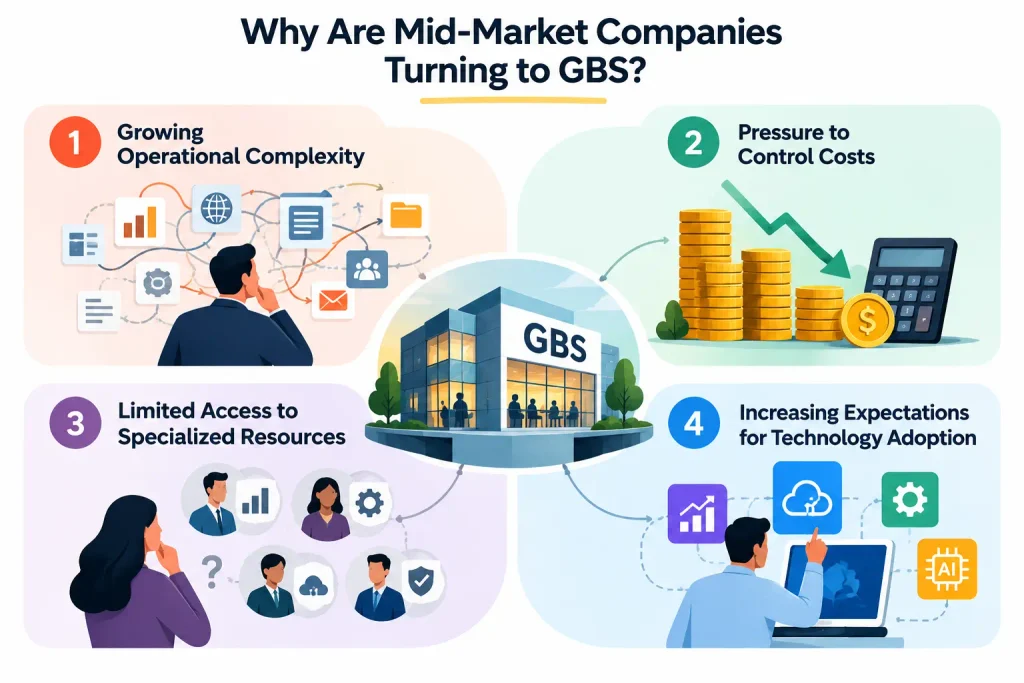
1. Growing Operational Complexity
As companies expand, they often add new departments, locations, suppliers, customers, and reporting requirements. Each addition can introduce different workflows and systems.
Without a coordinated approach, routine activities become harder to manage. Employees may spend time reconciling spreadsheets, correcting errors, chasing approvals, or transferring information between departments.
A GBS model helps establish common processes and clearer responsibilities, reducing unnecessary complexity as the business grows.
2. Pressure to Control Costs
Mid-market organizations must balance operational investment with profitability and growth. Maintaining separate teams, systems, and procedures across business units can increase overhead without necessarily improving service quality.
GBS creates opportunities to identify duplicated activities, consolidate suitable processes, and improve resource utilization.
These benefits do not require moving every function to a central location. Even standardizing selected workflows can help reduce avoidable effort and operating expenses.
3. Limited Access to Specialized Resources
Large enterprises may have dedicated transformation offices, enterprise architects, and specialized consulting teams. Mid-market businesses may have smaller internal teams responsible for both daily operations and improvement initiatives.
This makes it important to prioritize initiatives carefully.
Rather than attempting a complete organizational transformation, businesses can focus on high-impact processes, develop internal expertise, and introduce improvements in manageable stages.
4. Increasing Expectations for Technology Adoption
Automation, artificial intelligence, cloud platforms, and analytics are changing how business services operate. However, adopting technology without addressing underlying process problems can create additional complexity. Automating an inconsistent workflow may simply make inefficient activities happen faster.
A coordinated operating model encourages organizations to examine processes, clarify ownership, and improve data quality before selecting suitable technologies.
Can Mid-Market Companies Build GBS Without Big 4 Consultants?
Yes. A business can establish a GBS operating model without engaging a large consulting firm for every stage of the transformation.
Consultants can provide valuable expertise, particularly for complex multinational programs, organizational redesign, and specialized technology implementations. However, a large consulting engagement is not the only way to begin.
GBS for mid-market companies can start with a focused internal initiative that addresses clearly identified operational problems.
For example, a company might begin by reviewing its accounts payable process, documenting existing workflows, identifying approval delays, and standardizing invoice handling across locations.
Once these changes produce measurable improvements, the company can apply the same approach to procurement, employee administration, or other suitable functions.
A practical approach may include:
- Using internal subject-matter experts to document current processes.
- Assigning business owners to lead improvement initiatives.
- Standardizing procedures before investing in new technology.
- Using existing software capabilities where they meet requirements.
- Bringing in external specialists for clearly defined knowledge gaps.
- Measuring results before expanding the program.
The important distinction is between avoiding unnecessary consulting expenditure and avoiding expertise altogether. Businesses should invest in specialist support when the complexity, risk, or potential value justifies it.
A Practical Roadmap for Building GBS on a Budget
Building GBS does not have to be a single, expensive transformation project. A phased approach allows organizations to learn from early improvements while managing costs and operational risks.
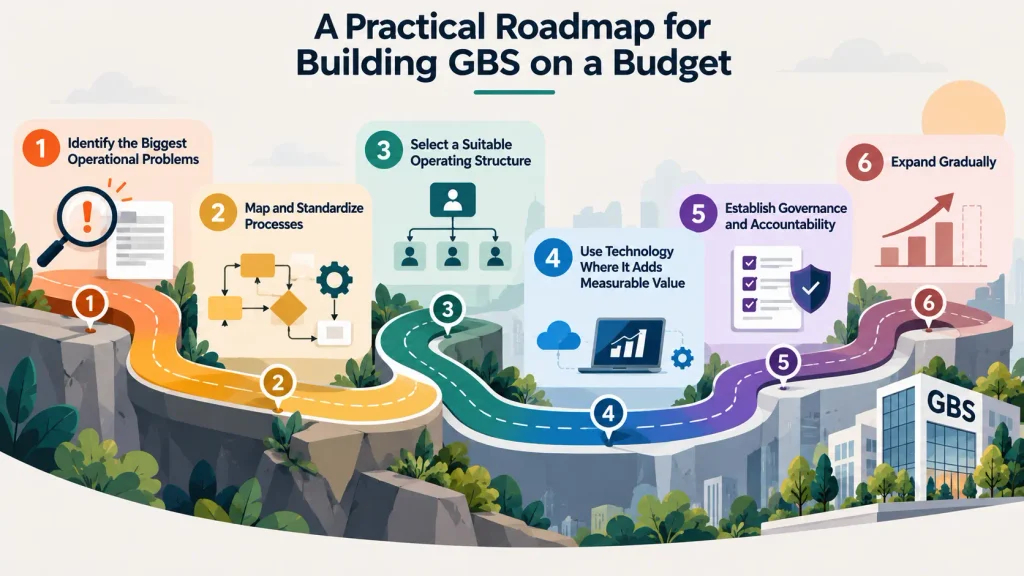
Step 1: Identify the Biggest Operational Problems
Start by understanding where employees spend unnecessary time and where processes regularly fail. Review activities such as invoice processing, employee onboarding, expense management, purchasing approvals, and financial reporting.
Look for recurring problems, including duplicate data entry, manual reconciliations, inconsistent procedures, and unclear responsibilities.
Prioritize problems based on business impact, frequency, implementation effort, and risk.
Step 2: Map and Standardize Processes
Before centralizing work, document how each process currently operates. Identify who initiates an activity, who approves it, what information is required, and where delays or errors occur.
Next, establish a common process wherever business requirements allow.
For instance, a company may standardize invoice approval rules, documentation requirements, and exception handling across its business units while preserving necessary local tax or regulatory differences.
Standardization creates a foundation for better reporting, automation, and accountability.
Step 3: Select a Suitable Operating Structure
Not every activity needs to be centralized in the same way. Some processes may be handled by a central team, while others may remain within business units but follow shared policies and technology standards.
Organizations should consider transaction volumes, local requirements, process complexity, employee capabilities, and service expectations before determining the appropriate structure.
A flexible model can help mid-market businesses improve coordination without introducing unnecessary management layers.
Step 4: Use Technology Where It Adds Measurable Value
Technology should support a defined operational objective rather than become the objective itself. Workflow automation may help route approvals, while document processing tools can extract information from invoices. Analytics can improve visibility into processing times, exceptions, and service performance.
Start with existing systems and available features before introducing additional platforms.
For GBS for mid-market companies, a focused automation initiative can provide a useful starting point, especially when it addresses a repetitive, high-volume process with measurable inefficiencies.
Step 5: Establish Governance and Accountability
A successful operating model needs clear ownership. Define who is responsible for process standards, service quality, technology decisions, risk management, and performance reporting.
Establish a small set of relevant metrics, such as cost per transaction, processing time, error rates, automation adoption, and internal customer satisfaction.
Regular reviews can help teams identify problems, prioritize improvements, and determine whether the model is delivering its intended benefits.
Step 6: Expand Gradually
Once an initial initiative demonstrates results, extend the approach to other suitable processes. For example, improvements in accounts payable may provide lessons for expense management, procurement operations, or financial reporting.
Expanding in stages allows the organization to build internal knowledge, manage change, and avoid committing resources to a large transformation before its value is established.
The Role of Automation and AI in Modern GBS
Automation can help mid-market organizations improve productivity without proportionally increasing headcount as transaction volumes grow.
Robotic process automation can handle certain rule-based activities, while workflow tools can coordinate approvals and task assignments. Intelligent document processing can extract information from business documents, reducing manual data entry.
AI-enabled tools may also assist with classifying requests, identifying unusual transactions, summarizing information, and supporting employees with routine questions. More advanced agentic AI applications can coordinate multiple steps within defined workflows, subject to appropriate permissions and controls.
However, these technologies are not suitable for every task. Processes involving complex judgment, sensitive information, or regulatory obligations may require human review and additional safeguards.
The best results typically come from combining suitable technology with standardized processes, reliable data, and clear accountability.
For organizations exploring GBS for mid-market companies, automation should be introduced according to business needs, technical readiness, and measurable value—not simply because a technology is available.
Common Challenges to Anticipate
Even a cost-conscious GBS initiative can encounter obstacles.
- Resistance to change: Employees may worry about losing control over familiar processes. Clear communication, training, and involvement in process design can improve adoption.
- Poor data quality: Inconsistent records and disconnected systems can undermine reporting and automation. Data ownership and validation rules should be established early.
- Over-centralization: Moving every activity into one structure can create delays or ignore legitimate local requirements. Centralize where it improves outcomes, not as an automatic rule.
- Unclear accountability: Shared processes can become difficult to manage when responsibilities are poorly defined. Assign process owners and establish escalation procedures.
- Unrealistic savings expectations: Benefits may take time to materialize, particularly when process redesign and technology implementation are required. Use realistic baselines and track actual results.
Recognizing these challenges early helps businesses build a more practical transformation plan.
Conclusion
Building Global Business Services is no longer an initiative that mid-market companies need to postpone until they can afford a major consulting engagement.
With a clear understanding of operational challenges, disciplined process standardization, appropriate technology, and accountable leadership, organizations can develop a more integrated operating model in manageable stages.
The most effective starting point is not a large transformation program. It is a clearly defined business problem, a realistic improvement plan, and a commitment to measuring results.
By focusing on practical improvements first, GBS for mid-market companies can create a foundation for more consistent service delivery, better operational visibility, and sustainable growth, while preserving resources for broader business priorities.