









As organizations grow, managing finance, HR, IT, procurement, and other business functions across departments and regions becomes increasingly complex. Many companies use centralized operating models to improve efficiency, standardize processes, and reduce duplication. The comparison of SSC vs GBS helps leaders understand two common approaches: the Shared Services Center (SSC) and Global Business Services (GBS). Although they share some goals, they differ in scope, governance, and
how services are coordinated.
Although the two models share similar objectives, they differ in their organizational structure, scope, governance, and approach to delivering business value. Understanding these differences helps organizations evaluate how their operating models can evolve to meet changing business needs.
In this guide, we explore SSC vs GBS, their key differences, respective benefits and challenges, and how organizations can determine which model best fits their business goals.
What Is a Shared Services Center (SSC)?
A Shared Services Center (SSC) is a centralized unit that delivers specific business services to multiple departments, business units, or locations within an organization.
Instead of allowing every department to manage its own administrative activities, a company consolidates similar tasks into a dedicated center. This approach reduces duplication, creates consistent processes, and allows specialized teams to handle recurring work more efficiently.
For example, a multinational company might establish a shared services center to process employee payroll, manage supplier invoices, handle employee queries, or maintain financial records for several business units.
Common functions managed by an SSC include:
- Finance and accounting: Invoice processing, accounts payable, accounts receivable, reconciliations, and financial reporting.
- Human resources: Payroll administration, employee data management, benefits administration, and recruitment support.
- Information technology: Help desk services, access management, and routine technical support.
- Procurement: Purchase order processing, supplier onboarding, and purchasing administration.
The primary objective of an SSC is to consolidate activities that can be performed more consistently and efficiently through a centralized structure.
However, shared services centers can differ significantly in maturity. Some focus mainly on transaction processing and cost reduction, while others introduce automation, performance management, and continuous improvement initiatives.
An SSC is therefore not necessarily limited to basic administrative work. Its capabilities depend on how the organization designs, governs, and develops the model.
What Is Global Business Services (GBS)?
Global Business Services (GBS) is an integrated operating model that brings together multiple business services, functions, and delivery locations under a coordinated governance structure.
To understand what is global business services in practical terms, consider an organization that operates separate finance, HR, procurement, and IT shared services teams across different countries. Each team may have its own leadership, technology, reporting structure, and performance targets.
A GBS model aims to coordinate these services through a more unified approach. Rather than managing each function as an isolated service operation, the organization aligns processes, technology, data, and performance objectives across the enterprise.
GBS commonly includes:
- Integrated service delivery: Coordinating finance, HR, procurement, IT, and other functions within a connected operating model.
- Global process standardization: Establishing consistent processes, policies, and performance measures across regions.
- Technology and automation: Using workflow automation, analytics, artificial intelligence, and integrated platforms to improve service delivery.
- End-to-end process ownership: Managing connected business processes across departmental boundaries rather than optimizing individual tasks alone.
- Strategic business partnership: Supporting enterprise priorities through better insights, improved service quality, and operational agility.
For instance, a GBS organization might coordinate the entire procure-to-pay process, connecting procurement operations, supplier management, invoice processing, payment activities, and reporting.
The goal is not simply to centralize work. It is to create a more integrated service model that improves how business functions work together.
GBS can also include regional delivery centers, local teams, specialist capabilities, and external service providers. The defining characteristic is the integrated governance and service-delivery approach, not the physical location of every employee.
Shared Services Center vs Global Business Services: Key Differences
The biggest difference in SSC vs GBS lies in how business services are organized and managed. A Shared Services Center generally consolidates specific activities or functions, while GBS coordinates multiple services through an integrated, enterprise-wide operating model.
The distinction becomes clearer when comparing their major characteristics.
| Comparison Factor | Shared Services Center (SSC) | Global Business Services (GBS) |
| Primary focus | Centralizing specific activities and services | Integrating services across business functions |
| Organizational structure | Often organized by function, region, or service center | Coordinated across functions, regions, and delivery channels |
| Governance | May have separate functional leadership and priorities | Typically uses more integrated governance and accountability |
| Process ownership | Often focused on individual activities or functions | More likely to emphasize end-to-end process ownership |
| Technology | May use function-specific tools and systems | Aims for greater technology and data integration |
| Performance measurement | Often emphasizes cost, productivity, accuracy, and service levels | Combines operational metrics with enterprise-wide outcomes |
| Business partnership | Primarily provides standardized services | Can play a broader role in business transformation and decision support |
| Scalability | Expands through additional services, teams, or locations | Scales through coordinated processes, capabilities, and global delivery models |
These differences represent common patterns rather than strict rules. A mature SSC can have global operations, advanced automation, and strong business partnerships. Similarly, a GBS organization may still operate specialized centers that handle routine transactions.
The distinction is therefore less about whether a company operates globally and more about how effectively its services are integrated.
How Do SSC and GBS Work in Practice?
Consider a company operating across North America, Europe, and Asia-Pacific. Initially, it establishes separate finance shared services centers in two regions. Each center processes invoices, manages reconciliations, and supports local business units. This example highlights SSC vs GBS in practice: the arrangement reduces duplication within each region and creates opportunities for specialization.
However, the company continues to face several challenges:
- Different invoice-processing procedures across regions.
- Multiple reporting systems and inconsistent performance metrics.
- Limited visibility into supplier payments across the enterprise.
- Separate improvement initiatives that produce uneven results.
- Difficulty coordinating finance, procurement, and IT teams.
The company then decides to adopt a GBS operating model. It introduces common process standards, establishes coordinated governance, aligns technology investments, and creates shared performance measures. Finance and procurement teams collaborate to improve the procure-to-pay process, while analytics provide a consolidated view of operational performance. The original shared services centers may continue operating, but they now function as components of a broader service-delivery model. This example illustrates an important point: GBS does not necessarily replace shared services centers. It can build on them.
An SSC can provide the operational foundation for GBS, while GBS expands the model through greater integration, accountability, and enterprise-wide coordination.
Benefits of a Shared Services Center
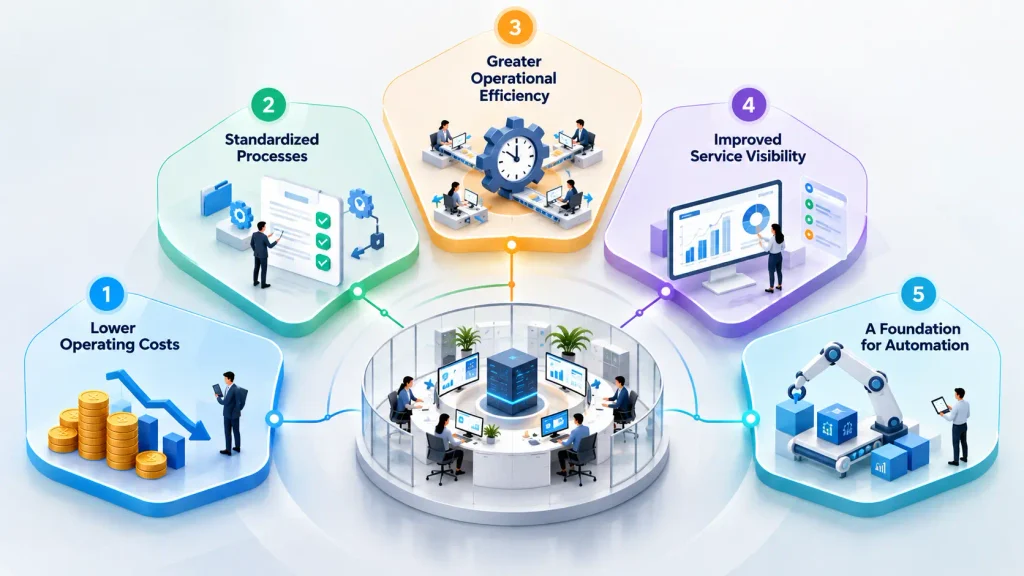
A shared services center can deliver meaningful benefits, particularly when an organization is trying to reduce duplication and improve operational consistency.
1. Lower Operating Costs
Consolidating similar activities reduces the need for every department to maintain separate teams, tools, and administrative processes. Shared resources can also improve economies of scale.
2. Standardized Processes
Centralized teams can establish common procedures, templates, and quality standards. This reduces unnecessary variation and makes performance easier to measure.
3. Greater Operational Efficiency
Dedicated teams can develop specialized knowledge, improve task allocation, and handle recurring activities more consistently.
4. Improved Service Visibility
A well-managed SSC can use service-level agreements, performance dashboards, and productivity metrics to identify bottlenecks and monitor service quality.
5. A Foundation for Automation
Consolidated processes make it easier to identify repetitive tasks that could benefit from workflow automation, robotic process automation, or other digital tools.
Despite these advantages, an SSC may struggle when individual centers operate independently or optimize their own performance without considering the wider business process.
Benefits of Global Business Services
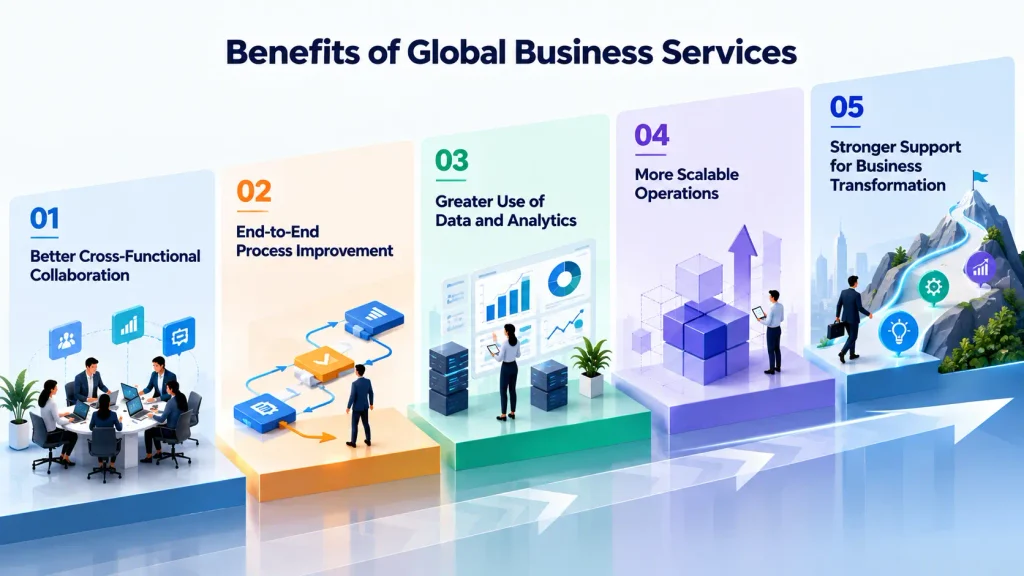
GBS builds on the principles of shared services while addressing the challenges that arise when multiple functions and delivery locations operate in isolation.
1. Better Cross-Functional Collaboration
An integrated model encourages finance, HR, procurement, IT, and other functions to coordinate their activities. This can reduce handoff delays and improve the experience of internal and external stakeholders.
2. End-to-End Process Improvement
GBS can focus on complete workflows rather than isolated tasks. For example, instead of measuring invoice-processing speed alone, an organization can examine the entire procure-to-pay process, from purchasing decisions to supplier payment.
3. Greater Use of Data and Analytics
A coordinated operating model can provide a more consistent view of performance across functions and regions. Leaders can use these insights to identify recurring issues, allocate resources, and prioritize improvements.
4. More Scalable Operations
Standardized processes and integrated governance can make it easier to introduce new services, expand into additional markets, or accommodate organizational changes.
5. Stronger Support for Business Transformation
Depending on its maturity, GBS can contribute to strategic initiatives such as digital transformation, process redesign, customer experience improvement, and enterprise-wide productivity programs.
However, these benefits are not automatic. GBS requires effective governance, clear accountability, reliable data, and collaboration between service teams and business stakeholders.
Without these foundations, an organization may simply create a more complicated structure without improving outcomes.
Common Challenges of SSC and GBS Models
Both models require careful planning, and neither guarantees operational excellence.
Shared services centers may encounter:
- Resistance from departments that are reluctant to give up control of their activities.
- Inconsistent processes between different centers.
- Service bottlenecks when demand increases faster than capacity.
- Overemphasis on cost reduction at the expense of service quality.
- Limited visibility into problems that span multiple functions.
Global Business Services organizations may encounter:
- Complex governance structures and unclear decision-making authority.
- Difficulties aligning regional requirements with global standards.
- High initial investment in technology, process redesign, and change management.
- Resistance from functional leaders concerned about autonomy.
- Challenges integrating legacy systems, data, and organizational cultures.
A successful implementation depends on more than choosing a model. Organizations must establish realistic objectives, define ownership, communicate changes clearly, and measure performance consistently.
How to Choose Between SSC and GBS
The right model depends on the organization’s size, operational maturity, business complexity, and long-term objectives. Comparing SSC vs GBS helps organizations decide whether to strengthen their existing shared services or transition toward a more integrated operating model.
An SSC may be a practical starting point when an organization has fragmented administrative processes, duplicated resources, or inconsistent service delivery. Centralizing selected activities can produce measurable improvements without requiring a complete operating-model redesign.
GBS may be more appropriate when an organization already operates multiple shared services teams but continues to experience fragmented governance, disconnected technology, and limited coordination across functions.
Before deciding, business leaders should consider five questions:
- What problem are we trying to solve? Identify whether the primary issue is duplication, cost, service quality, process fragmentation, or lack of enterprise-wide visibility.
- How mature are our current processes? Assess whether activities are documented, standardized, measurable, and suitable for automation.
- How integrated are our business functions? Determine whether teams operate independently or need to collaborate across complete business processes.
- What technology and data capabilities do we have? Evaluate whether current systems support consistent reporting, workflow integration, and effective decision-making.
- What outcomes matter most? Define measurable objectives, such as shorter processing times, fewer errors, improved stakeholder satisfaction, or better end-to-end performance.
Organizations do not always need to move directly from decentralized operations to a fully integrated GBS model. Many can evolve gradually by strengthening shared services, standardizing processes, improving governance, and expanding cross-functional collaboration.
The Role of Automation in SSC and GBS
Automation is an important consideration in SSC vs GBS, but its impact depends on how it is implemented. Within an SSC, automation often targets repetitive activities such as invoice data entry, account reconciliation, employee record updates, and routine service requests.
Within GBS, automation can support broader workflows across multiple functions. For example, an automated procure-to-pay process can connect purchase orders, invoice validation, exception handling, approval workflows, and payment reporting.
Artificial intelligence can also support document classification, information extraction, knowledge management, and decision-making. More advanced AI-enabled workflows can coordinate tasks across systems, subject to appropriate controls and human oversight.
However, automating an inefficient process does not automatically make it efficient. Organizations should first map workflows, remove unnecessary steps, establish clear ownership, and address data-quality issues.
The most effective approach combines process improvement, suitable technology, and measurable business objectives.
Conclusion
The difference between a Shared Services Center and Global Business Services is primarily a difference in operating-model design and integration.
An SSC centralizes selected services to improve efficiency, consistency, and cost management. GBS takes a broader approach by coordinating multiple functions, processes, technologies, and delivery locations through integrated governance.
Neither model is universally better. A well-designed SSC can deliver substantial value, while a poorly implemented GBS structure can introduce unnecessary complexity. The right choice depends on the organization’s needs, maturity, and ambitions.
For companies exploring operational transformation, understanding what is global business services provides a useful starting point for evaluating how existing shared services could evolve. Exploring Finance and GBS Shared Services can help organizations understand how finance operations and shared services can be optimized through process integration, automation, and continuous improvement. By focusing on business outcomes, organizations can develop service-delivery models that are more efficient, adaptable, and aligned with long-term goals.
Ready to transform your shared services operations? Contact Us to discuss how Auxiliobits can help you streamline processes, improve operational efficiency, and advance your GBS transformation journey.