









As mid-market organizations expand into new markets, add business units, and adopt new technologies, managing finance, HR, IT, and procurement becomes increasingly complex. Processes that once worked well within a single office may become fragmented across departments, systems, and locations. This creates an important question for business leaders: what is global business services, and how can this operating model help organizations manage growing complexity?
Global Business Services (GBS) is an integrated operating model that brings multiple business services together through coordinated governance, standardized processes, shared technology, and performance management. Rather than treating each support function as an independent operation, GBS encourages teams to work together toward common business objectives.
Although the model is often associated with large multinational enterprises, mid-market organizations can also benefit from its underlying principles. Understanding how GBS works can help leaders identify operational inefficiencies, improve collaboration, and build a foundation for sustainable growth.
This guide explains the meaning of GBS, its key components, its benefits and challenges, and how mid-market leaders can evaluate whether it fits their organization.
What Is Global Business Services (GBS)?
To understand what is global business services in practical terms, think of it as a coordinated way of managing the services that keep an organization running.
In a traditional organizational structure, finance, HR, IT, and procurement often operate independently. Each function may have its own processes, systems, reporting structures, and performance targets. While this arrangement can work at a smaller scale, it can become difficult to manage as the business grows.
GBS takes a more integrated approach. It coordinates these functions through shared governance, common process standards, connected technology, and clearly defined responsibilities.
For example, a company may have separate teams handling supplier onboarding, purchase orders, invoice processing, and payments. When these activities operate independently, delays and data inconsistencies can occur between teams.
A GBS model encourages the organization to examine how these activities connect, establish clearer ownership, and improve the complete process rather than optimizing each task in isolation.
The objective is not simply to centralize every activity or move employees into one location. Instead, GBS aims to improve how services are delivered across the organization.
Depending on its needs, a GBS model may include centralized service centers, regional teams, local specialists, external service providers, and technology-enabled workflows. The defining characteristic is the integration of these capabilities through a coordinated operating model.
Why Is GBS Becoming Relevant for Mid-Market Organizations?
Mid-market companies often reach a stage where their existing operating structures struggle to keep pace with growth. A company might expand from one country into several markets, acquire another business, introduce new product lines, or increase its workforce significantly. Each development adds operational demands.
Finance may need to manage more transactions and reporting requirements. HR may need to support different employee populations. Procurement may work with a larger supplier network, while IT must maintain more applications and access controls.
When every function responds independently, organizations can develop overlapping responsibilities, inconsistent processes, and disconnected systems.
Several common challenges make GBS worth exploring.
1. Growing Operational Complexity
As businesses expand, the number of transactions, stakeholders, and internal dependencies increases. Informal processes that once worked well may become difficult to maintain. A more coordinated service-delivery model helps organizations establish consistent procedures and clearer accountability as complexity grows.
2. Fragmented Technology and Data
Different departments may use separate applications, spreadsheets, and reporting tools. This can make it difficult to establish a reliable view of operational performance. GBS encourages greater alignment between systems, data definitions, and reporting practices, helping leaders make decisions using more consistent information.
3. Rising Administrative Costs
Duplicated activities, manual data entry, repeated approvals, and inefficient handoffs can consume resources without creating proportional business value. An integrated operating model helps leaders identify these inefficiencies and determine where standardization, process redesign, or automation could improve performance.
4. Limited Cross-Functional Visibility
A department may meet its own targets while contributing to delays elsewhere in the organization. For example, procurement may complete purchasing approvals quickly, but inconsistent supplier records may delay invoice processing. Looking at the connected process makes it easier to identify the underlying issue.
5. Pressure to Scale Without Adding Complexity
Mid-market organizations need operating models that can support growth without requiring a separate team, system, or procedure for every new business unit. GBS can provide a framework for expanding services through repeatable processes, coordinated governance, and scalable technology.
What Are the Core Components of a GBS Operating Model?
GBS is not a single organizational structure or software platform. It combines several operating principles that help business services work together more effectively.
1. Integrated Service Delivery
Integrated service delivery connects activities across functions, regions, and service centers. For example, finance, HR, and IT may continue to have specialized teams, but their service processes can follow common governance principles and coordinated performance objectives.
For mid-market organizations, integration does not necessarily require consolidating every function immediately. Leaders can begin by identifying where disconnected activities create the greatest operational problems.
2. Standardized Business Processes
Standardization establishes common procedures for activities that are performed repeatedly across the organization. These may include invoice processing, employee onboarding, supplier registration, financial reconciliations, and service request management.
Consistent processes make it easier to measure performance, train employees, identify exceptions, and introduce automation.
Standardization does not mean every region must follow identical procedures regardless of local requirements. Regulatory obligations, customer needs, and business conditions may justify controlled variations.
3. Clear Governance and Accountability
An integrated model requires clarity about who owns decisions, processes, service quality, and improvement initiatives. Without clear governance, different teams may pursue competing priorities or assume that another department is responsible for resolving a problem.
Effective governance establishes decision-making authority, escalation procedures, performance expectations, and accountability across connected services.
4. Connected Technology and Data
Technology supports GBS by helping teams exchange information, coordinate workflows, and monitor results. Relevant capabilities may include enterprise resource planning systems, workflow platforms, automation tools, analytics dashboards, and shared service management applications.
The objective is not to purchase every available technology. It is to determine which capabilities address existing process gaps and support the organization’s operating priorities.
5. Performance Management and Continuous Improvement
GBS requires a consistent approach to measuring how services perform and whether improvements produce meaningful results. Organizations may track processing time, error rates, cost per transaction, service request resolution, compliance, and stakeholder satisfaction.
These measures should reflect both operational efficiency and service quality. Reducing costs is less valuable if the result is a poor employee experience, delayed supplier payments, or increased operational risk.
What Functions Can Be Included in Global Business Services?
The scope of GBS varies by organization. Mid-market companies can start with a limited set of functions and expand as their operating model matures.
Common areas include the following.
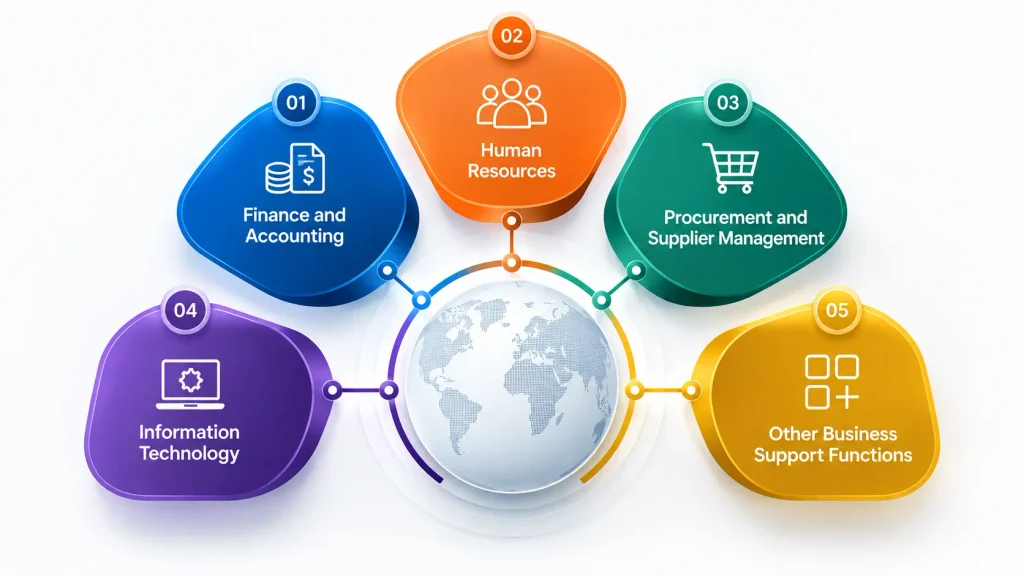
1. Finance and Accounting
Finance services may include accounts payable, accounts receivable, cash application, reconciliations, expense management, and financial reporting. An integrated approach can help organizations establish consistent transaction processes, improve reporting visibility, and reduce manual handoffs between finance and other departments.
2. Human Resources
HR services may cover employee data management, payroll administration, benefits support, recruitment coordination, and employee inquiries. Common workflows can improve consistency while allowing HR specialists to focus on workforce planning, employee development, and other activities requiring human judgment.
3. Procurement and Supplier Management
Procurement services may include purchase order administration, supplier onboarding, contract support, invoice coordination, and purchasing analytics. Connecting these activities can help organizations improve supplier data quality, reduce process delays, and gain greater visibility into purchasing activities.
4. Information Technology
IT services may include access management, service desk support, application administration, and routine technical requests. Standardized service management processes can improve response consistency, clarify ownership, and support more effective technology governance.
5. Other Business Support Functions
Depending on the organization, GBS may also include customer operations, data management, compliance support, or other administrative services. The appropriate scope depends on the organization’s business needs, regulatory environment, operational maturity, and ability to manage integrated services effectively.
What Are the Benefits of Global Business Services?
Understanding what is global business services also means recognizing that its benefits depend on how well the model is implemented.
GBS can create value in several areas when organizations establish clear processes, governance, and measurable objectives.
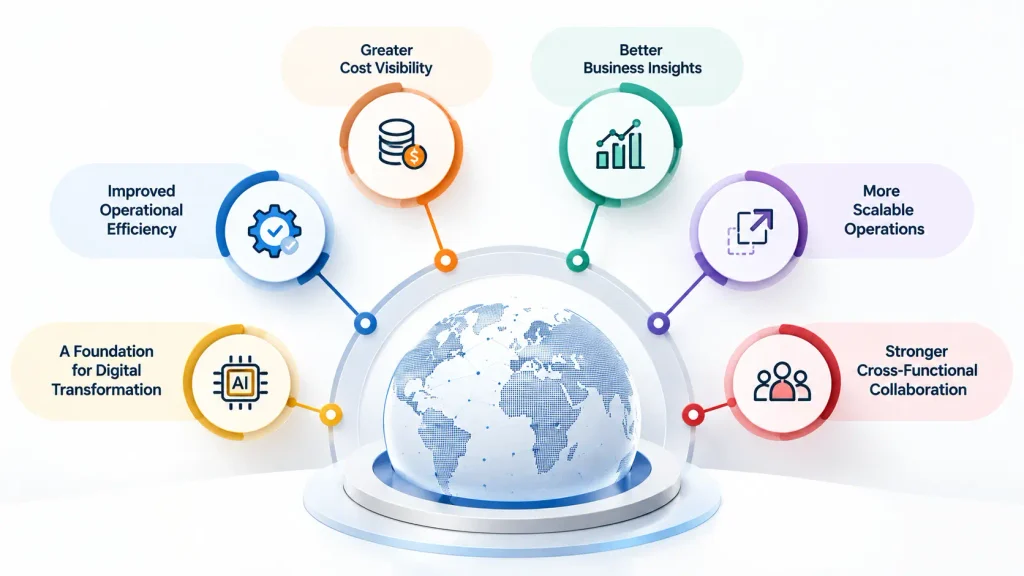
1. Improved Operational Efficiency
Standardized processes and reduced duplication can help teams complete work more consistently. Better coordination can also reduce unnecessary handoffs and delays between departments.
2. Greater Cost Visibility
A coordinated service model makes it easier to understand where resources are used, which activities create avoidable costs, and where improvements may have the greatest impact. The goal is not simply to reduce spending. It is to use resources more effectively while maintaining service quality.
3. Better Business Insights
Consistent data and reporting can help leaders understand performance across functions and locations. Instead of reviewing isolated departmental metrics, decision-makers can identify patterns across connected workflows and investigate problems that affect multiple teams.
4. More Scalable Operations
Standardized processes and reusable technology capabilities can help organizations accommodate additional transactions, business units, and locations without redesigning every process from scratch. This is particularly relevant for mid-market businesses preparing for expansion or organizational change.
5. Stronger Cross-Functional Collaboration
When teams share process objectives and clearly defined responsibilities, they can address problems that extend beyond individual departments. For example, finance and procurement can work together to reduce invoice exceptions, improve supplier information, and shorten the time between purchasing and payment.
6. A Foundation for Digital Transformation
GBS can provide a structured environment for introducing automation, analytics, and AI-enabled workflows. Because processes and responsibilities are more clearly defined, organizations can evaluate technology opportunities against identifiable operational needs rather than adopting tools without a clear purpose.
Is Global Business Services Right for Every Mid-Market Organization?
GBS is not a universal requirement, and organizations do not need to adopt a comprehensive model simply because they are growing. A smaller mid-market company with a limited geographic footprint and relatively straightforward operations may achieve its goals through better process documentation, selective centralization, and targeted automation.
An organization operating across multiple countries, business units, or systems may have stronger reasons to explore integrated governance and service delivery.
Leaders should consider the complexity of their operations, the maturity of existing processes, the level of duplication, the quality of available data, and the resources required to manage change.
A useful starting point is to ask three questions:
- Are disconnected processes creating recurring operational problems?
- Would better coordination across functions improve measurable business outcomes?
- Does the organization have the leadership, data, and process discipline required to support greater integration?
If the answers indicate a meaningful opportunity, GBS principles may help guide the next stage of operating-model development.
Conclusion
Global Business Services offers organizations a structured way to coordinate business support functions, improve process integration, and create more consistent service delivery.
For mid-market leaders, understanding what is global business services provides a starting point for evaluating whether existing operating structures can support future growth. The model can help organizations address fragmented processes, improve visibility, and establish a foundation for technology-enabled transformation.
However, GBS is not simply a larger shared services center or a technology implementation project. It requires clear governance, accountable process ownership, reliable data, and a sustained focus on business outcomes.
Organizations can begin with targeted improvements and expand their capabilities as operational needs evolve. By focusing on practical problems, measurable results, and continuous improvement, mid-market leaders can determine which GBS principles are most relevant to their business and build an operating model that supports sustainable growth.