Agentic AI Architecture for GBS

How Agentic AI Actually Works Inside a GBS Function

Global Business Services (GBS) organizations have spent years building scale through centralization, standardization, shared technology platforms, process harmonization, and automation. Yet even mature GBS functions still rely heavily on people to coordinate work between systems and towers. Employees read emails, interpret exceptions, check transaction statuses, follow up on approvals, reconcile information across applications, determine what should happen next, and intervene whenever a workflow encounters something that was not anticipated in its original design.

That coordination layer is where agentic AI becomes materially different from another automation initiative.
Agentic AI Architecture for GBS
The opportunity is not simply to place an AI agent inside Accounts Payable, Record-to-Report, Procurement, HR Operations, or IT Service Management. A GBS organization creates value precisely because it connects these functions. A supplier change can involve procurement, supplier master, compliance, accounts payable, tax, and treasury. An employee onboarding event can trigger HR, payroll, IT, security, finance, and facilities activities. A month-end close exception can require finance teams to work across ERP transactions, reconciliation tools, service-management platforms, and reporting systems.

Agentic AI therefore becomes significantly more valuable when it is designed as an operating architecture for coordinated work across GBS, rather than as a collection of intelligent bots sitting inside individual processes.

The architectural question is not simply, “Where can we put an AI agent?” It is, “How should agents, automation, enterprise systems, data, people, and governance work together to move a GBS outcome from trigger to resolution?”

That distinction changes the architecture, the operating model, the governance model, and ultimately the economics of GBS transformation.

Start Here If You're New to Agentic AI

If you are new to Agentic AI, start with Auxiliobits’ existing What Are Agentic AI Agents? A Beginner’s Guide for Enterprises and From RPA to APA: How Agentic AI Is Redefining Automation rather than treating this page as another introduction to the category. Those resources establish the fundamental distinction: traditional automation generally executes predefined tasks, while agentic AI combines contextual understanding, planning, decision-making, tool use, and autonomous execution to pursue a defined business outcome. In an enterprise environment, an agent can interpret structured and unstructured information, determine which action is appropriate, interact with APIs or RPA, and escalate when the situation falls outside its authority. For GBS leaders, the important point is what happens when that capability moves beyond one process. The moment agents have to coordinate work across towers, entities, applications, policies, and human teams, Agentic AI stops being primarily an automation technology and becomes an architectural question.

What Changes When You Apply This Across an Entire GBS (Not One Process)

What Changes When You Apply This
A first agentic AI deployment in GBS is relatively easy to understand. Consider an accounts payable exception agent. It receives an invoice, extracts the relevant information, checks the purchase order, identifies a mismatch, determines whether the exception can be resolved automatically, and either takes the next permitted action or routes the case to a human.

That is useful, but it is still a process-level implementation.

The architecture becomes fundamentally different when the organization asks Agentic AI to coordinate an outcome that crosses multiple GBS towers. Consider a supplier requesting a change to its banking information. What initially looks like an AP or Procurement task may require supplier identification, master-data validation, document verification, compliance checks, fraud-risk assessment, approval, ERP updates, downstream payment validation, notification, and audit evidence. Each individual step may already have an automation or system supporting it, but no single tower necessarily owns the intelligence required to coordinate the entire outcome.

This is where multi-tower orchestration becomes the genuinely new ground for GBS.

See how agentic AI connects GBS towers. When automation stops at the tower boundary, people still become the coordination layer. See how Auxiliobits connects finance, HR, IT, procurement, and other shared services through AI, RPA, and workflow orchestration to create a more connected GBS operating model.

01GBS Is a Network of Interdependent Work, Not a Collection of Towers

GBS organizations are commonly structured around functional towers such as finance, procurement, HR, IT, customer operations, supply chain, and other enterprise services. That structure makes organizational sense, but business events rarely stay inside those boundaries.

A new employee, for example, can trigger an HR record creation, payroll setup, identity provisioning, access management, cost-center allocation, equipment provisioning, and facilities request. A supplier onboarding process can involve procurement, compliance, Supplier Master, Finance, Tax, Accounts Payable, and Treasury are all involved. A customer dispute may move between customer service, sales, accounts receivable, finance, and legal. A financial-close exception can involve the ERP, finance operations, IT, data teams, reporting, and business stakeholders.

Most GBS automation programs have historically optimized the vertical dimension: make the individual process inside each tower faster and cheaper. Agentic GBS architecture has to address both the vertical and horizontal dimensions. It must improve individual processes and coordinate the dependencies between them.

That is why adding an agent to every existing workflow is not enough. If every tower creates its own agents without a shared orchestration model, the organization simply creates a new generation of silos.
The most important architectural shift is from process automation to outcome orchestration.

Imagine a GBS organization with hundreds of automated workflows. That does not necessarily mean the operating model is intelligent. The invoice may be processed automatically, but a human still reviews the exception. Another workflow may send the approval request, but someone manually checks whether the approval was completed. A separate automation may update the ERP, while an analyst checks whether the downstream record actually changed. The organization has automation, but people still coordinate the business outcome.

Agentic architecture moves the coordination layer upward.

Instead of a sequence that looks like human → bot → human → workflow → human → ERP, the target becomes an operating loop in which a business event enters an orchestration layer, the appropriate agents and deterministic automations are selected, enterprise systems are accessed through approved tools, outcomes are validated, and humans are brought in only when the situation crosses a defined decision or risk boundary.

This does not eliminate people from GBS. It changes where their involvement is required.
At the GBS scale, an agent should not be an unrestricted digital worker with access to every enterprise application. The architecture needs a coordination layer that determines which agent or automation should handle a particular piece of work, what context it needs, which tools it can access, what actions it is authorized to perform, which policies apply, when another agent should be involved, and when a human must take over.

The orchestrator effectively becomes the control plane for operational work.

Consider a supplier-bank-change scenario. A supplier agent can validate the request and identify the supplier. A compliance agent can assess whether the documentation meets policy requirements. A risk agent can evaluate the change against defined risk signals. An approval workflow can determine whether human authorization is required. An ERP automation can make the permitted system update. A monitoring agent can then verify that the downstream payment environment reflects the change.

The intelligence does not have to live inside one agent. The architecture distributes responsibility while maintaining a shared process state and a controlled path to the desired outcome.

This is the foundation of multi-agent GBS operations.
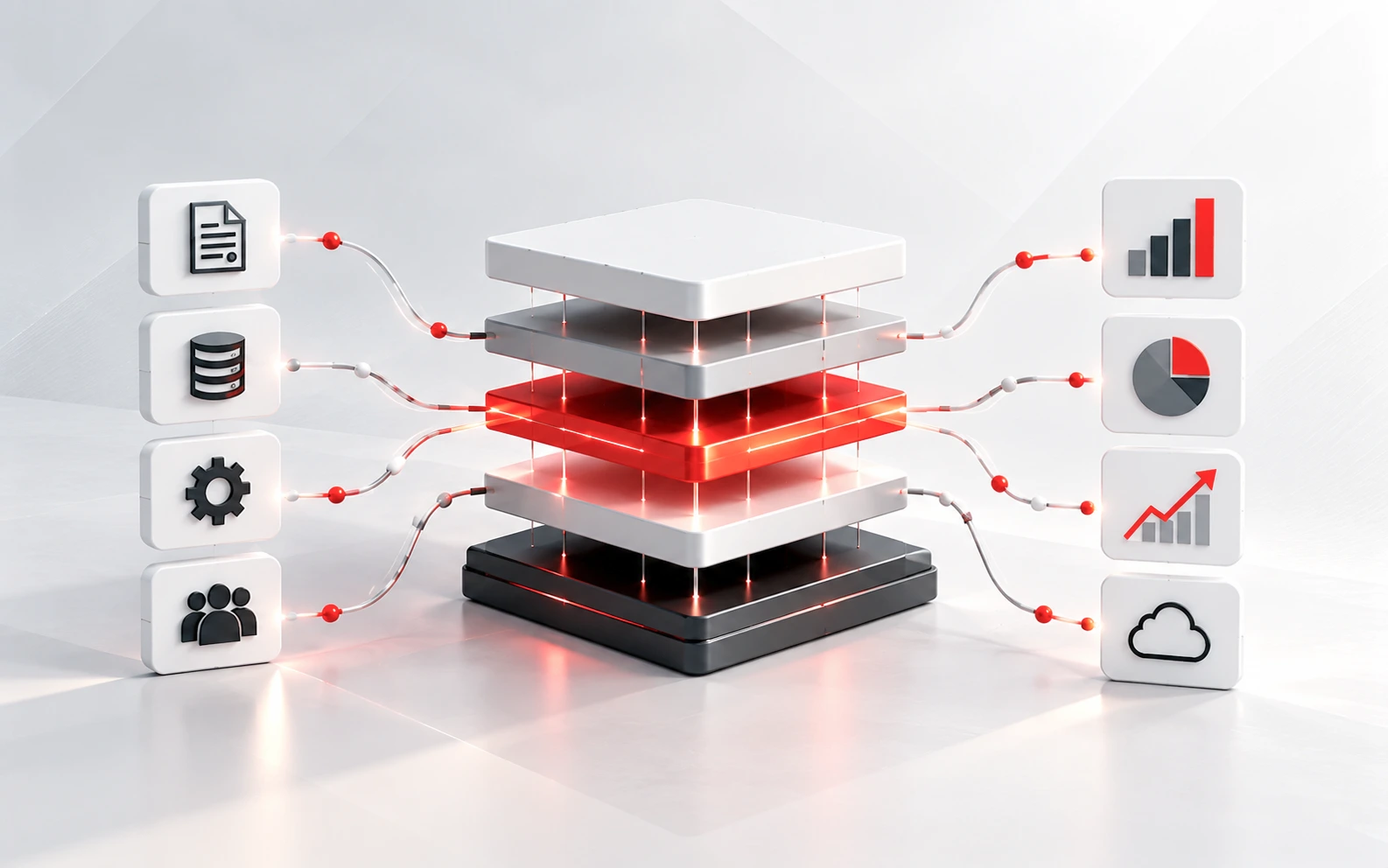
A useful way to understand the architecture is as a set of interconnected layers.

The first layer is the business-event and experience layer. Work can begin with an email, document, system event, user request, exception, scheduled activity, or a threshold breach. A GBS agent should not always require a human to open a workflow manually. It can respond to relevant business events and initiate the appropriate process.

The second layer is the agentic intelligence layer. This contains domain-specific agents responsible for meaningful business outcomes rather than tiny individual tasks. Examples could include an invoice resolution agent, supplier risk agent, reconciliation agent, close management agent, employee lifecycle agent, or IT service agent. The goal is not to create an agent for every button click. Agent boundaries should represent meaningful responsibilities.

The third layer is orchestration. This coordinates agents, workflows, APIs, RPA, business rules, and human interventions. It maintains the process state and determines what should happen next based on current context and outcomes.

The fourth layer is knowledge, context, and memory. Agents need access to the information required to make an operational decision: policies, SOPs, approval matrices, transaction history, contracts, supplier records, customer information, employee data, entity configurations, and other enterprise knowledge. Without that context, a powerful language model remains disconnected from the actual GBS operating environment.

The fifth layer is enterprise integration and execution. Agents must be able to act through APIs, ERP interfaces, RPA, databases, workflow platforms, document repositories, email, ITSM tools, and legacy applications. Auxiliobits’ existing Agentic AI architecture describes this combination of LLMs, enterprise data, APIs, RPA, and other execution mechanisms as the foundation for agents that can reason and act across enterprise systems.

The final layer is governance and observability. Every meaningful action needs the appropriate identity, authorization, policy controls, monitoring, auditability, and human-oversight mechanisms.

These layers should not be treated as isolated technology components. They form an operating system for coordinated GBS work.

One of the biggest misconceptions about agentic AI is that it makes RPA irrelevant.

In practice, the two technologies can serve different roles.

An agent may determine that a supplier record needs to be updated, but the actual ERP environment may expose no suitable API. An existing UiPath automation may already be capable of performing that interaction reliably. In that scenario, the agent does not need to replace the bot. It can use the bot as an execution capability.

This creates a useful separation between decision and execution.

The agent determines what needs to happen and why. The orchestration layer determines which approved capability should execute it. RPA performs deterministic UI-based actions where necessary, while APIs and other integrations handle tasks that can be executed programmatically.

Auxiliobits’ RPA-to-APA framework makes this distinction explicit: the agentic layer manages outcomes and context, while RPA remains a practical execution mechanism alongside cognitive services, APIs, orchestration, and memory/context capabilities.

This is particularly important for GBS organizations with years of investment in automation. An agentic transformation does not need to mean abandoning the existing automation estate. It can mean making that estate available to a more intelligent coordination layer.
The strongest GBS use cases are often not isolated tasks but business outcomes that require several towers to cooperate.

Employee onboarding is a straightforward example. Instead of optimizing HR, IT, payroll, and facilities independently, an agentic architecture can manage the outcome of having the employee fully ready for work by the required date. If HR information is incomplete, the system can request it. If an approval is pending, it can follow up. If an IT provisioning step fails, it can raise or route the appropriate issue. When a dependency is resolved, the process can continue without requiring a person to manually restart it.

The same principle applies to supplier onboarding, customer disputes, month-end close, master-data management, intercompany reconciliation, and regulatory reporting.

The key question for GBS leaders therefore changes from “Which process should we automate next?” to “Which business outcomes currently consume the most human coordination across towers?”

Those outcomes are often where Agentic AI can create the greatest architectural advantage.
A common mistake is to design agents around applications. An enterprise might create an SAP Agent, Workday Agent, ServiceNow Agent, and Salesforce Agent. While technically convenient, this can reproduce application-centric silos.

A better model is to design agents around business responsibilities.

Supplier Compliance Agents can use information from procurement platforms, ERP, document repositories, compliance databases, and email. A close management agent can coordinate ERP transactions, reconciliations, tickets, approvals, and reporting. An employee lifecycle agent can work across HR, payroll, identity, IT, and facilities systems.

This creates an architecture aligned with the way GBS actually delivers services rather than the way enterprise applications happen to be purchased.
At a high level, agentic execution follows a recurring operational pattern: the system receives a goal or business event, understands the context, determines a plan, selects the appropriate tools, executes actions, validates the outcome, records the result, and either continues or escalates.

The distinction from a traditional workflow is that the path does not necessarily have to be completely predetermined.

For an invoice exception, an agent may discover that the purchase order is valid but the quantity differs. It can determine which validation is required, retrieve the relevant information, apply the permitted business rules, and decide whether the exception can be resolved or needs human intervention. If a downstream system fails, the architecture can treat that failure as a state requiring recovery rather than simply terminating the entire process.

This does not mean the agent has unlimited freedom. It means the architecture gives the agent bounded flexibility within a controlled operating environment.

That is the essence of enterprise Agentic AI.

Our Platform Approach—UiPath Agentic Orchestration + Claude/Azure AI

Our Platform Approach
Agentic GBS architecture should build on the enterprise technology organizations already have rather than assuming that every existing platform needs to be replaced. The technical foundation can be understood through Auxiliobits’ Tech Stack Behind Agentic AI in the Enterprise and Implementing APA with UiPath. These resources describe the components required to move from an AI model to an enterprise-capable agentic system, including LLMs, orchestration, memory and context, tool and API integration, execution environments, and observability.

For GBS, the same foundation needs to be extended horizontally across towers and processes.

01The LLM Is One Component, Not the Architecture

Claude or Azure AI can provide important cognitive capabilities for an enterprise agent. A model can interpret emails, documents, contracts, tickets, explanations, and other unstructured information. It can help classify situations, summarize context, evaluate possible actions, and support decision-making.

But the model itself does not know which ERP transaction it is authorized to execute, which approval matrix applies to a specific entity, whether a supplier record is authoritative, which RPA workflow should be invoked, what evidence must be retained, or when a human needs to take over.

Those capabilities come from the surrounding architecture.

This distinction is critical because many enterprise AI projects begin with the model and then try to build the operating environment around it. A GBS architecture should take the opposite view: define the business outcome, process state, data, permissions, tools, governance, and execution requirements first, then determine where AI reasoning adds value.

The LLM is the cognitive component. The orchestration layer, enterprise context, tools, identity, policies, monitoring, and execution environment turn that cognitive capability into an operational agent.
UiPath provides a practical foundation for organizations with established RPA estates and enterprise automation requirements. Auxiliobits’ UiPath architecture guidance highlights capabilities such as long-running workflows, triggers, queues, Data Service, Action Center, AI capabilities, and modular workflows that can support agentic patterns.

At the GBS scale, these capabilities can support a model in which automation becomes a reusable execution layer.

For example, an agent determines that a transaction must be updated in an ERP system. The orchestration layer checks which approved execution mechanism is available. If a direct API is available, the agent can invoke it. If the application requires UI interaction, the orchestration layer can invoke the appropriate UiPath automation. The execution result is returned to the orchestration layer, which validates the outcome and determines whether the broader process should continue.

This architecture preserves the value of existing automation investments while adding a more intelligent coordination mechanism above them.

UiPath also provides mechanisms for human-in-the-loop execution. Auxiliobits’ implementation guidance describes Action Center for escalation and exception handling, Data Service for context and process state, queues for coordination, and long-running workflows for persistent processes.

That makes the platform particularly relevant to GBS processes that do not complete in a single transaction.
The AI layer provides the reasoning and language capabilities needed to handle the parts of enterprise work that are difficult to encode as deterministic rules.

An agent may need to interpret a supplier email, compare a contract clause with policy, summarize a reconciliation exception, determine whether documentation satisfies a requirement, or explain why a particular transaction should be escalated.

Claude can serve as an LLM within that architecture, while Azure AI can provide enterprise AI capabilities within organizations that have standardized on the Microsoft ecosystem. The appropriate model and deployment approach will vary by use case, data sensitivity, latency requirements, cost, and enterprise architecture.

The key principle is to avoid making the model provider the architectural center of gravity.

Models will evolve. Enterprise architecture should not need to be rebuilt every time the preferred model changes.

The durable layer should be the orchestration and enterprise integration architecture that connects models to business context and controlled actions.
At a conceptual level, the platform can be viewed as a sequence of connected capabilities. At the top are business users and business events. These initiate or trigger work. Below that is the GBS agentic orchestration layer, which manages process state, routes work, coordinates agents, and applies policy. The next layer contains specialized domain agents that reason about particular business responsibilities. Below the agents sits the AI and knowledge layer, combining LLM capabilities with enterprise data, policies, documents, historical context, and other knowledge sources. The execution layer then connects to APIs, UiPath, workflow engines, databases, and other automation capabilities.

Finally, these capabilities act on the ERP, CRM, HR, procurement, ITSM, legacy, and other enterprise systems that remain the systems of record. Governance, security, monitoring, and auditability operate across all of these layers rather than being added after implementation.

This architecture creates a clear separation of responsibilities. The model provides intelligence. Agents provide business-oriented reasoning. Orchestration provides coordination. Automation provides deterministic execution. Enterprise systems provide transactional truth. Governance provides control.
The strategic advantage of this approach appears when the organization moves beyond the first use case.

If every agentic AI initiative builds its own authentication, knowledge retrieval, orchestration, monitoring, human-escalation, and integration patterns, GBS will end up with another collection of disconnected technology projects.

A shared architecture allows capabilities to be reused.

The first supplier agent establishes identity and access patterns. The next finance agent can reuse them. The first multi-step orchestration establishes process-state management. The next HR use case can reuse it. The first human-escalation mechanism establishes approval and intervention patterns that can then be applied to procurement, finance, and IT.

This is how Agentic AI becomes a GBS capability rather than a series of isolated proofs of concept.

Auxiliobits’ Enterprise AI Operating System similarly positions orchestration, agents, enterprise systems, data, and governance as components of an enterprise-wide operating model rather than isolated AI experiments.
Autonomy should never be treated as a binary decision.

A GBS process can contain tasks that are fully deterministic, decisions that can be made within defined thresholds, and situations that require human judgment.

A useful autonomy model might therefore distinguish between routine actions that can be executed automatically, decisions that can be recommended for approval, actions that can be performed automatically within predefined thresholds, and high-risk or ambiguous cases that must be escalated.

For example, a reconciliation agent may be permitted to resolve a small, well-understood variance when all supporting evidence matches defined rules. A material variance may require human approval. A transaction involving an unusual legal entity, sensitive data, or an uncertain policy interpretation may be automatically routed to a specialist.

This approach makes autonomy measurable and governable.

The goal is not maximum autonomy. The goal is appropriate autonomy.

Governance and Guardrails at GBS Scale

Governance and Guardrails at GBS Scale
Agentic AI changes the governance question from “Who owns this bot?” to “Who is accountable for the decisions, actions, data access, and outcomes produced by this agent?”

That distinction becomes critical when agents operate across multiple GBS towers and enterprise systems. A single error in an isolated workflow may affect one process. An incorrectly designed autonomous decision that propagates across interconnected processes can create a much larger operational, financial, compliance, or reputational impact.

Auxiliobits’ Agentic Process Automation approach explicitly treats governance as foundational to scaling autonomous workflows, with controls around accountability, risk, monitoring, compliance, and autonomous behavior.

01Governance Must Be Embedded in the Architecture

A governance framework that exists only as a policy document is not sufficient.

Controls need to be translated into technical behavior.

If policy states that payments above a certain threshold require approval, the payment agent should technically be unable to complete the transaction until an authorized approval state exists. If supplier-bank changes require additional verification, the supplier agent should not be able to bypass that control simply because it has sufficient confidence in the request.

This is the difference between governance as documentation and governance as architecture.
Every agent should have an identifiable identity and an explicitly defined access scope.

The organization should be able to determine which agent acted, which systems it accessed, what permissions it used, what actions it performed, and under whose authority it operated.

Least-privilege access becomes particularly important because an agent may be able to access several systems to complete a business outcome. The fact that an agent can technically access a system does not mean it should have unrestricted permissions within that system.

A supplier compliance agent may need to read supplier records and documents, but it should not automatically have authority to release payments. A reporting agent may need access to financial data, but it should not be able to post accounting entries.

The permissions should reflect the business responsibility of the agent.
GBS agents can potentially interact with sensitive financial, employee, customer, supplier, contractual, and operational information.

The architecture should therefore define what data an agent can retrieve, what information can be passed into an AI model, how sensitive information is handled, how data is retained, and which contexts can be shared between agents.

The objective is not simply to give agents access to “all enterprise knowledge.” It is to provide the right information for the task while maintaining the controls required by the organization.

Context should be treated as an enterprise asset with access controls, not as an unrestricted memory layer.
Not every decision should be autonomous. The architecture should define explicit boundaries based on factors such as financial value, risk, confidence, regulatory impact, data sensitivity, business criticality, and exception type.

A low-risk, repetitive transaction may be fully automated. A medium-risk decision may be automatically executed but monitored. A high-risk action may require human approval. An ambiguous situation should be escalated rather than forcing the agent to guess.

This is how organizations can increase autonomy without creating uncontrolled autonomy.
The ability to read information and the ability to change enterprise state should be treated differently.

An agent that can read an ERP record is not equivalent to an agent that can modify it. An agent that can recommend a journal entry is not the same as one that can post it. An agent that can identify a supplier-bank-change request is not equivalent to one that can change the supplier master.

Action permissions should therefore be explicitly mapped to business responsibilities.
A GBS leader should be able to answer basic operational questions about an autonomous transaction: What triggered the action? What information was used? Which agent handled it? Which tools or systems did it access? What action was taken? Was a human involved? What was the final outcome?

That does not require exposing internal model reasoning or treating a model’s generated explanation as an audit trail.

It requires operational traceability.

The architecture should maintain appropriate records of triggers, decisions, tool calls, approvals, exceptions, actions, and outcomes so that material transactions can be reconstructed and reviewed.
As multi-agent systems become more common, governance must also cover communication between agents.

A procurement agent may pass information to a compliance agent. A compliance agent may return a decision to an orchestration agent. The orchestration agent may then authorize an ERP execution step.

Every transition introduces another point at which identity, authorization, data scope, and validation need to be considered.

Auxiliobits’ enterprise security guidance emphasizes secure communication, authentication, authorization, encrypted connections, role-based access, secure APIs, and zero-trust principles for distributed agent environments.

This becomes increasingly important as GBS moves from individual agents toward multi-agent operating models.
Traditional automation metrics focus on bot uptime, transaction volume, and processing time. Agentic GBS requires a broader set of measures.

Autonomy rate measures how much work is completed without human intervention. Escalation rate shows how frequently humans are required. Goal completion time measures how quickly an agent delivers the intended outcome. Exception resolution rate shows how many exceptions the system can resolve without escalation. Rework rate measures how often an autonomous action requires correction. Cost per outcome allows the organization to compare the economics of agentic execution with the existing operating model.

These metrics are more meaningful than simply counting how many agents have been deployed.

The objective is not to maximize the number of agents.

It is to improve GBS outcomes.

Proof — Technical Overview of the Material Ledger Case Study

Proof-Material-Ledger-Case-Study-1
A practical way to understand the architecture is to examine a process where scale, system dependencies, long-running execution, exception handling, and human intervention all matter.

Auxiliobits’ material ledger case study involved a luxury apparel manufacturer operating across more than 65 European plants and 20 company codes. The monthly Material Ledger Closing process ran through SAP ECC and required finance teams to execute multiple SAP transaction codes, perform status checks, execute a six-step costing sequence, manage period locks, and monitor exceptions. The process previously consumed several days in the monthly close calendar and required skilled finance staff to spend significant time on mechanical system execution.

The interesting part of the case is not simply the time saved. It is the architecture used to make a long-running, multi-entity process reliable.

01 Start With Process State

The material ledger process could not be treated as a single transaction.

It contained multiple stages, including prerequisite validation, price determination, costing execution, background-job monitoring, final processing, period closure, and validation.

That means the automation needed to know where the process was at any given point. This concept of persistent process state is fundamental to agentic architecture. A system coordinating work across GBS cannot simply remember that a process “started.” It needs to know which actions have been completed, which are running, which failed, what should happen next, and whether a human has already resolved an exception.

Without state, long-running autonomy becomes fragile.
The case also demonstrates the importance of configuration-driven architecture.

Plant lists, company codes, and execution parameters were maintained through configuration rather than hard-coded directly into the automation. This meant that the process could scale across the organization’s operating footprint without requiring developers to rewrite the core execution logic for every new entity or plant.

This principle becomes even more important for GBS.

GBS environments change constantly through acquisitions, divestitures, new legal entities, ERP migrations, organizational restructuring, and geographic expansion.

If business configuration is embedded directly into automation logic, every organizational change becomes a development project. If configuration is separated from execution, the architecture becomes much more adaptable.
The material ledger process involved predictable SAP interactions. The solution therefore used UiPath to execute the defined SAP transactions and sequence the required activities.

This is an important lesson for agentic AI architecture: not every step needs an LLM.

Where the action is deterministic, deterministic automation is usually the better engineering choice.

An agent should not reason about whether to click a known SAP transaction if the business rule has already determined that the transaction must be executed. The agentic layer can determine that the process has reached the required state, while UiPath performs the repeatable system interaction.

This combination is more practical than trying to replace every existing automation with AI.
One of the most valuable architectural patterns in the material ledger implementation was the structured exception path.

When an exception occurred, the automation could raise a ServiceNow incident with structured information. Once the human resolved the issue, the automation could then resume from the appropriate point instead of restarting the entire process.

That is an important distinction between automation that simply stops when something unexpected happens and automation that can participate in a resilient operating model.

In a GBS environment, exceptions are inevitable. The goal should not be to eliminate every exception before automation begins. The goal should be to design how the system identifies, routes, resolves, records, and recovers from exceptions.

That is where agentic orchestration can extend the value of deterministic automation.
The material ledger process also demonstrates that GBS automation rarely exists inside one application.

The implementation involved SAP, ServiceNow, configuration data, notifications, and other supporting components. The automation therefore had to coordinate more than just SAP transactions.

That is representative of most mature GBS environments.

The ERP remains the system of record, but the actual business process crosses multiple systems.

An agentic architecture therefore needs an integration layer capable of coordinating those systems rather than assuming that one application owns the entire outcome.
The case delivered a significant operational improvement. Auxiliobits reports a reduction in processing time from the previous multi-day process to approximately four hours overall, with 71 plants automated across 20 company codes, more than 1,900 annual effort hours saved, and 95%+ accuracy achieved after automation. The case also reports that the process reduced active human oversight to under one hour per month and eliminated five manual working days from the monthly close calendar.

But the strategic result is more important than the individual automation metrics.

Finance specialists were able to spend less time executing repetitive SAP transactions and more time on analysis, cost accounting insight, and financial planning.

That is the actual purpose of GBS automation: not merely to make a bot faster, but to change how scarce expertise is allocated.
The case also demonstrates why Agentic AI should not be positioned as a replacement for every form of automation.

The strongest architecture combines different technologies according to the nature of the work.

An agentic layer can determine whether the close process is ready to begin. Business rules can validate prerequisites. UiPath can execute deterministic SAP transactions. Monitoring can track background jobs. An intelligent layer can interpret an exception and determine the appropriate recovery path. ServiceNow can manage the human intervention. Once the exception is resolved, orchestration can resume the process from the correct state.

In other words, the architecture can combine AI reasoning, business rules, RPA, enterprise applications, human judgment, and orchestration without forcing one technology to do everything.

That is a much more realistic model of enterprise agentic AI.

The GBS Architecture Maturity Path

The GBS Architecture Maturity Path
Organizations do not need to move directly from traditional automation to fully autonomous multi-agent operations.

A more practical maturity path starts with deterministic automation, where repetitive and rule-based tasks are automated. The next stage introduces intelligent automation, using AI for document understanding, classification, prediction, and exception support. The organization can then introduce agentic process automation, where agents coordinate multi-step outcomes and interact dynamically with enterprise systems. The next level is multi-agent orchestration, where specialized agents coordinate across processes and GBS towers.

At the most mature stage, GBS becomes an intelligent operating layer in which business events continuously trigger coordinated digital work, with humans focused on judgment, governance, relationships, and high-value exceptions.

The progression should be based on business readiness rather than technology ambition. A process with highly standardized rules and predictable execution may be better suited to RPA. A process involving unstructured information and recurring judgment may benefit from AI-assisted automation. A process involving multiple systems, exceptions, dynamic sequencing, and cross-functional coordination may be a strong candidate for agentic orchestration.

The architecture should follow the work. Ready to move from automation to agentic orchestration?

Not every process needs an AI agent. The right approach is to match the technology to the complexity of the work. See how agentic process automation can build on your existing RPA and automation investments to coordinate more dynamic, exception-driven processes.

What GBS Leaders Should Assess Before Deploying Agents

What GBS Leaders Should Assess
The right starting point for an agentic AI program is not a model demonstration. It is an assessment of the GBS operating environment.

Leaders should examine how standardized the processes are, how many systems are involved, how much work moves between towers, where exceptions occur, how much existing RPA is already deployed, whether APIs are available, how accessible the required data is, how policies are documented, and where humans currently provide coordination rather than judgment.

The organization should also identify the decisions agents are expected to make and define the boundaries around those decisions.

This creates a more realistic picture of agentic readiness.

A GBS organization may have excellent AI models but poor process standardization. Another may have standardized processes but fragmented data. A third may have a strong RPA estate but no orchestration layer. Each organization needs a different starting point.

The objective is therefore not to ask whether the organization is “ready for Agentic AI” in the abstract.

The question is which parts of the GBS are ready for which level of autonomy and what architectural gaps must be addressed before scaling it.

From Shared Services to Intelligent Services

From Shared Services to Intelligent Services
The original value proposition of shared services was scale: centralize work, standardize processes, consolidate expertise, improve utilization, and reduce duplication.

GBS expanded that ambition by connecting towers, creating enterprise-wide capabilities, and aligning services more closely with business outcomes.

Agentic AI introduces another progression.

The future GBS is not simply a centralized organization with more automation. It is an operating environment in which work can be continuously sensed, interpreted, coordinated, executed, monitored, and escalated according to the requirements of the outcome.

A supplier issue does not have to sit in an inbox waiting for someone to determine what happens next. A reconciliation exception does not necessarily have to become another manually managed ticket. A close process does not require people to monitor every predictable stage. An employee request does not need to be manually handed from one tower to another simply because the underlying systems are separate.

The architecture can coordinate those interactions while keeping humans responsible for the decisions that genuinely require human judgment.

That is the real shift. See what intelligent automation can do for shared services Move beyond isolated automation and create connected, scalable operations across finance and shared services. Explore how intelligent automation can streamline processes, manage exceptions, and reduce the manual coordination that limits GBS efficiency.

The Architectural Principle That Matters Most

The Architectural Principle That Matters Most
The most important principle is simple: do not build an AI layer beside your GBS; build an intelligence and orchestration layer across it.

An isolated agent can improve a workflow. A coordinated agentic architecture can change how workflows interact.

That distinction will determine whether Agentic AI becomes another collection of automation projects or becomes part of the GBS operating model.

The models will continue to change. Agent frameworks will evolve. Enterprise applications will expose more APIs. Automation platforms will become more intelligent. New communication standards will emerge. But the fundamental architecture will remain the same: intelligence needs context, context needs controlled access to enterprise systems, actions need governance, and autonomous work needs measurable outcomes.

For GBS leaders, the opportunity is therefore not to replace every existing automation with an AI agent. It is to build an architecture in which the right combination of AI, RPA, APIs, workflows, enterprise applications, data, and people can coordinate work toward an outcome.

That is how Agentic AI actually works inside a GBS function.

Explore Agentic AI for GBS

If your GBS organization already has RPA, workflow automation, ERP platforms, shared services, and enterprise AI capabilities but still depends heavily on people to coordinate work between them, the next opportunity may not be more automation. It may be intelligent orchestration across the automation you already have. Explore how Agentic Process Automation can help connect AI agents, automation, enterprise systems, and human oversight into a more autonomous operating model.