






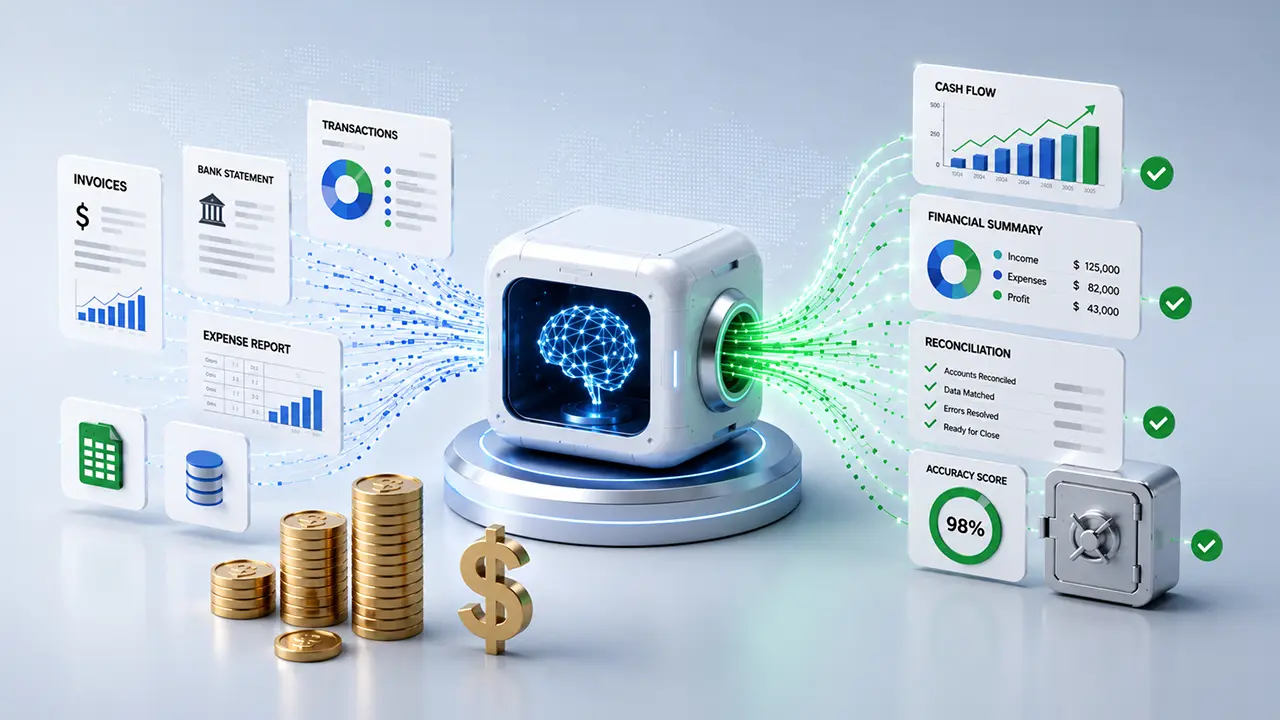
Key Takeaways
- Autonomous finance operations go beyond rule-based automation by enabling AI systems to make policy-driven decisions, execute routine financial tasks, and escalate only genuine exceptions, allowing finance teams to focus on strategic work.
- Not every finance process is equally ready for autonomy. Accounts payable and reconciliation are the most mature use cases, while treasury, forecasting, and compliance require more governance and careful implementation.
- Successful autonomous finance initiatives depend on strong data quality, integrated enterprise systems, clearly documented policies, and comprehensive audit trails rather than AI technology alone.
- Organizations should adopt a phased approach by defining trust levels, measuring touchless processing rates, and gradually expanding autonomous decision-making instead of attempting a full-scale transformation at once.
- When evaluating vendors, finance leaders should look beyond AI marketing claims and assess measurable capabilities such as autonomous transaction rates, exception handling, governance controls, and auditability to ensure long-term success.
Most finance teams have already automated something. Invoice matching is rule-based. Bank feeds sync automatically. Approval workflows route themselves. And yet, month-end close still takes days, exceptions still pile up in someone’s inbox, and a controller somewhere is still reconciling a spreadsheet at 9 p.m.
That gap between “We’ve automated parts of finance” and “Finance runs itself, with humans directing exceptions and strategy” is exactly what autonomous finance operations is designed to close. Instead of automating isolated tasks, autonomous finance operations connects processes, intelligence, and decision-making so finance teams can move from reacting to exceptions to proactively managing them.
This isn’t another “AI is changing finance” overview. If you’re already evaluating autonomous finance operations, you don’t need convincing that the category exists. You need help distinguishing genuine autonomous finance operations from rebranded automation, understanding what it actually costs to implement successfully, and knowing which questions separate a platform that will stand up to an audit from one that simply automates more manual work.
What “Autonomous” Means and Where the Term Gets Misused
It’s worth being precise, because “autonomous” has become one of the most overused words in finance software marketing. A significant share of tools marketed as autonomous are, underneath, the same deterministic rule engines finance teams have used for a decade, just with a new label.
Traditional automation executes a predefined rule: if the invoice matches the PO within tolerance, auto-approve it. It’s fast and deterministic but brittle — anything outside the rule kicks back to a human, and someone still has to write and maintain every rule.
Assisted intelligence adds a recommendation layer on top: the system suggests a GL code or flags a likely duplicate, but a person still makes every decision. This is where a large portion of “AI-powered” finance tools actually sit today.
Autonomous finance operations is a different tier. It combines automation with genuine decision-making: systems that interpret unstructured inputs (a vendor email, an unusual invoice, a cash flow anomaly), apply judgment based on policy and historical precedent, take action, and escalate only the exceptions that genuinely require a human. The finance team’s role shifts from executing transactions to supervising a system that executes them.
The Four-Tier Autonomy Model
Use this model to sanity-check any vendor’s claims, including your own current tools:
| Tier | Description | Human role | Failure mode if misclassified |
| Tier 0 — Manual | Every step performed by a person | Executor | N/A |
| Tier 1 — Automated | Rules-based systems handle defined, structured tasks | Rule-writer, exception-handler | Silent failure when inputs fall outside the rule set |
| Tier 2 — Assisted | The system recommends; human decides and acts | Approver | Recommendation fatigue — humans rubber-stamp without real review |
| Tier 3 — Autonomous (bounded) | The system decides and acts within defined policy tiers; escalates true exceptions | Supervisor | Policy gaps get exploited or missed if audit trail is weak |
Most finance organizations sit at Tier 1, moving toward Tier 2. Genuine autonomous finance operations mean a deliberate, governed move into Tier 3, not by removing controls, but by encoding them into the system so they execute automatically instead of depending on a person remembering to apply them.
A useful vendor-screening question: ask any vendor to show you, specifically, what percentage of their “autonomous” transactions are actually resolved without any human touch versus routed to a human queue with an AI-generated suggestion attached. The gap between those two numbers tells you which tier you’re actually buying.
Why This Is Gaining Urgency Now
A few forces are converging to make this shift less optional than it used to be:
- Transaction volume is outpacing headcount growth. Finance teams are expected to support scaling revenue without scaling proportionally, which means the marginal transaction has to get cheaper to process.
- The talent gap in accounting is real. Fewer graduates are entering the profession, and experienced finance talent increasingly wants to spend time on analysis, not data entry.
- Real-time expectations have shifted. Boards and executives increasingly expect near-real-time visibility into cash, spend, and forecasts — not a report that’s three weeks stale.
- Decisioning technology has matured enough to be trustworthy for bounded, policy-driven tasks. This is the piece that’s genuinely new. Five years ago, “autonomous” in finance meant more automation scripts. Today it means systems that can reason over context, not just match fields — though as above, this maturity varies significantly by vendor.
None of this means finance leaders should adopt autonomous operations for their own sake. It means the calculus has changed enough that a structured evaluation is worth the time.
Where Autonomous Finance Operations Applies Today and How Mature Each Area Really Is
Autonomy isn’t an all-or-nothing switch — it’s applied domain by domain, and the technology is significantly more mature in some areas than in others. Being honest about that difference matters for sequencing your rollout.
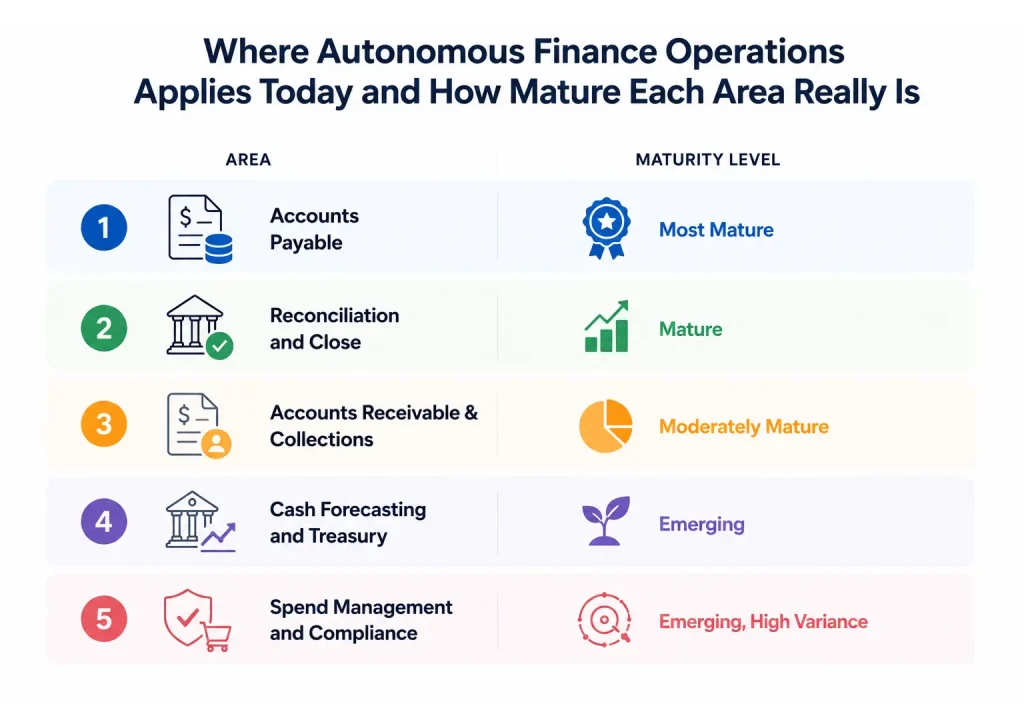
1. Accounts Payable — Most Mature
This is typically the strongest starting point. Autonomous AP systems can ingest invoices in any format, extract and validate line items, match against POs and receipts, flag genuine anomalies, and route only true exceptions for human review. Because AP is high-volume and well-understood, it’s also where “touchless rate” (the percentage of invoices processed with zero human intervention) is easiest to measure and where organizations tend to see the fastest signal on whether a system is actually performing.
2. Reconciliation and Close — Mature
Continuous, autonomous reconciliation — matching transactions across systems in near real time rather than in a month-end scramble — converts a periodic fire drill into a background process, surfacing exceptions as they occur rather than discovering them on day three of close.
3. Accounts Receivable & Collections — Moderately Mature
Autonomous AR tools can prioritize collections outreach based on payment behavior patterns, draft context-aware follow-ups, apply cash to the correct invoices even with partial or ambiguous remittance data, and differentiate genuinely at-risk accounts from simply late ones. This area requires more judgment than AP, so expect a longer tuning period before touchless rates climb.
4. Cash Forecasting and Treasury — Emerging
Autonomous systems can continuously ingest AP/AR data, bank balances, and historical patterns to maintain a rolling forecast, flagging deviations before they become urgent. The task is higher-value but also higher-stakes — most organizations don’t hand this fully to a system until they’ve built a track record elsewhere first.
5. Spend Management and Compliance — Emerging, High Variance
Policy-aware systems can autonomously approve in-policy spend and flag genuine outliers while maintaining a defensible audit trail. Maturity here varies more by industry and regulatory complexity than any other category — heavily regulated organizations should expect a longer runway.
What It Requires to Work, Not Just to Launch
This is the part that separates a rollout that sticks from a pilot that quietly gets shelved after six months.
1. Clean, connected data. Autonomous decisioning is only as good as the data it relies on. If your ERP, banking, procurement, and CRM systems aren’t integrated — or if master data (vendor records, chart of accounts, cost centers) is inconsistent — autonomous systems will make decisions on bad information faster than a human would have caught the error. In practice, data and integration work is the single most common source of timeline slippage in these projects.
2. Codified policy — not tribal knowledge. Autonomy requires that approval thresholds, tolerance levels, escalation paths, and compliance rules exist in a form a system can act on, not just in a policy PDF or in a controller’s head. Organizations with informal, exception-heavy approval cultures typically need a policy-codification phase before autonomy is realistic — this step is often the least glamorous but most predictive for whether a rollout succeeds.
3. A tiered trust model that tightens deliberately. Organizations that succeed don’t flip a switch to “fully autonomous”. They define explicit tiers — what the system can decide unsupervised, what requires human-in-the-loop approval, and what always routes to a person regardless of confidence score — and they tighten that tiering only as the system earns a track record, not on a fixed calendar.
4. Auditability by design, not as an afterthought. Every autonomous action needs a traceable record: what data the system saw, what policy it applied, what decision it made, and why. This isn’t optional in finance — “the system decided” is not an answer an auditor will accept without the supporting trail. If a vendor can’t show you a sample audit log during evaluation, treat that as a disqualifying gap, not a detail to sort out later.
5. Change management, treated as a workstream, not a footnote. The most common failure mode isn’t technical – it’s organizational. Finance teams that experience autonomy as a threat to headcount will resist it quietly and effectively, feeding the system ambiguous cases to “prove” it doesn’t work. Teams that understand the shift as a move toward higher-value work—analysis, forecasting, business partnering— tend to adopt faster and get materially more value from the same technology.
Where to Go From Here
Autonomous finance operations isn’t a single product decision—it’s an operating model shift that touches data infrastructure, policy, governance, and team structure. Getting it right starts with an assessment of where your finance function stands today, a clear view of which process is the right place to start, and a willingness to push vendors past the marketing language on “autonomous” to the specifics of tiering, audit trails, and denominators.
If it would help, we’re glad to walk through what a phased rollout could look like for your specific finance stack, including a realistic view of the timeline, sequencing, and the metrics worth tracking from week one. Reach out to talk through your environment.