






Key Takeaways
- Automation governance in finance provides the controls, documentation, and oversight needed to ensure automated financial processes remain compliant, transparent, and audit-ready.
- An effective governance framework combines regulatory alignment, centralized ownership, risk-based controls, structured change management, continuous monitoring, and independent reviews.
- Organizations should evaluate whether building governance capabilities internally or adopting a dedicated governance platform best supports their automation strategy, compliance needs, and long-term scalability.
- Retrofitting governance after automation has scaled is significantly more expensive and disruptive than embedding governance into automation initiatives from the outset.
- Regularly assessing governance maturity with a structured scorecard helps identify compliance gaps early, strengthen audit readiness, and support the safe expansion of finance automation.
Most finance organizations don’t fail audits because their automation is bad. They fail because they can’t answer three specific questions: What is running against our financial data right now? Who approved the last change to its logic? And can we reconstruct, six months later, exactly why it made a given decision?
Automation governance in finance is the discipline that makes those three questions answerable — every time, for every bot, workflow, or model touching financial data. This piece goes further than a conceptual overview. It walks through the specific regulatory frameworks examiners actually cite, what each pillar of a governance program needs to contain at the field level, how to evaluate build-vs-buy for supporting tooling, and a scorecard you can use in a vendor or framework selection process this quarter.
The Regulatory Fine Print Most Programs Miss
Generic “governance is important” content skips the part that actually matters to a buyer: which specific requirements your automation footprint is being measured against.
- SOX Section 404 / ICFR: Internal Control over Financial Reporting requires that controls be documented, tested, and attributable to an owner. A bot that posts or adjusts journal entries is, functionally, a control and should be treated as one in your control matrix, rather than being left off because “it’s automation, not a person.”
- COSO 2013 Internal Control Framework. The five COSO components (control environment, risk assessment, control activities, information & communication, and monitoring) map directly onto automation governance pillars. Auditors increasingly expect you to show this mapping explicitly, rather than simply asserting general oversight.
- Federal Reserve SR 11-7 (guidance on managing model risk). Originally written for statistical and pricing models, SR 11-7’s three lines of defense — model development, independent validation, and internal audit — are now the template regulators expect for any AI-driven financial decisioning, including fraud scoring and credit risk models built on ML.
- Basel Committee BCBS 239 (risk data aggregation). If automation touches risk reporting, BCBS 239’s requirements around data accuracy, completeness, and timeliness apply to the automated pipeline, not just the source data.
- SEC Rule 17a-4 and recordkeeping requirements. Automated decisions and the data behind them need to be retained and retrievable in the same way manual records are — a requirement many RPA implementations weren’t built with in mind.
- EU AI Act, high-risk classification. For firms operating in or serving the EU, AI systems used in creditworthiness assessment are explicitly classified high-risk, triggering conformity assessments, documentation, and human oversight requirements well beyond what most existing RPA governance covers.
If your current governance documentation doesn’t map to at least the frameworks relevant to your jurisdiction and use case, that’s the gap an examiner will find before you do.
The Five Pillars — At the Level of Detail That Actually Holds Up in Audit
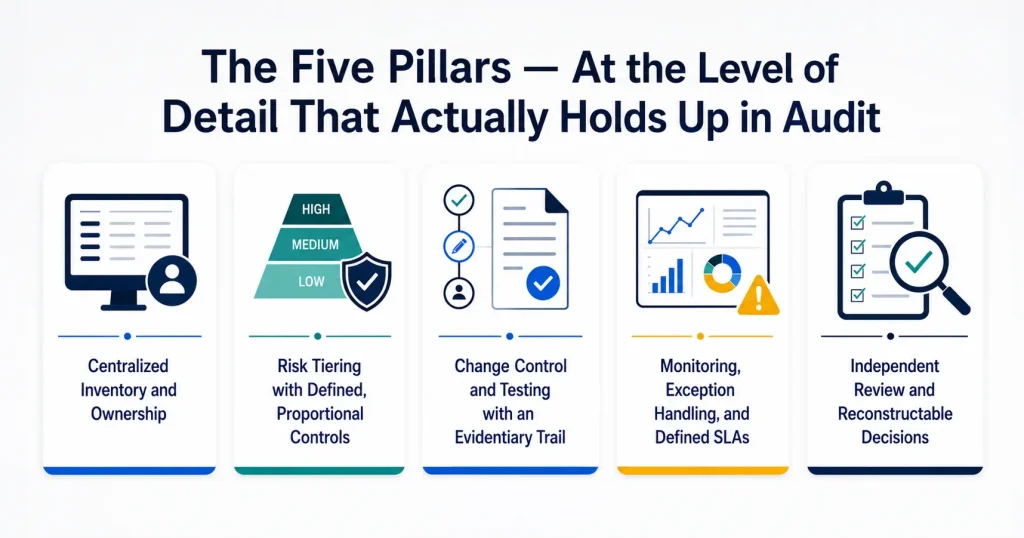
1. Centralized Inventory and Ownership
A real inventory isn’t a spreadsheet someone updates quarterly. At minimum, each entry needs:
- Unique automation ID and business process it supports
- Named business owner and technical owner (not a team distribution list)
- Systems and data fields it reads from and writes to
- Risk tier (see below) and date of last independent review
- Link to the change history and most recent test results
If your inventory can’t answer “show me every automation that writes to the general ledger” in under five minutes, it’s not audit-ready.
2. Risk Tiering With Defined, Proportional Controls
Tiering only works if each tier has concrete, differentiated requirements attached — not just a label. A workable structure:
| Tier | Example | Required Controls |
| Low | Internal report formatting | Owner assigned, basic logging, annual review |
| Medium | Invoice matching, reconciliation prep | Peer-reviewed change approval, monthly log review, semi-annual independent check |
| High | Journal entry posting, regulatory report generation | Formal change control with testing evidence, real-time monitoring, quarterly independent audit |
| Critical | Wire initiation, credit/fraud decisioning models | Dual sign-off on changes, continuous monitoring with alert thresholds, independent validation per SR 11-7 principles, documented explainability for each decision |
A program that applies the same light-touch review to a report-formatting bot and a wire-initiation bot isn’t under-governing the first — it’s under-governing the second, which is where the real exposure sits.
3. Change Control and Testing With an Evidentiary Trail
Every logic change should generate a documented business justification, a named approver distinct from the developer, before/after test case results against expected outputs, and a rollback plan. For high- and critical-tier automations, testing should include edge cases and adversarial inputs — not just the happy path. The artifact that matters in an audit isn’t “we tested it”; it’s the retained test evidence itself.
4. Monitoring, Exception Handling, and Defined SLAs
Monitoring needs measurable thresholds, not general alerting. Practical examples: an exception rate above X% within a processing batch triggers automatic escalation; any automation touching financial postings that fails silently for more than a defined window (e.g., one processing cycle) triggers a hard stop, not a queued ticket. Every exception needs a documented resolution path with an owner and a time-to-resolution SLA — “The exception queue is reviewed weekly” is not a control an examiner will accept for high-tier automation.
5. Independent Review and Reconstructable Decisions
‘Independent review’ means someone outside the building team, on a defined cadence (quarterly for high tiers, at minimum annually for lower tiers), re-validates that the automation still does what it’s documented to do. For AI-driven decisioning specifically, this includes bias testing across relevant segments and confirming the model’s explainability output still matches its actual decision logic — drift here is common and easy to miss without a scheduled check.
Build vs. Buy: Evaluating Governance Tooling
Once the framework is defined, most organizations hit a practical question: build the inventory, monitoring, and workflow tooling internally, or adopt a dedicated automation/AI governance platform? Here’s how that decision typically plays out.
| Criteria | Build In-House | Buy a Governance Platform |
| Time to first audit-ready state | 9–18 months typical, given competing IT priorities | Weeks to a few months for core inventory + risk tiering |
| Regulatory framework mapping | Manual, requires dedicated compliance/IT collaboration | Often pre-built mappings to SOX, SR 11-7, BCBS 239 |
| Cross-tool visibility | Limited to what your team instruments | Typically includes connectors across major RPA/AI platforms |
| Ongoing maintenance cost | Ongoing engineering resource required indefinitely | Vendor-maintained, subscription-based |
| Customization to internal risk taxonomy | Full control | Varies — check configurability before buying |
| Best fit for | Highly bespoke automation environments, strong internal platform engineering capacity | Organizations scaling automation faster than internal tooling can keep pace |
If you’re evaluating vendors in this space, the questions that separate a real governance platform from a dashboard wrapper are: Does it maintain a change history with retained test evidence or just the current-state configuration? Does it support tiered controls with different workflows per tier, or one generic approval chain? Does it produce audit-ready reports mapped to named frameworks (SOX, SR 11-7, BCBS 239) or generic activity logs you’d have to translate yourself?
Case Study: What Retrofitting Actually Costs
A mid-size financial services firm scaled RPA from 6 bots to more than 40 across accounts payable, reconciliations, and regulatory reporting over three years, with governance handled informally by individual process owners. During a routine external audit, the firm was asked to produce documented change approval and test evidence for bot-driven journal entries across the full inventory.
They could produce complete records for roughly a third of the bots. The remainder required manual reconstruction — interviewing original developers (two of whom had left the company), rebuilding test evidence retroactively, and formally re-classifying risk tiers for the first time. The remediation effort ran nine months, involved three full-time equivalents plus external audit support, and delayed two planned automation expansions until the framework was in place. The five-pillar structure they ended up building is functionally identical to what could have been implemented at rollout for a fraction of the cost and without the audit finding attached to their record.
The pattern holds broadly: governance retrofitted under audit pressure costs meaningfully more, in both time and dollars, than governance built in parallel with automation scale – and it comes with a documented finding that governance-by-design avoids entirely.
A Scorecard for Evaluating Your Own Program
Score each area 0 (absent), 1 (partial), or 2 (fully in place):
- Centralized inventory covering 100% of automations touching financial data, with named owners
- Defined risk tiers with distinct, proportional controls per tier — not a single generic control set
- Change control producing retained, reviewable test evidence for every logic change
- Monitoring with defined numeric thresholds and time-bound escalation paths
- Independent review on a fixed cadence, including bias/drift checks for AI-driven decisioning
- Explicit mapping of your controls to the regulatory frameworks relevant to your jurisdiction (SOX, SR 11-7, BCBS 239, EU AI Act, or equivalent)
12/12: audit-ready by design. 7–11: functional but with specific, findable gaps. Below 7: retrofit risk is active and worth addressing before your next audit cycle rather than after it.
Where to Go From Here
The organizations that avoid the retrofit scenario above share one trait: they treat governance tooling and framework design as a deliberate build-vs-buy decision made early, not a compliance exercise assembled after an audit finding forces the question.
If you’re currently scoring your program against the checklist above or weighing whether to build internal tooling versus adopt a dedicated platform, it’s worth working through the specifics with someone who’s seen both paths play out. Reach out for a tailored governance assessment.