






Key Takeaways
- Scaling finance automation requires a strong operating model built on standardized processes, shared architecture, and governance—not simply deploying more bots.
- The SUGE framework (Standardize, Unify, Govern, Extend) provides a practical roadmap for expanding automation across finance without creating technical debt.
- Organizations that invest in reusable orchestration, integrated controls, and consistent governance can onboard new automations faster while improving compliance and reducing costs.
- Evaluating automation platforms for enterprise scale demands a focus on orchestration, auditability, exception handling, business-user configurability, and long-term total cost of ownership rather than pilot speed alone.
- Success should be measured by scalable outcomes such as faster process onboarding, broader automation coverage, higher straight-through processing rates, and fewer audit findings—not by the number of bots deployed.
Here’s a pattern we see in almost every finance transformation review: the first three automations are easy to justify, and the fourth is where the program quietly stalls.
Not because the technology stops working, but because no one designed for what comes after the pilot. Much of the advice on scaling finance automation treats it as a matter of doing the same thing more times. Automate accounts payable, then reconciliations, then the financial close, and eventually you’ll have an automated finance function.
That’s not what we’ve seen work. Scaling finance automation isn’t additive—it’s architectural. The organizations that succeed aren’t the ones with the most bots; they’re the ones that establish a shared operating layer before expanding beyond their third or fourth process. That foundation makes every new automation faster, more consistent, and more cost-effective to deploy instead of increasingly complex to maintain.
This guide explains our approach to scaling finance automation for finance leaders who have already proven automation’s value and are now focused on expanding it across the enterprise—securely, efficiently, and without rebuilding the same capabilities for every new process. If you’re evaluating platforms or vendors for the next phase of your automation journey, the comparison table and scorecard later in this guide are designed to help you make an informed decision.
The Real Reason Pilots Don’t Scale
Most stalled automation programs aren’t held back by technology or funding. The order in which teams made decisions holds them back. Teams automate processes first and postpone designing the operating model, only to discover that scaling disconnected automations is far more difficult than building them.
That shows up as four specific failure patterns:
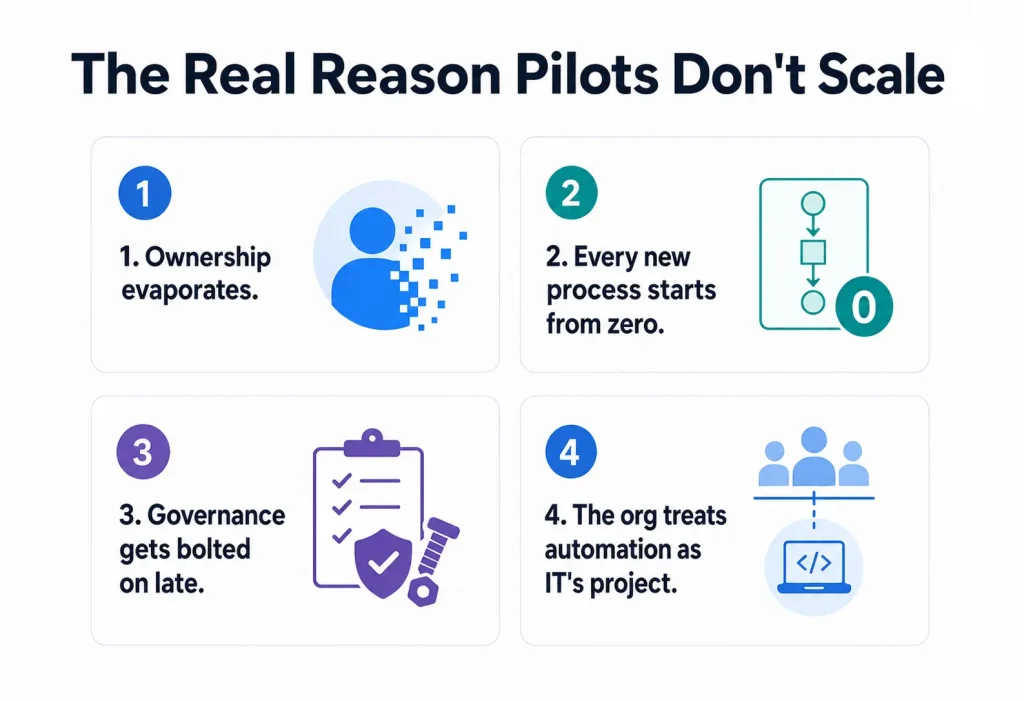
- Ownership evaporates. The pilot’s champion moves, roles change, and the automation becomes an unwanted, orphaned script that nobody wants to touch, let alone extend.
- Every new process starts from zero. Without a shared data and integration layer, each automation is its own point-to-point project – the same discovery, integration work, and testing, repeated every time.
- Governance gets bolted on late. Low-risk pilots rarely attract audit scrutiny. The moment automation touches close, revenue recognition, or intercompany processes, missing controls become a real finding, not a hypothetical one.
- The org treats automation as IT’s project. Finance teams that were not involved in the design process often distrust or bypass the automation, limiting its scalability regardless of the underlying technology.
None of these are solved by picking a better bot. They’re solved by sequencing governance and architecture ahead of the third automation, not after the tenth.
The Framework: Standardize, Unify, Govern, Extend (SUGE)
We use a four-stage model with finance clients moving from pilot to enterprise scale. It’s deliberately not a maturity curve you passively climb — it’s an order of operations, and skipping a stage is the single most common reason programs stall.
- 1. Standardize — Document one authoritative version of each core process (close, AP, AR, and reconciliations) before automating it. If three business units run differently, you are not automating a single process; you are automating three separate processes, and you will pay for that three times over.
- 2. Unify — Put a shared orchestration and data layer underneath every automation, so ERPs, banks, and reporting tools are integrated once and reused, not re-integrated per project. This is the single biggest driver of whether your fifth automation takes five weeks or five months.
- 3. Govern — Build audit trails, exception routing, and human-review thresholds into the automation design itself, calibrated to the risk of the process – not as a control layer added after the audit asks questions.
- 4. Extend — Only once 1–3 are in place do you expand into higher-value, higher-risk territory: forecasting support and intercompany embedded controls in reporting. This is where automation stops being a cost-saving side project and starts changing how finance operates.
Most finance functions we talk to have real Stage 1 work done — a few standardized, automated processes — but jump straight to “extend” without ever building Stage 2 or 3. That’s the plateau. It’s not a technology gap; it’s a sequencing gap.
Case in Point: A Mid-Market Manufacturer
A manufacturing client came to us with three working automations — AP three-way matching, a bank-reconciliation macro, and a close checklist tool — each built by a different team, on different platforms, with no shared audit trail. Automation was “working,” but every new request meant a new point-to-point build, and an internal audit had flagged inconsistent controls across the three.
We didn’t touch the automation logic first. We consolidated all three onto a single orchestration layer (Stage 2), standardized the underlying close and reconciliation processes across their four business units (Stage 1, done in parallel); and built one governance model with consistent exception routing and audit logging across all three processes (Stage 3).
Within two quarters:
- Time to onboard a new automated process dropped from roughly 10–12 weeks to under 3 because the integration layer already existed.
- The audit flagged zero control inconsistencies in the next review cycle, versus three findings the year prior.
- The finance team added two additional automated processes (intercompany elimination support and a rolling forecast data feed) in the following two quarters — something the original point-to-point setup had made prohibitively expensive to attempt.
The technology stack barely changed. What changed was that automation number four onwards no longer required a full rebuild every time.
Comparing Approaches: What Actually Scales
If you’re evaluating how to move past your current pilots, it helps to be honest about which category of tool you’re really choosing between — these are not interchangeable, and vendors will often blur the lines.
| Approach | Good for | Breaks down when |
| Standalone RPA bots | Automating a single, stable, high-volume task fast | You need the bot to react to exceptions, or the underlying process varies by entity |
| Point-to-point integrations | Connecting two specific systems for one workflow | You add a third or fourth system — integration cost compounds instead of amortizing |
| General-purpose iPaaS / workflow tools | IT-led automation across many departments | Finance-specific controls (SOX evidence, approval hierarchies, close calendars) aren’t native and must be custom-built |
| Unified finance automation orchestration layer | Scaling across processes with shared data, controls, and audit trail built in | Requires more upfront design work before the first process goes live |
The uncomfortable truth for many buyers: the tool that made your first pilot fastest to ship (usually standalone RPA or a point-to-point integration) is frequently the same tool that makes your fifth automation slowest to add. Optimizing for pilot speed and optimizing for scale are different design goals, and most procurement processes only test for the first one.
A Scorecard for Evaluating Platforms at This Stage
If you’re actively shortlisting vendors for a scale-up phase rather than a first pilot, weight your evaluation toward these criteria — they matter far more at scale than at the pilot stage:
| Criterion | Why it matters at scale | Ask the vendor |
| Cross-system orchestration | Determines if process #5 is cheap or expensive to add | “Show me a workflow spanning three systems, live.” |
| Native audit trail & controls | Determines if governance is designed-in or bolted-on | “Walk me through evidence generation for a SOX-relevant process.” |
| Business-user configurability | Determines if finance can extend automation without a dev backlog | “Can a finance analyst modify this workflow without IT?” |
| Exception handling & human-in-the-loop routing | Determines whether scale increases risk or reduces it | “What happens when this workflow hits data it’s never seen?” |
| Total cost of ownership at 10+ processes, not 1 | Pilot pricing rarely reflects scaled maintenance cost | “What does year-two cost look like at full deployment?” |
| Change management support | Determines adoption speed across teams, not just capability | “What’s your standard onboarding model for a finance team, not just an IT team?” |
Most RFPs are still built around pilot-stage questions (Does it work, how fast can we go live?). Building your evaluation around scale-stage questions is the single highest-leverage change you can make to a vendor comparison at this point in your journey.
Metrics That Tell You If You’re Actually Scaling
Track these alongside standard efficiency metrics – they’re the ones that expose whether you’re compounding automation or just accumulating it:
- Time to onboard a new process should shrink release over release if your foundation is solid; flat or rising is a sequencing problem.
- Coverage as a percentage of core finance processes, not raw bot count.
- Straight-through processing rate across the portfolio, not per bot.
- Audit findings related to automated processes, trending toward zero, not accumulating with each new automation.
Where This Leaves You
If your team has a few working automations and is now facing the “how do we make this everywhere, safely” question, the answer almost never comes down to finding a smarter bot. It comes down to whether you standardize, unify, and govern before you extend and whether the platform you choose next was actually built for that sequence, not just for shipping pilot number one fast.
We walk finance leaders through exactly this kind of assessment, mapping your current automation footprint against the SUGE model, scoring your existing or shortlisted platforms against the criteria above, and identifying the single highest-leverage next step for your environment. Request a working session with our team to get that assessment built around your actual stack, not a generic maturity chart.