







Key Takeaways
- AI in finance delivers the greatest business value when organizations distinguish between decisions that should be automated, augmented by AI, or remain under human control.
- High-impact financial decisions require explainable AI models, strong governance, and clear human accountability to meet regulatory and business requirements.
- AI significantly improves forecasting, fraud detection, credit risk assessment, and scenario planning, but data quality remains the foundation of successful implementation.
- Evaluating AI readiness involves more than selecting the right technology—it requires reliable data, auditability, performance monitoring, and well-defined ownership.
- Organizations that strategically apply AI to enhance decision-making rather than simply automate processes are better positioned to improve accuracy, reduce risk, and gain a competitive advantage.
AI in finance is redefining how organizations make strategic, operational, and financial decisions. As finance teams manage increasing volumes of data, evolving regulations, and growing pressure for real-time insights, traditional decision-making methods are no longer enough. By leveraging AI in finance, businesses can analyze vast datasets, identify hidden patterns, predict future outcomes, and generate actionable recommendations with greater speed and accuracy. This enables finance leaders to move beyond historical reporting and embrace data-driven decision-making that supports business growth.
From forecasting cash flow and detecting financial risks to optimizing budgets and improving investment decisions, AI-powered technologies are transforming every aspect of the finance function. Rather than replacing finance professionals, AI enhances their ability to make informed decisions by automating repetitive analysis and delivering intelligent insights. In this blog, we’ll explore the role of AI in finance, its impact on financial decision-making, key use cases, benefits, challenges, and best practices for organizations looking to build a smarter, more agile finance function.
The Judgment Line: A Simple Way to Triage Any Financial Decision
Before evaluating AI vendors, comparing models, or investing in new technologies, finance leaders should first classify the decisions they want AI to support. A practical way to do this is through the judgement line—a simple decision framework that helps determine where AI should take the lead, where it should act as a trusted advisor, and where human accountability must remain non-negotiable.
Rather than asking, “Can AI do this?” the more valuable question is, “What role should AI play in this decision?” Organizing financial decisions into three categories provides a clearer roadmap for implementation while reducing operational and compliance risks.
1. Automate
These are high-volume, rules-based decisions with minimal ambiguity. The outcome is governed by predefined business rules, and the correct answer remains consistent regardless of changing business context. AI and automation can execute these tasks with speed, accuracy, and minimal human intervention, making them ideal candidates for end-to-end automation.
Typical examples include invoice matching, account reconciliation, standard transaction monitoring, routine payment processing, and data validation.
2. Augment
These decisions involve complex patterns, large datasets, and predictive analysis, but they still require human judgment. In this category, AI acts as an intelligent assistant—analyzing data, identifying trends, highlighting anomalies, and generating recommendations—while finance professionals make the final decision.
Use cases include credit risk scoring, fraud detection, cash flow forecasting, variance analysis, pricing recommendations, and financial planning. This is where AI delivers its greatest strategic value by enhancing human expertise rather than replacing it.
3. Anchor
Some financial decisions carry significant strategic, regulatory, or reputational consequences. These are typically low-frequency but high-impact decisions where accountability must remain with a clearly identified human decision-maker. While AI can simulate scenarios, evaluate risks, and provide data-driven insights, it should never be the final authority.
Examples include capital allocation, mergers and acquisitions (M&A) modeling, corporate restructuring, regulatory disclosures, executive compensation decisions, and major investment approvals.
Many AI vendors focus primarily on demonstrating the Automate layer because it delivers quick wins, faster implementation, and easily measurable ROI. However, automation alone rarely creates a lasting competitive advantage. According to KPMG’s 2026 Global AI in Finance research, the most significant improvements in decision quality, decision speed, and forecasting accuracy are achieved within the Augment layer, where AI works alongside finance professionals rather than replacing them. This is also the area where explainability, governance, and model transparency become critical, as poor recommendations or opaque models can undermine trust and introduce unnecessary risk.
A useful principle for finance leaders is simple: if you cannot clearly explain how an AI-assisted decision was reached in a concise paragraph to a regulator, auditor, or board member, that decision should not be fully automated. High transaction volumes may make automation attractive, but accountability, transparency, and regulatory compliance should always take precedence over efficiency.
Where AI Changes Financial Decision-Making
Mapped against the judgement line, here’s how the major use cases shake out.
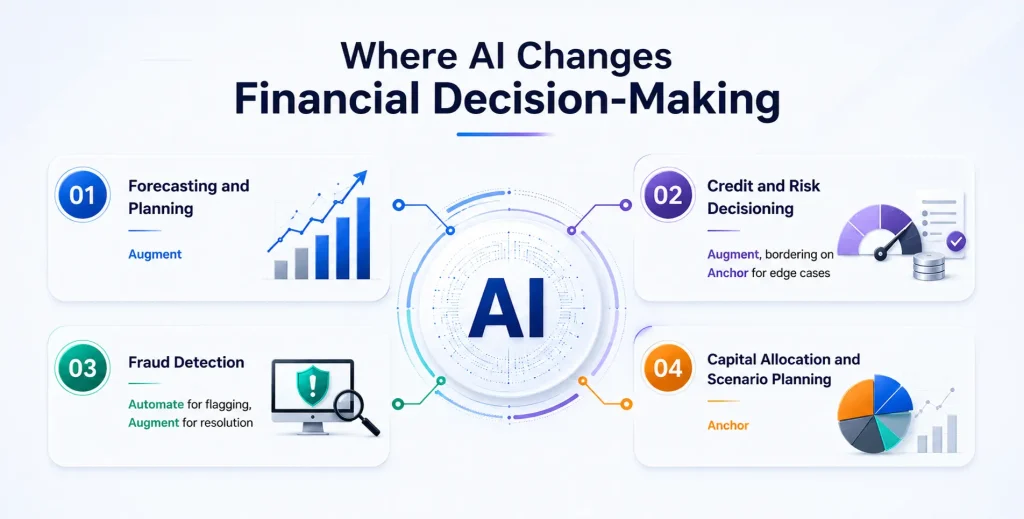
1. Forecasting and Planning — Augment
Traditional forecasting leans on historical trend lines refreshed quarterly. AI-driven forecasting ingests more variables and updates continuously, but the output is a better input to human planning, not a replacement for it. The data foundation matters more than model sophistication here: banking, with clean transactional data, sees 71% of leaders report meaningful forecast accuracy gains, versus 44% in healthcare, where data is fragmented across systems. A great model on messy data still produces a mediocre forecast.
2. Credit and Risk Decisioning — Augment, bordering on Anchor for edge cases
AI credit models can weigh far more variables than a traditional scorecard and update continuously rather than at fixed review intervals. Credit risk modeling is now one of the leading AI use cases in risk and compliance functions. The catch is explainability: research on how finance practitioners weigh AI criteria found accuracy and regulatory compliance function as non-negotiable baseline requirements, while ease of understanding determines whether the tool is trusted enough to actually get used. A credit model that can’t produce a plain-language reason for a decline isn’t ready for this bucket, no matter how accurate it tests.
3. Fraud Detection — Automate for flagging, Augment for resolution
This is the most mature AI application in finance, and for good reason: pattern recognition across transaction volumes no human team could review manually. Roughly 90% of financial institutions now use some form of AI for fraud detection. The flagging step is a clean Automate use case; deciding what to do with a flagged account still belongs in Augment.
4. Capital Allocation and Scenario Planning — Anchor
This is the newest and highest-stakes frontier — agentic AI systems that model multiple capital allocation scenarios and recommend a path. Organizations deploying agentic AI for finance report outperforming their peers by roughly 32 percentage points on average, with this growing to nearly 40 points on forecast accuracy and ROI. But this is precisely the category where a named human decision-maker needs to stay accountable for the final call, both for governance reasons and because the downside of a bad call here is the largest in the organization.
Score Your Own Organization: The AI Decision Readiness Check
Before you evaluate a specific vendor or platform, run your organization through this quick diagnostic. Answer each honestly — this is a private gut check, not a scorecard for a business case.
| Question | 0 points | 1 point | 2 points |
| Can you produce an audit trail explaining why an AI system made a specific decision? | No | Partially, with manual work | Yes, built into the workflow |
| Is the data feeding your highest-value use case centralized and clean? | Fragmented across systems | Centralized but inconsistent | Centralized and reliable |
| Do you track where AI decisions fail, not just where they succeed? | Not tracked | Tracked informally | Tracked with defined metrics |
| Is there a named human owner accountable for every Anchor-layer decision? | No | Informally | Yes, explicitly assigned |
0–2: Exploring. Focus on the data foundation and one automate-layer pilot before going further. 3–5: Piloting. You have the basics; the next unlock is building the audit trail before you scale. 6–7: Scaling. You’re ahead of most peers — fewer than half of organizations report being fully assurance-ready today. 8: Leading. You’re in the small group correlated with 3–6x higher error-reduction rates and meaningfully higher confidence in scaling AI further.
If you scored 5 or below, that’s not a cause for concern — it’s the norm. It just means the highest-leverage next step is governance and data work, not a new model.
Questions to Resolve Before You Commit
“Will this hold up to an auditor or regulator?” Ask any vendor to walk through, step by step, how one specific output would be explained during an audit. A vague answer here is disqualifying for anything above the Automate layer.
“Do we have the data to make this worth it?” Resolve the data question before the model question. More than a third of finance leaders cite data quality as both their top barrier and their top opportunity — meaning it’s usually the actual bottleneck, not the model choice.
“Are we automating the right layer?” If your entire evaluation focuses only on automate-layer use cases, you are likely missing the larger opportunity — augment-layer decision quality.
“Build, buy, or extend what we already have?” The right call depends on where the decision sits on the judgement line. Automate-layer work is often well served by extending existing tools. Augmenting and anchoring layer decisions usually lead to a more deliberate build-vs-buy evaluation, given the higher stakes.
Where to Go From Here
The organizations pulling ahead in AI-driven finance decision-making aren’t using more AI than everyone else — they’re more disciplined about where they apply it, and they build the audit trail before they chase the next use case. The judgement line and readiness check above are a starting point for that discipline, not a finished answer; the real work is applying them to your specific decision inventory.
Ready to map your own decisions against the judgement line? Book a session with our team.