





Key Takeaways
- Successful AI finance transformation begins with one high-value finance workstream instead of attempting enterprise-wide automation from day one.
- Clean data is important, but organizations should improve only the data required for a specific use case rather than delaying AI initiatives with large-scale data projects.
- The PGE Framework—Prove, Govern, Expand—helps finance teams build trust, establish governance, and scale AI adoption in a structured way.
- Governance, explainability, and human review are critical to long-term adoption, as finance leaders need confidence in AI-generated outcomes.
- Measuring business impact, user adoption, and decision quality before expanding to additional processes creates a sustainable and scalable AI-first finance function.
Building an AI-first finance function is no longer a future aspiration—it has become a strategic priority for organizations seeking greater agility, accuracy, and resilience. As finance leaders face increasing pressure to accelerate decision-making, improve compliance, and reduce operational costs, traditional automation alone is no longer enough. AI finance transformation enables finance teams to move beyond rule-based processes by leveraging intelligent technologies that automate complex workflows, generate predictive insights, and support real-time financial decision-making. From accounts payable and receivable to financial planning, reporting, and risk management, AI is redefining how finance functions operate. This blog explores the key pillars of building an AI-first finance function, the technologies driving AI finance transformation, and the practical steps organizations can take to create a smarter, more efficient, and future-ready finance organization.
Why “Fix Your Data First” Isn’t a Sequence
One of the biggest misconceptions in AI finance transformation is the belief that organizations must thoroughly clean their data before deploying AI. In reality, finance data is rarely perfect, and waiting for it to be often delays transformation indefinitely.
The real issue isn’t poor data—it’s trying to fix all the data at once. Many organizations launch large-scale data initiatives instead of focusing on the data required for a single, high-value finance process. Months later, they may have a well-managed data environment but no AI solution delivering measurable business outcomes.
A more effective approach to AI finance transformation is to improve only the data needed for one proven use case, deploy it successfully, and then build on that foundation. By combining targeted data improvements with strong governance and user adoption, organizations can create momentum and avoid getting trapped in endless data preparation projects.
The PGE Framework: Prove, Govern, Expand
One of the biggest reasons AI finance transformation initiatives stall is not a lack of technology—it is a lack of sequencing. Finance leaders often try to automate multiple processes at once, scale before trust is established, or declare victory based on a promising pilot rather than sustained adoption. The result is fragmented automation, inconsistent governance, and low business confidence.
The PGE Framework—Prove, Govern, Expand—provides a practical path for building an AI-first finance function that scales responsibly and delivers measurable value.
Prove — Start with One High-Value Workstream
Begin your AI finance transformation by selecting one finance workstream where the economics are already well understood across the industry—such as accounts payable exception handling, invoice processing, reconciliations, expense management, or month-end close activities.
The goal is not to fix every data problem in the organization. Instead, identify and resolve only the data gaps that block that specific use case, then deliver a working solution within one quarter.
What “Prove” should accomplish
- A clear baseline for cost, cycle time, and error rates.
- A production-ready workflow—not just a demo.
- Measurable business outcomes.
- Evidence that finance users will actually adopt the process.
Govern — Build Trust Before You Scale
Once the first workstream is delivering value, do not scale immediately. First, establish the governance model that will apply across every future finance automation initiative.
This means formalizing:
- Audit trails for every AI-assisted decision.
- Human-review thresholds for exceptions and high-risk transactions.
- Explainability standards that allow finance teams to justify outputs to auditors, controllers, CFOs, and regulators.
- Role-based accountability for approvals, overrides, and monitoring.
Skipping this step is one of the most common reasons AI finance transformation programs lose momentum. Finance teams rarely reject AI due to model inaccuracy; instead, they reject it because they cannot confidently explain the output to senior management.
Key insight
Trust is not a soft benefit—it is an adoption mechanism. A highly accurate model will still fail to achieve enterprise adoption if finance leaders cannot defend it in a review meeting
Expand — Scale Only After Adoption Stabilizes
After Prove and Govern are working reliably for one workstream, extend the same data foundations, governance standards, and adoption practices to the next processes.
This stage is where many transformations quietly fail.
Leadership sees early success in workstream one and immediately reallocates resources to workstream two. But if users have not fully incorporated the new process into their daily operations, the “successful pilot” often fades away within a few months.
Remember
A pilot who looks successful in month three and is quietly abandoned by month six was never truly proven—they were only new.
Why the Order Matters
The power of the PGE Framework is not in the individual steps; it is in the sequence.
Teams that Expand before they Govern often end up managing three half-adopted processes instead of one fully trusted process. In practice, that is worse than not starting at all because complexity grows faster than confidence.
Score Your Function: The PGE Readiness Rubric
Rate your organization 0–2 on each line (0 = not in place, 1 = partially in place, 2 = fully in place). This takes about five minutes and gives you an honest read on which PGE stage you’re actually in, not which stage your last vendor pitch assumed you were in.
| Dimension | 0 points | 1 point | 2 points |
| Value stream selection | AI applied broadly with no clear starting workstream | One workstream identified but not scoped or resourced | One high-value, well-understood workstream chosen and resourced |
| Data readiness (for that workstream only) | Data fragmented across entities, no owner | Data is inconsistent but the gaps are documented | Data for the chosen workstream is standardized and reconciled |
| Human review thresholds | Every output manually re-checked, no defined exceptions | Some review rules exist informally | Written thresholds define when AI output needs sign-off vs. flows through |
| Explainability | Team can’t describe how outputs are generated | Team can describe it but documentation is inconsistent | Audit trail exists and is reviewable on demand |
| Adoption mandate | Usage left entirely to individual initiative | Encouraged but not tracked | Usage measured and actively driven by leadership |
| Success metric | Success measured only by time saved on manual entry | Cycle time tracked but not tied to decisions | Forecast accuracy, cycle time, and decision quality all tracked |
Scoring guide:
- 0–4: Tinkering. You’re experimenting without a governed starting point. Don’t buy more tools — pick one workstream and start scoping data gaps this month.
- 5–8: Proving. You have a workstream in motion, but governance is informal. Prioritize writing down review thresholds before adding scope.
- 9–11: Governing. Foundation is solid on one workstream. You’re ready to formalize governance and start planning the second workstream.
- 12: Expanding. You’ve proven the pattern once. Replicate the same data, governance, and adoption approach on the next workstream — resist the urge to redesign the pattern from scratch each time.
Scored yourself and landed in Tinkering or Proving? That’s the majority of finance teams we talk to, and it’s exactly where a second, outside read is most useful — a 20-minute working session against your specific processes tends to surface which single line item is actually blocking you, which is rarely the one teams assume. [Book a PGE scorecard walkthrough →]
The Use Case Prioritization Matrix
Before picking which workstream to Prove first, run every candidate through two questions: how well-understood is the value elsewhere in finance, and how ready is your data today? Plot each candidate:
| Data Ready Now | Data Needs Work | |
| Value Well-Understood (invoice-to-cash, procure-to-pay, close reconciliation) | Start here. Fastest path to a working Prove-stage result. | Second priority — worth a scoped data sprint before starting. |
| Value Still Emerging (FP&A forecasting, scenario modeling, strategic reporting) | Interesting, but resist starting here — trust has to be earned on the well-understood cases first. | Deprioritize until at least one other workstream has cleared Govern. |
The instinct we see most often is backwards: teams want to start with FP&A forecasting because it’s the most visible to leadership, then wonder why adoption never sticks. Visibility isn’t the same as readiness. The workstreams that build durable trust are usually the less glamorous ones — reconciliation, closeness, and transaction categorization — precisely because they’re bounded enough to prove quickly and explain clearly.
A 90-Day Plan to Move One Workstream Through Prove
This is deliberately scoped to one workstream — trying to run this plan across multiple processes at once is the fastest way to re-create the “tinkering” pattern at scale.
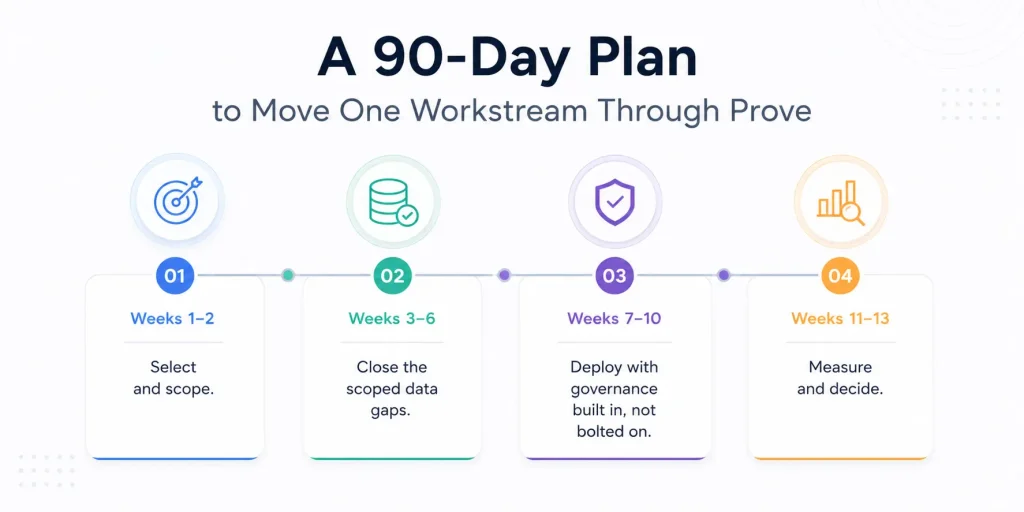
Weeks 1–2: Select and scope. Run the prioritization matrix above with your finance leadership team. Pick one workstream in the top-left quadrant. Document the specific data gaps blocking it — not a full data audit, just the fields, reconciliation steps, and entity-level inconsistencies relevant to this one process.
Weeks 3–6: Close the scoped data gaps. Standardize only what the chosen workstream needs — chart-of-accounts alignment, consolidation logic, or transaction tagging specific to that process. Resist the temptation to expand scope to “fix data properly” everywhere; that’s the paralysis trap.
Weeks 7–10: Deploy with governance built in, not bolted on. Stand up the AI-assisted workflow and, in the same sprint, write the human-review thresholds and audit-trail requirements – not as a follow-up phase but as part of the same deliverable. This is what separates governance from a compliance afterthought bolted on after adoption has already happened informally.
Weeks 11–13: Measure and decide. Track cycle time, output accuracy, and — critically — whether the team is using the AI output by default or still manually double-checking it. If adoption is genuinely holding without shadow manual work, you’ve cleared Prove and Govern. If not, the gap is almost always trust, not capability — go back to the explainability line in the rubric before adding a second workstream.
Common Objections and What We’d Push Back On
“We don’t have budget for a data project on top of an AI project.” Under PGE, there is no separate data project — data work is scoped to exactly one workstream and completed inside a 90-day window, not run as an open-ended initiative. If your team is quoting a data project measured in quarters, the scope is wrong, not the budget.
“Our team isn’t ready to hand judgment calls to AI.” They aren’t being asked to. The Govern stage exists specifically to define what stays human. If that line hasn’t been drawn explicitly yet, that’s the actual gap — not team readiness.
“We tried a pilot, and it didn’t stick.” Check it against the rubric above. Nearly every stalled pilot we’ve seen scores high on “value stream selection” and near-zero on “explainability” and “adoption mandate”. That’s a fixable, specific gap, not a reason to conclude that AI isn’t working for your team.
Where This Leaves Finance Leaders
An AI-first finance function isn’t built by fixing data in the abstract or by buying a better model. It’s built by proving one workstream end-to-end – data, governance, and adoption together – before expanding to the next one. The teams that get stuck aren’t the ones with worse technology. They’re the ones that skipped Govern or tried to Expand before Prove had actually held.
If you’ve scored yourself against the rubric above, we’d like to see where you landed. Book a session with us, and we will help you get started.