







Key Takeaways
- Finance error reduction starts by eliminating root causes, not adding more reviews.
- Measuring error debt helps build a stronger business case for automation.
- Manual processes and spreadsheets remain the biggest sources of recurring errors.
- Automation, standardized workflows, and real-time monitoring improve accuracy and efficiency.
- A proactive finance error reduction strategy enables faster closes and better decision-making.
There is no denying that finance error reduction often gets mistaken for adding more reviews. Somewhere in your finance team today, someone is double-checking a spreadsheet that someone else already reviewed yesterday. When an error occurs, the default response is another approval, another reconciliation, or another checkpoint. Over time, those layers create longer close cycles and more manual work, and yet the same errors continue to appear.
The organizations that achieve lasting finance error reduction take a different approach. Instead of adding more controls, they identify where errors originate, eliminate the process gaps causing them, and measure the real cost of leaving those issues unresolved.
That hidden cost is error debt—the accumulation of small process inefficiencies that compound over time. A few minutes of manual data entry or spreadsheet rework may seem insignificant, but across thousands of transactions, they increase risk, slow the close, and drain productivity. This article explores how to identify, measure, and reduce error debt to build finance processes that are accurate, efficient, and resilient by design.
Why Finance Error Reduction Deserves a Seat at the Strategy Table
Finance error reduction is often viewed as an operational objective, but its impact extends far beyond the finance function. Manual errors consume valuable time, delay reporting, and limit finance’s ability to deliver strategic insights. Studies from Gartner, the Association of Certified Fraud Examiners (ACFE), and Ernst & Young (EY) consistently show that many financial misstatements and operational losses stem from inefficient manual processes rather than intentional fraud.
The cost of these inefficiencies is significant. An EY survey found that finance teams spend nearly 30% of their time on manual reconciliations and correcting errors—time that could be invested in forecasting, financial planning, and business partnering instead.
In most organizations, this effort isn’t spread evenly across every process. It tends to concentrate around a handful of recurring pain points, such as intercompany reconciliations, vendor payment matching, or foreign exchange (FX) revaluations. Finance leaders already know which reports require the most rework and which processes generate the most exceptions. The challenge is that these recurring issues are rarely measured as a business cost.
A Simple Way to Measure Error Debt
You don’t need a complex assessment to understand the financial impact of recurring errors. A practical estimate can be calculated using a simple framework:
Error Debt Cost (per cycle) = (Hours spent on manual correction × Fully loaded hourly rate) + (Number of downstream errors × Average cost per escalation) + (Days of close delay × Daily cost of delayed reporting)
Consider a typical mid-market finance organization with 50–200 employees:
- 45 hours per close cycle spent on manual reconciliation and corrections at a fully loaded cost of $65 per hour = $2,925
- 6 downstream errors requiring cross-functional investigation and resolution at $400 per escalation = $2,400
- 1.5 days of reporting delays valued at $1,000 per day = $1,500
That adds up to approximately $6,825 per close cycle, or more than $80,000 annually—and that’s before factoring in audit costs, compliance risks, missed business opportunities, or employee burnout caused by repetitive rework.
Putting a number on error debt changes the conversation. Instead of treating finance error reduction as a process improvement initiative, organizations can evaluate it as a strategic investment with measurable operational and financial returns. That’s the foundation for making informed automation decisions and building a stronger business case for transformation.
The Four Biggest Sources of Finance Error Debt
Before investing in any finance error reduction initiative, it’s important to understand where errors actually originate. Many organizations focus on fixing the symptoms—adding more reviews or controls—rather than addressing the root cause. As a result, improvement efforts often fall short because the chosen solution doesn’t match the underlying problem.
The majority of financial error debt typically accumulates in four areas.
| Source | Typical Share of Total Errors* | How It Compounds | Best-Fit Solution |
| Manual data entry across disconnected systems | ~35–40% | Gradually through repetitive tasks | Automated data integration and validation |
| Spreadsheet dependency for critical processes | ~25–30% | Quickly through formula or version errors | Centralized, governed data platform |
| Inconsistent approval workflows | ~15–20% | Peaks during high-volume periods | Standardized, automated approval workflows |
| Limited real-time visibility | Amplifies all other sources | Continuously | Real-time monitoring and reconciliation |
Directional estimates based on common patterns across mid-market and enterprise finance teams. Actual figures will vary by organization.
1. Manual Data Entry Across Disconnected Systems
Manual data movement remains one of the largest contributors to finance errors. When information is repeatedly copied between ERPs, CRMs, spreadsheets, and reporting tools, every transfer introduces the possibility of incorrect entries, duplicate records, missing values, or formatting inconsistencies.
Although each task may take only a few minutes, the cumulative impact across hundreds or thousands of transactions creates significant error debt. Automating data movement and validation eliminates these repetitive risks while improving efficiency.
2. Heavy Reliance on Spreadsheets
Spreadsheets continue to be indispensable for many finance teams, but they also introduce considerable risk when used for business-critical processes. Formula errors, outdated file versions, manual edits, and limited audit trails can affect financial reporting, and they may not be detected immediately.
Unlike isolated data entry mistakes, spreadsheet errors often have a broad impact, influencing multiple reports and decisions before anyone discovers them. Reducing spreadsheet dependency through governed data platforms and automated reporting significantly improves finance error reduction efforts.
3. Inconsistent Approval Workflows
Approval processes that rely on emails, manual follow-ups, or undocumented exceptions create unnecessary control gaps. During busy periods such as month-end close, year-end reporting, or acquisitions, teams often bypass established procedures to meet deadlines, increasing the likelihood of errors reaching the general ledger.
Standardized, automated approval workflows help ensure every transaction follows the same review process while providing a complete audit trail for compliance and governance.
4. Limited Real-Time Visibility
Many finance teams don’t identify issues until the month-end close, when correcting them is far more time-consuming and disruptive. By then, the transaction context may be lost, supporting documentation may be harder to retrieve, and multiple downstream processes may already be affected.
Limited visibility doesn’t necessarily create new errors—it magnifies the cost of existing ones. Real-time monitoring, automated reconciliations, and exception alerts enable finance teams to detect and resolve issues early, preventing small discrepancies from becoming costly reporting problems.
What Effective Finance Error Reduction Looks Like
Successful finance error reduction doesn’t come from adding more reviews; it comes from preventing errors before they impact financial reporting. Organizations that consistently reduce errors typically focus on four core capabilities:
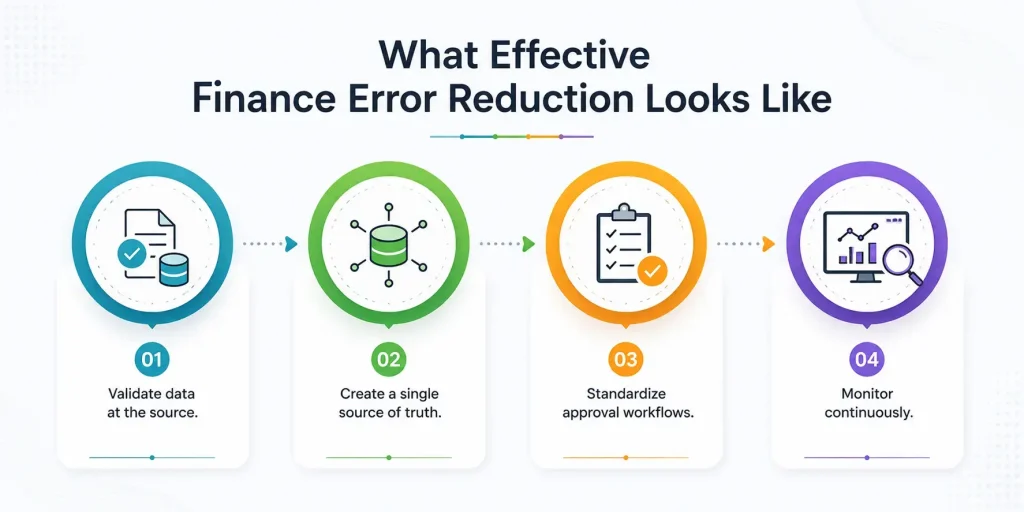
1. Validate data at the source
The earlier you identify an error, the less expensive it is to fix. Automated validation rules and anomaly detection catch issues as data is entered, preventing them from flowing into downstream processes.
2. Create a single source of truth
Consolidating financial data into a governed environment eliminates inconsistencies between systems and reduces the need for manual reconciliations, improving both accuracy and reporting confidence.
3. Standardize approval workflows
Automated approval processes ensure controls are applied consistently, reducing manual exceptions and strengthening compliance without slowing operations.
4. Monitor continuously
Real-time monitoring and automated reconciliations help teams detect and resolve discrepancies as they occur, instead of discovering them during month-end close when fixes are more costly and disruptive.
Together, these capabilities help finance teams move from correcting errors after the fact to preventing them altogether, creating faster closes, stronger controls, and more reliable financial reporting
Conclusion
Finance error reduction is no longer just an operational priority—it’s a strategic advantage. As finance teams manage growing transaction volumes and increasingly complex reporting requirements, relying on manual reviews and reactive controls only adds cost while leaving the root causes of errors unresolved.
A successful finance error reduction strategy focuses on eliminating error debt at its source. By automating data validation, reducing spreadsheet dependency, standardizing approval workflows, and enabling real-time monitoring, organizations can minimize recurring errors, accelerate the financial close, and improve confidence in every financial report.
The journey doesn’t require transforming every process overnight. Start by identifying where your team spends the most time correcting mistakes, quantifying the cost of those recurring errors, and prioritize improvements that deliver the greatest business impact. Investing in finance error reduction strengthens financial controls and frees finance professionals to focus on higher-value work such as forecasting, analysis, and strategic decision-making.
Ultimately, organizations that treat finance error reduction as a long-term business initiative—not just a compliance exercise—will be better positioned to improve efficiency, reduce risk, and build a more resilient finance function.