







Key Takeaways
- Financial reporting automation streamlines data collection, validation, reconciliation, consolidation, and report generation, enabling finance teams to produce faster and more accurate financial reports.
- Automating reporting processes reduces manual effort, minimizes spreadsheet errors, strengthens compliance, and allows finance professionals to focus on strategic analysis instead of repetitive administrative tasks.
- Organizations can improve financial visibility, accelerate month-end close cycles, and scale reporting across multiple entities, currencies, and business units without increasing operational complexity.
- Successful implementation depends on standardized financial data, seamless integration with core business systems, well-defined governance, and continuous optimization of automated workflows.
- As AI and intelligent automation continue to evolve, financial reporting automation will support continuous close, predictive insights, and more autonomous finance operations, helping organizations make faster and more informed business decisions.
Financial reporting automation is transforming how finance teams prepare, validate, and deliver critical financial reports. As organizations face increasing data volumes, stricter regulatory requirements, and growing expectations for real-time financial insights, manual reporting processes have become difficult to scale. Automating key reporting tasks helps finance teams improve efficiency while reducing the risk of errors and delays.
By streamlining activities such as data collection, reconciliation, consolidation, and report generation, financial reporting automation enables organizations to accelerate financial close cycles and produce more accurate reports. Beyond saving time, it allows finance professionals to shift their focus from repetitive administrative work to strategic analysis, helping businesses make faster, data-driven decisions with greater confidence.
What Is Financial Reporting Automation?
Financial reporting automation is the use of technology to streamline the preparation, validation, consolidation, and distribution of financial reports. Instead of relying on manual spreadsheets and repetitive data entry, organizations automate routine reporting tasks using integrated systems, predefined workflows, and intelligent technologies.
A financial reporting automation solution connects with core business applications such as ERP systems, accounting software, payroll platforms, banking systems, and CRM applications to collect financial data automatically. It then validates the information, applies business rules, reconciles transactions, consolidates data from multiple entities, and generates standardized reports with minimal manual intervention.
Modern automation solutions also provide approval workflows, audit trails, and real-time dashboards, enabling finance teams to maintain better control over reporting processes while improving transparency and compliance.
As businesses continue to grow and generate larger volumes of financial data, financial reporting automation has become an essential capability for improving reporting accuracy, accelerating financial close cycles, and supporting faster business decisions.
Why Businesses Need Financial Reporting Automation
Finance functions are under increasing pressure to deliver accurate reports more quickly than ever. Leadership teams expect real-time visibility into business performance, regulators demand greater transparency, and finance professionals must contribute strategic insights beyond traditional reporting responsibilities.
However, many organizations continue to rely on manual reporting processes that involve exporting data from multiple systems, consolidating spreadsheets, validating figures, and preparing reports manually. These activities consume valuable time and increase the likelihood of errors, particularly as businesses expand across multiple entities, currencies, and regions.
Manual financial reporting also creates operational challenges. Different departments often maintain data in separate systems, making it difficult to establish a single source of truth. Finance teams spend significant time reconciling discrepancies instead of analyzing financial performance, while version control issues and spreadsheet dependencies make collaboration increasingly complex.
Compliance requirements further add to the burden. Organizations must maintain detailed audit trails, follow standardized approval workflows, and ensure the accuracy of every financial report. Managing these requirements manually can be both time-consuming and risky.
Financial reporting automation creates a standardised reporting process that reduces manual effort, improves data consistency, and accelerates report generation, thereby addressing these challenges. Instead of spending days collecting and validating information, finance teams can focus on interpreting results, identifying trends, and supporting strategic business decisions.
Key Benefits of Financial Reporting Automation
Implementing financial reporting automation delivers value beyond reducing manual work. It enables finance teams to operate more efficiently while improving the quality, consistency, and reliability of financial information across the organization.
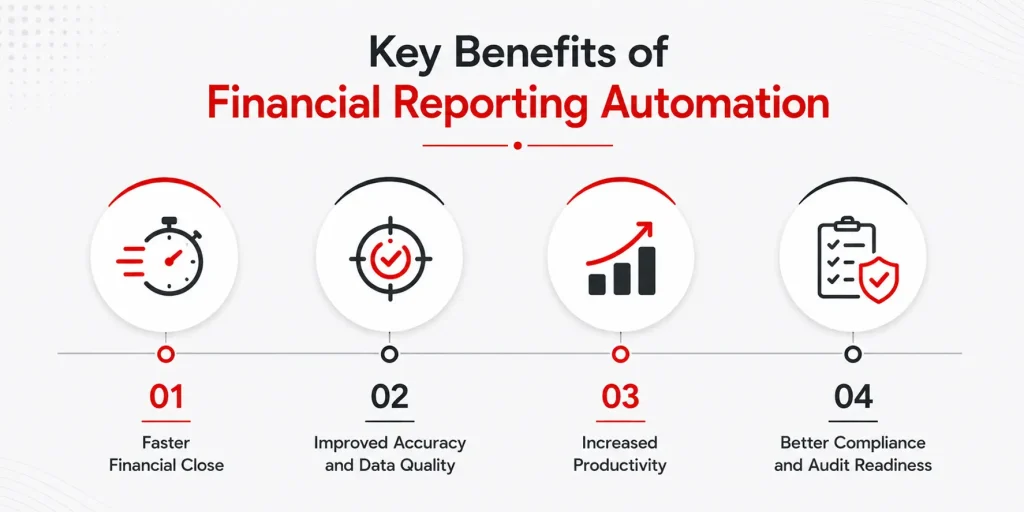
1. Faster Financial Close
Month-end and year-end close processes often require finance teams to collect data from multiple systems, reconcile transactions, validate balances, and prepare reports under tight deadlines. Manual execution of these activities can extend reporting cycles and delay critical business decisions.
Financial reporting automation accelerates these processes by automatically collecting data, validating transactions, and generating reports from standardized templates. As a result, organizations can shorten financial close cycles while ensuring reports are delivered on time.
2. Improved Accuracy and Data Quality
Manual data entry and spreadsheet-based reporting introduce opportunities for human error. Even minor mistakes in formulas or calculations can affect financial statements and decision-making.
Automation minimizes these risks by applying consistent business rules throughout the reporting process. Automated validation checks identify inconsistencies, duplicate entries, or missing information before reports are finalized, helping finance teams produce more accurate and reliable financial data.
3. Increased Productivity
A significant portion of a finance professional’s time is often spent performing repetitive administrative tasks such as compiling spreadsheets, validating figures, and formatting reports.
By automating these activities, organizations free finance teams to focus on higher-value responsibilities, including financial planning, forecasting, profitability analysis, scenario modeling, and strategic business advisory. Rather than simply producing reports, finance professionals can spend more time generating insights that support organizational growth.
4. Better Compliance and Audit Readiness
Regulatory reporting requires complete transparency and well-documented financial processes. Manual workflows often make it difficult to maintain consistent records, track approvals, or retrieve historical report versions during audits.
Financial reporting automation strengthens governance by creating standardized workflows, maintaining detailed audit trails, recording every approval, and preserving version history automatically. This simplifies audit preparation while improving compliance with internal controls and regulatory requirements.
Better Financial Visibility and Decision-Making
One of the biggest advantages of financial reporting automation is the ability to provide timely, reliable financial information. Traditional reporting methods often leave leadership teams working with historical data that may already be outdated by the time reports are finalized.
By automating data collection and report generation, organizations gain quicker access to key financial metrics, enabling executives to monitor performance, identify trends, and respond to changing business conditions with confidence. Real-time dashboards and automated reports provide greater visibility into revenue, expenses, cash flow, and profitability, helping finance become a strategic advisor rather than just a reporting function.
1. Improved Scalability
As organizations grow, so does the complexity of financial reporting. Expanding into new markets, acquiring businesses, or operating multiple subsidiaries introduces additional reporting requirements, currencies, and compliance obligations.
Financial reporting automation enables organizations to scale without significantly increasing manual effort. Automated workflows can consolidate financial data from multiple entities, standardize reporting across business units, and support global financial operations while maintaining consistency and accuracy.
This scalability allows finance teams to support business growth without becoming overwhelmed by increasingly complex reporting processes.
2. Reduced Operational Risk
Manual reporting processes often rely heavily on individual expertise and disconnected spreadsheets. If key employees are unavailable or reporting logic exists only in personal files, organizations face significant operational risk.
Automation standardizes reporting workflows and documents every step of the process, reducing dependency on institutional knowledge. This improves business continuity and ensures that financial reports are generated consistently, regardless of personnel changes.
Best Practices for Successful Financial Reporting Automation
Successfully implementing financial reporting automation requires more than selecting the right technology. Organizations should establish standardized processes and governance to maximize long-term value.
1. Standardize Financial Data
Automation performs best when financial data is accurate and consistent. Before implementation, organizations should standardize their chart of accounts, reporting structures, and data definitions to eliminate inconsistencies across business units
2. Integrate Core Business Systems
Financial reporting depends on information from multiple enterprise applications. Integrating ERP, accounting, payroll, procurement, banking, and CRM systems creates a single source of truth, reducing manual data transfers and improving reporting accuracy.
3. Prioritize High-Impact Processes
Rather than attempting to automate every reporting activity at once, organizations should begin with processes that deliver the greatest business value. Month-end close, financial consolidation, account reconciliation, and management reporting often provide the fastest return on investment.
4. Establish Governance and Approval Workflows
Automation should strengthen financial controls rather than bypass them. Clearly defined approval workflows, role-based access controls, and automated audit trails help maintain compliance while ensuring accountability throughout the reporting process.
5. Continuously Monitor and Improve
Business requirements evolve, and reporting processes should evolve with them. Regularly reviewing automated workflows, monitoring performance metrics, and incorporating user feedback helps organizations optimize reporting efficiency and adapt to changing business needs.
Organizations looking to extend automation beyond finance can benefit from broader Agentic Process Automation initiatives that orchestrate workflows across departments and automate end-to-end business processes. Similarly, Intelligent Enterprise Automation enables businesses to combine AI, analytics, and workflow automation to create more connected and resilient operations.
The Future of Financial Reporting Automation
Financial reporting automation continues to evolve as finance operations increasingly integrate artificial intelligence and intelligent automation.
Modern AI-powered solutions can identify anomalies, detect reporting exceptions, recommend corrective actions, and provide predictive insights based on historical financial data. Rather than simply automating repetitive tasks, these technologies help finance teams make faster and more informed decisions.
The emergence of Agentic AI is taking automation even further. AI agents can coordinate multi-step workflows, monitor reporting deadlines, trigger approvals, and manage routine financial activities with minimal human intervention. Finance professionals remain responsible for oversight and strategic decision-making, while AI handles repetitive operational tasks.
As organizations pursue digital finance transformation, financial reporting automation will increasingly serve as the foundation for continuous close, real-time reporting, and data-driven decision-making.
Conclusion
As financial reporting becomes more complex, organizations can no longer rely on manual processes that are slow, error-prone, and difficult to scale. Financial reporting automation enables finance teams to streamline data collection, improve reporting accuracy, strengthen compliance, and accelerate financial close cycles while reducing operational risk.
Beyond improving efficiency, automation empowers finance professionals to focus on strategic initiatives such as forecasting, performance analysis, and business planning. When combined with AI-driven capabilities, organizations can move beyond basic process automation toward more intelligent, proactive finance operations.
Businesses that invest in financial reporting automation today will be better positioned to improve financial visibility, enhance decision-making, and build a more agile finance function capable of supporting long-term growth.