







Key Takeaways
- Finance transformation combines automation with strong controls, compliance, and auditability.
- AI delivers the greatest value when finance processes mature across capture, reconciliation, reporting, and reasoning.
- Point solutions and manual reconciliations can limit automation ROI despite technology investments.
- Assessing process maturity helps prioritize the most impactful automation opportunities.
- Choose platforms based on integration, exception handling, audit trails, and measurable ROI.
Ask ten finance leaders “do you have finance automation?” and nine will say yes. Ask what that means and you’ll get ten different answers — an RPA bot that reads invoices, a bank feed that auto-categorizes transactions, an ERP with a few workflow rules bolted on. All of it counts as something. Very little of it counts as a system.
That gap — between “we automated a task” and “our finance function runs on automation” — is where most evaluation-stage confusion lives. This post exists to close it: a working definition of finance process automation, the layered model that separates real automation from decorated manual work, the failure modes that quietly cap ROI, and a self-diagnostic you can run against your stack before you sit through another vendor demo.
What do you understand by Finance Process Automation?
Finance process automation (FPA) is the use of software to execute, route, and control recurring finance workflows — transaction capture, reconciliation, approvals, reporting, and forecasting — with minimal manual intervention, while preserving an audit trail at every step.
Two words matter more than the rest: control and audit trail. A script that moves data from one system to another isn’t finance automation — it’s data plumbing. Finance automation only earns the name when it also enforces policy (who can approve what, at what threshold, with what evidence) and leaves a record that will survive an audit without a finance analyst reconstructing it from memory.
The Automation Spectrum: Four Layers, Not One Switch
Most vendors sell finance automation as a single toggle. In practice, it’s a stack, and where your organization sits on it determines what ROI is available.
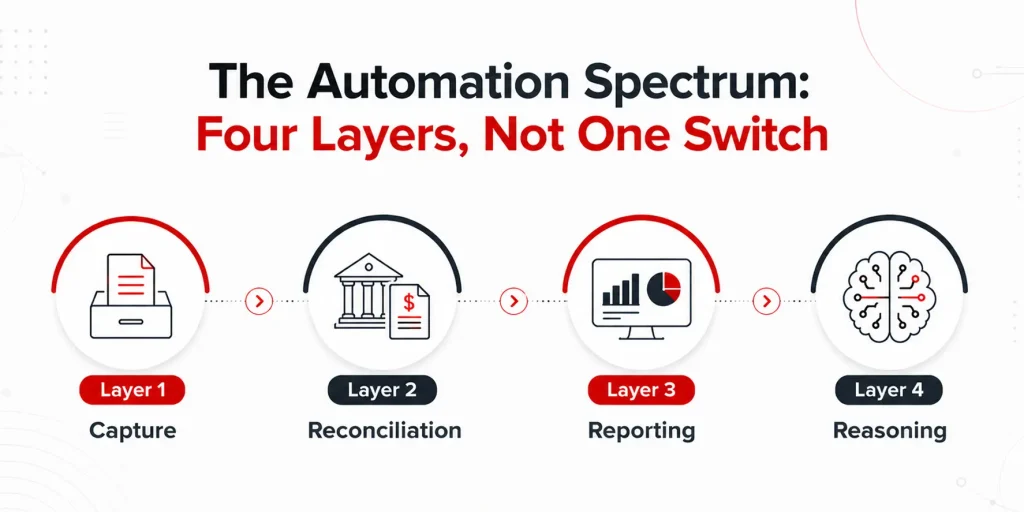
- Layer 1 — Capture. Getting transactions, invoices, and receipts into a system without manual keying: OCR, bank feeds, EDI, email parsing. This is where most companies start and where most stop.
- Layer 2 — Reconciliation. Matching what was captured against what was expected—bank statements against ledger entries, invoices against purchase orders, and subledgers against the general ledger. This is the layer where errors are caught, and it is the one most often done in spreadsheets, even at companies with a modern ERP.
- Layer 3 — Reporting. Turning reconciled data into statements, dashboards, and variance analysis without a close-week scramble. Real-time reporting only works if Layers 1 and 2 are clean; automating reporting on top of a messy reconciliation process just produces confident-looking wrong numbers faster.
- Layer 4 — Reasoning. Forecasting, anomaly detection, and scenario modeling use the automated data trail to flag potential issues, rather than just reporting past problems. Very few organizations operate here, and almost none get here without first solidifying Layers 1–3.
Here’s the diagnostic value of this model: a company can have expensive, sophisticated tooling at Layer 1 and still be functionally unautomated, because the bottleneck sits at Layer 2. Knowing which layer is actually constraining you is more useful than knowing how many tools you own.
Three Traps That Cap ROI Even With Good Tools
1. Point Solution Sprawl
Each finance sub-process gets its own best-in-class tool — one for expenses, one for AP, one for close management — none of which talk to each other. The organization can point to five automated tools and still spend twenty hours a month reconciling between them. Automation exists; integration doesn’t. ROI gets absorbed by the manual stitching work nobody budgeted for.
2. Approval Theater
A workflow tool routes approvals automatically, but the actual decision-making — checking the invoice against the contract, verifying the vendor, and confirming the budget — still happens manually before the approver clicks “approve” in the system. The audit trail shows a fast, automated approval; the real bottleneck, the judgment call, is untouched and invisible. Leadership sees improved approval-cycle metrics and concludes the process is fixed when only the paperwork got faster.
3. Reconciliation Debt
Teams automate transaction capture and reporting but leave reconciliation manual “for now,” planning to formalize it later. It never gets formalized. Every reporting cycle inherits small, uncorrected discrepancies from the reconciliation layer, and finance spends increasing time explaining variances instead of preventing them. The debt compounds silently until a close takes noticeably longer than it did the year before, and nobody can point to the single cause.
Each of these traps produces the same symptom: automation spend goes up, but hours saved plateau. If that pattern sounds familiar, the fix usually isn’t more automation — it’s automation at a different layer than the one you last invested in
Self-Diagnostic: Where Does Your Finance Function Actually Sit?
Score each row honestly against current-state reality, not against what the tools are theoretically capable of.
| Dimension | Lagging | Average | Leading |
| Transaction capture | Manual entry from paper/PDF invoices and statements | OCR/bank feeds in place, but exceptions handled manually with no clear volume threshold | Automated capture with defined exception routing and a shrinking manual-entry rate tracked monthly |
| Reconciliation | Spreadsheet-based, performed at month-end only | Tool-assisted matching, but unmatched items pile up and get “cleared” in bulk before close | Continuous/daily automated matching with real-time exception aging reports |
| Approvals | Email or paper-based sign-off, no system enforcement of thresholds | System-routed approvals, but thresholds and delegation rules are outdated or bypassed regularly | Policy-enforced routing with audit-ready logs and periodic threshold reviews tied to risk, not habit |
| Reporting | Reports built manually in spreadsheets post-close | Dashboards exist but require manual reconciliation checks before anyone trusts the numbers | Real-time dashboards sourced directly from reconciled data, with variance flags generated automatically |
| Forecasting | Static annual budget, revisited quarterly at best | Rolling forecast exists but is rebuilt manually each cycle | Forecast updates automatically from live transaction and reconciliation data, with scenario modeling built in |
Mostly Lagging: You’re likely stuck at Layer 1 of the automation spectrum, and any tooling conversation should start with capture and reconciliation before reporting or forecasting tools are considered.
Mostly Average: You have real automation with real gaps — usually at the reconciliation or approval-integrity layer. This is the most common band, and also the one where Approval Theater and Reconciliation Debt do the most damage, because the automation looks complete on a dashboard.
Mostly Leading: Your constraint probably isn’t automation coverage anymore — it’s whether Layer 4 reasoning tools (forecasting, anomaly detection) justify their cost against the marginal time they’d actually save a team that’s already fast.
What to Actually Compare When Evaluating Platforms
Most comparison guides rank vendors by feature checklist. A more useful lens is asking which layer of the automation spectrum each platform actually strengthens, because that’s what determines whether it fixes your bottleneck or just adds another point solution:
- Does it close the loop or add a link? Ask specifically how the tool handles exceptions that don’t match automatically – that’s where Approval Theatre and Reconciliation Debt hide.
- Is the audit trail native or bolted on? A tool that automates the action but logs it separately from where auditors actually look creates reconciliation work of its own.
- Can it show you its ROI math, not just its ROI claim? A vendor that can’t break down labor cost, error cost, and cycle-time savings the way this post just did is asking you to trust a number instead of verify one.
Where This Leaves You
Finance process automation isn’t a single purchase decision — it’s a maturity position on a four-layer spectrum, and most of the ROI that gets left on the table comes from investing at the wrong layer rather than not investing enough. The scorecard above should tell you, honestly, which layer is actually constraining your team right now. That’s the question worth answering before the next vendor conversation, not after.