





Key Takeaways
- Procurement-finance integration succeeds or fails based on the accuracy of critical data handoffs, including PO-to-invoice matching, vendor master data, and receipt-to-GL posting.
- Common integration issues often stem from poor data governance, one-way data flows, disconnected master data, and overly ambitious implementation strategies rather than ERP limitations.
- Selecting the right integration architecture—point-to-point, middleware, or native connectors—depends on system complexity, scalability requirements, and long-term maintenance considerations.
- Building a compelling business case requires quantifying operational savings, reducing financial risk, and demonstrating measurable improvements in reporting, compliance, and financial visibility.
- Organizations achieve the best results by strengthening master data governance first, integrating high-value workflows incrementally, and designing automation with robust exception handling from the outset.
Procurement and finance rarely disagree about what happened. They disagree about what the system says happened — and by the time anyone notices, the invoice is already three weeks overdue or the GL entry is already wrong.
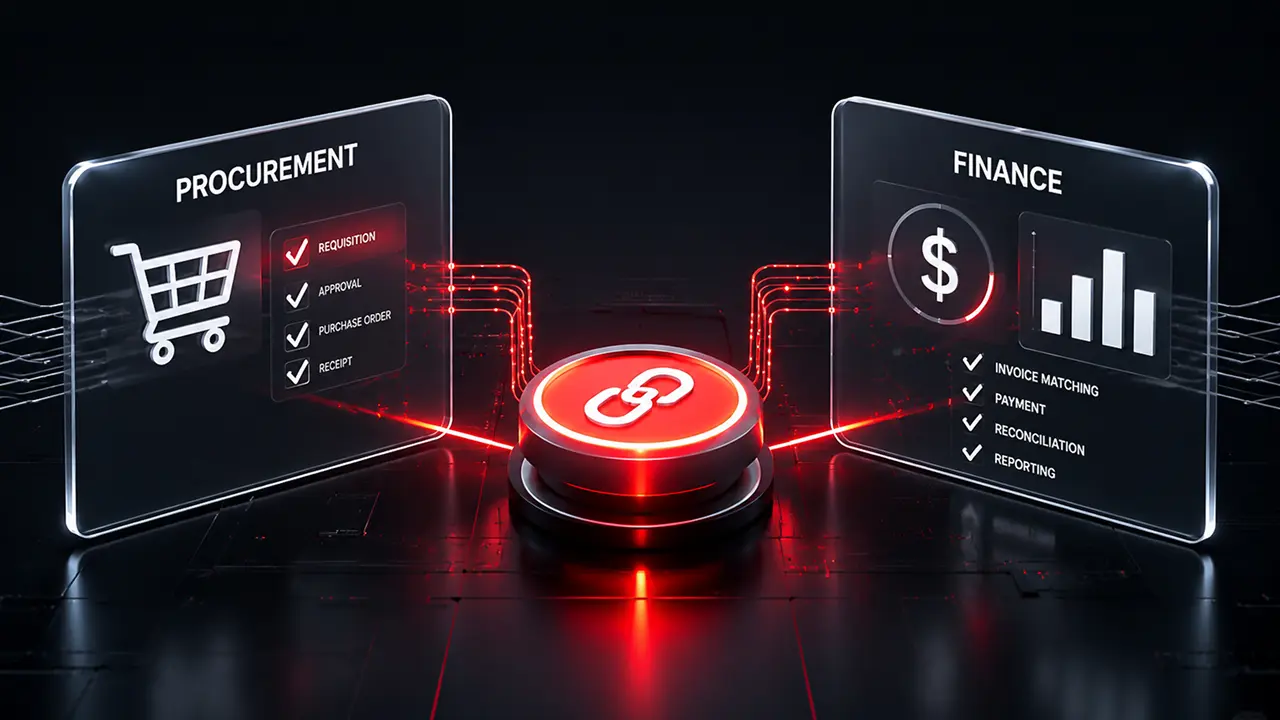
This isn’t a communication problem. It’s an integration problem. Procurement generates the data finance depends on — POs, receipts, vendor terms, tax codes — and if that data doesn’t move cleanly between systems, every downstream process inherits the gap: AP automation stalls, working capital forecasts go stale, and audit trails have holes exactly where auditors look first.
“ERP automation integration” gets sold as a plumbing fix. It’s really a data-governance decision with plumbing attached. This post breaks down where these integrations actually fail, how to diagnose your setup honestly, and how to build a business case that survives finance’s scrutiny — not just procurement’s enthusiasm.
The Three Handoffs That Actually Break
Most procurement-finance integration failures trace back to one of three data handoffs, not to the ERP itself.
PO-to-invoice matching. The purchase order lives in procurement’s system of record. The invoice arrives in AP, sometimes through a portal, sometimes as a PDF, sometimes via a supplier who never saw the PO number. If matching logic isn’t integrated at the field level — quantity, unit price, tax treatment, cost center — someone is manually reconciling exceptions, and manual reconciliation is where control first breaks down.
Vendor master data. Procurement onboards a supplier. Finance needs banking details, tax status, and payment terms to be identical in their system — not “close enough”. A single mismatched field (a stale bank account, a duplicate vendor ID under a slightly different name) is how payment fraud and duplicate payments occur. This step is the handoff most integration projects underestimate, because it looks like a data-entry problem until it’s a control failure.
Receipt-to-GL posting. Goods or services get received. That event needs to trigger a GL posting with the right accrual, the right cost center, and the right period. If receiving happens in one system and accruals are calculated in another — manually, in a spreadsheet, at month-end — your close process absorbs procurement’s timing problems.
Everything else in an ERP integration project is secondary to getting these three handoffs right.
Four Ways Integration Projects Quietly Fail
Vendors will tell you their platform “integrates natively” with SAP, Oracle, or NetSuite. That claim is often exaggerated. In practice, integration failure tends to take one of four shapes:
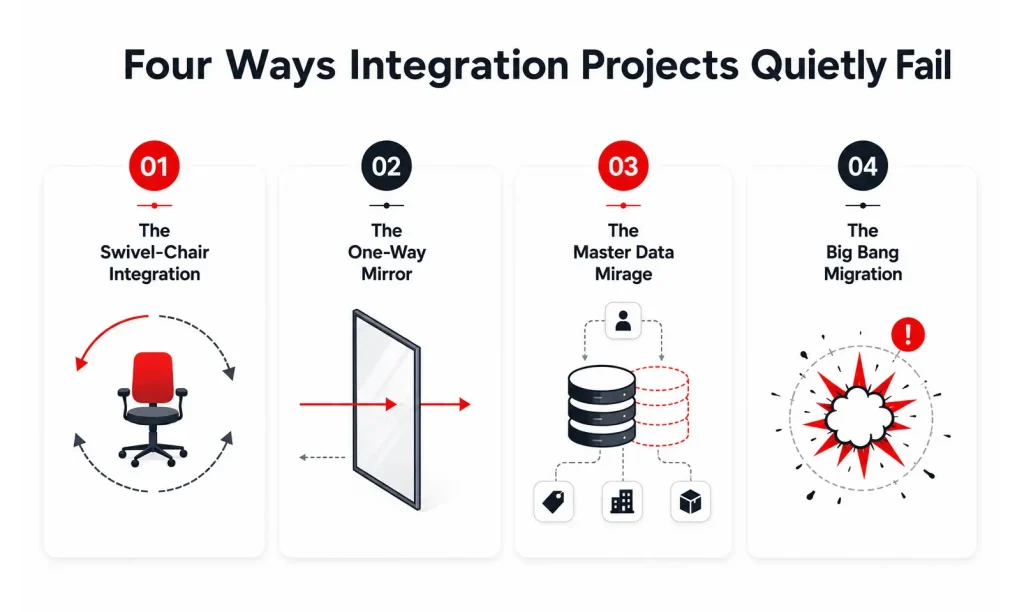
- The Swivel-Chair Integration. Two systems are technically connected, but someone still has to open both, compare screens, and manually key in what doesn’t sync — usually tax codes, cost allocations, or currency conversions that the “integration” wasn’t built to handle. The systems are connected in name; the human is still the integration layer.
- The One-Way Mirror. Data flows procurement-to-finance but not back. Finance corrects a GL code or flags a vendor as high-risk, and that correction never makes it upstream into procurement’s system. The same error recurs every cycle because nothing closed the loop.
- The Master Data Mirage. Vendor and item records look synced because they share an ID field, but the underlying attributes — payment terms, tax jurisdiction, and approval hierarchy — drift out of sync over time as each team updates its system independently. It looks integrated in a demo and fails in an audit.
- The Big Bang Migration. The team tries to integrate everything — every ERP module, every supplier category, every legacy workflow — in a single go-live. Scope creep turns a 90-day project into a 14-month one, and the business reverts to manual workarounds while waiting, which become permanent.
If any of these sound familiar, the fix usually isn’t “more integration”. It’s narrower, better-governed integration.
Point-to-Point, Middleware, or Native Connectors: Choosing an Architecture
The architecture decision shapes every failure mode above. There are three broad options, and the right one depends on how many systems you’re connecting and how often their data contracts change.
| Approach | Best fit | Main risk |
| Point-to-point (custom API calls) | Two systems, stable data structure, low integration complexity | Brittle at scale — every new system multiplies the number of connections to maintain |
| Middleware / iPaaS layer | Three or more systems, frequent schema changes, and the need for a single source of truth for mapping logic | Adds a layer to govern and pay for, but centralizes control and audit trail |
| Native ERP connectors | Procurement and finance modules within the same ERP suite | Fast to deploy, but limits flexibility if you later add a best-of-breed procurement tool outside the suite |
A common mistake is picking point-to-point because it’s fastest to ship, then discovering two years later that every new system added since has been bolted on the same way — with no shared mapping logic, no central error log, and no single place to see why a transaction failed. Middleware costs more up front and pays for itself the moment you’re integrating a fourth or fifth system.
Where Does Your Integration Actually Stand?
Before proposing a fix, it’s worth being honest about the current state. Score your organization across these five dimensions:
| Dimension | Lagging | Average | Leading |
| Data sync frequency | Manual export/import, weekly or ad hoc | Scheduled batch sync (daily/nightly) | Real-time or near-real-time event-driven sync |
| Exception handling | Exceptions surface in AP at invoice time | Exceptions flagged at PO/receipt stage, resolved manually | Exceptions auto-routed with rules-based resolution |
| Master data governance | No single owner; procurement and finance maintain separate records | One team owns updates; other team requests changes | Shared governance workflow with automated validation before either system accepts a change |
| Audit trail | Reconstructed manually during audits | System logs exist but aren’t centralized | Full transaction lineage visible in one place, PO to payment |
| Matching automation | Fully manual three-way match | Rules-based match for standard POs, manual for exceptions | Automated match with machine-assisted exception triage |
Most mid-market organizations land in “Average” on two or three dimensions and “Lagging” on at least one — usually master data governance, because it’s the least visible until something goes wrong. If that’s you, it’s not a sign the whole program has failed; it’s a sign you know exactly where the next investment should go.
What the Business Case Actually Looks Like
Finance won’t approve an erp automation integration project based on the promise of “efficiency”. They’ll approve it on a defensible calculation of what the current gap costs. Here’s an illustrative framework — the numbers below are for a hypothetical mid-market company and should be replaced with your own figures.
Illustrative example: A company processing 15,000 invoices/year
- Manual exception handling at PO-invoice mismatch: assume 12% of invoices require manual touch, at ~20 minutes each and a fully loaded AP cost of ₹600/hour → roughly ₹3.6 lakh/year in labor alone.
- Duplicate or delayed payments from master data drift: even a conservative 0.5% error rate on payment value against an average invoice of ₹85,000, represents meaningful working-capital leakage and potential early-payment discount loss.
- Month-end close delays occur due to manual accrual reconciliation: if integration removes two days from the close and finance quantifies the cost of a delayed close (covenant reporting, cash forecasting accuracy), that’s a real number finance will recognize immediately.
The point isn’t the specific figures — it’s the structure. A credible ROI case separates hard labor savings (easy to defend, easy for finance to verify) from risk-avoidance value (harder to quantify, but often larger) and from strategic value (faster close, better forecasting — real, but the hardest to put a number on). Present all three, labeled honestly, rather than folding them into one inflated “efficiency gain” figure. Finance teams are more likely to approve a modest, well-labeled number than a large, unlabeled one.
Where to Start
Given the failure modes above, the most effective sequencing is to fix master data governance first, even before touching architecture.
- Fix master data governance first, even before touching architecture. A clean, jointly owned vendor master makes every other integration decision easier and cheaper.
- Integrate the PO-to-invoice-to-GL chain narrowly before expanding to every module. This is the handoff with the clearest ROI and the least ambiguity about ownership.
- Choose middleware if you’re integrating three or more systems, even if a point-to-point fix looks faster this quarter. The maintenance cost compounds.
- Build the exception-routing logic before you automate everything else. Automation without exception handling just moves the manual work downstream instead of removing it.
Procurement-finance integration isn’t a single project with a go-live date. It’s an ongoing governance discipline that a system architecture either supports or fights against. Get the architecture and ownership right, and the automation does what it should — it fades into the background.