







- Maverick spend is typically caused by inefficient procurement processes rather than employee non-compliance. When approved purchasing routes are slower than workarounds, employees naturally bypass them.
- Relying solely on Spend Under Management (SUM) can create a misleading picture of procurement compliance. Organizations should identify the root causes of off-contract spending instead of focusing only on percentage-based metrics.
- Maverick spend generally falls into four categories—Convenience Bypass, Shadow Vendor Loyalty, Catalog Blind Spots, and Exception Creep—each requiring a different automation strategy rather than a one-size-fits-all policy.
- Procurement automation reduces off-contract spending by streamlining approvals, accelerating supplier onboarding, expanding catalog coverage, and providing real-time monitoring that prevents issues before they become widespread.
- A structured 90-day implementation focused on diagnosing spending patterns, removing high-friction bottlenecks, and automating detection can significantly reduce maverick spend while improving procurement compliance and operational efficiency.
Most procurement teams treat maverick spend as a behavior problem. Send a sharper policy memo. Run a compliance training. Remind employees, again, to use the approved catalog. And every quarter, the number barely moves.
That’s because maverick spend purchases made outside approved contracts, suppliers, or workflows is rarely about employees ignoring the rules. It’s about the rules being slower than the workaround. When the “correct” path takes three days and a phone call to a known vendor takes ten minutes, you don’t have a compliance gap. You have a design gap. And design gaps don’t close with memos; they close with systems that make the right path the quickest path.
This post breaks down why maverick spend persists even in mature procurement organizations, the four behavioral patterns that drive it, a self-diagnostic scorecard to locate your own exposure, and a transparent ROI framework for what closing the gap with automation is actually worth.
The Metric That’s Hiding Your Real Exposure
Ask most procurement leaders how much maverick spend they have, and they’ll point to one number: Spend Under Management (SUM) percentage. It’s the headline metric in nearly every vendor pitch deck, and on its face it looks like progress – 87% SUM sounds like a win.
Here’s the problem. SUM is a fraction, and fractions can be improved two ways: shrink the numerator of non-compliant spend, or quietly redefine the denominator. Reclassify a spend category as “out of scope.” Exclude a business unit that’s especially noncompliant. Count a purchase as “managed” the moment it touches the P2P system, even if it was raised after the fact to backfill an already-completed maverick purchase.
Call this the Denominator Game — and it’s worth naming explicitly because it’s the single most common way procurement teams convince themselves a problem is solved when it’s only been measured differently. A SUM percentage tells you what fraction of spend is captured. It tells you nothing about why the uncaptured fraction exists, which suppliers it’s flowing to, or what it’s costing you in lost rebates, off-contract pricing, and audit risk. If your maverick spend strategy starts and ends with a SUM dashboard, you’re managing the metric, not the leakage.
The Four Faces of Maverick Spend
In practice, maverick spend isn’t one behavior — it’s four distinct patterns, each with a different root cause and a different fix. Misdiagnosing which one you’re dealing with is why so many policy-only interventions fail.
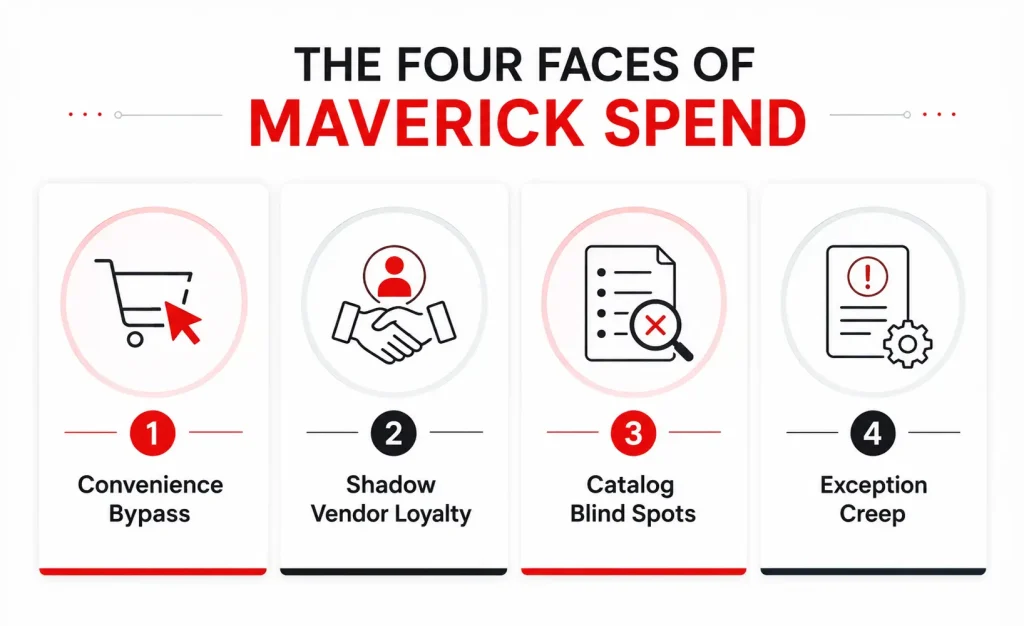
1. Convenience Bypass
An employee needs something today. The approved channel requires a multi-step requisition and a multi-day approval chain. A known vendor will deliver tomorrow with a phone call. The bypass isn’t defiance — it’s a rational response to friction. Fix the friction, and most Convenience Bypass spend disappears on its own.
2. Shadow Vendor Loyalty
A team has a long-standing relationship with a supplier who isn’t on the approved list — often because that supplier was never formally onboarded or because the relationship predates the current contract. The purchase feels legitimate to the buyer because, in their experience, it is. This pattern doesn’t respond to policy reminders; it responds to either onboarding that supplier properly or making the approved alternative genuinely comparable on service and speed.
3. Catalog Blind Spots
The punch-out catalog covers maybe 70-80% of common categories well. The remaining long-tail, urgent, or specialized items simply aren’t there. Faced with a catalog that doesn’t have what they need, employees go around the system — not out of disregard for it, but because the system gave them no compliant option.
4. Exception Creep
Every procurement system has an emergency or off-cycle path for genuine exceptions. The trouble starts when that path is easier to use than the standard one, and an entire category of “routine emergencies” migrates onto it permanently. The exception process becomes the default process, and nobody notices because each individual instance looks justified.
Each of these four patterns leaves a different signature in your transaction data — and each calls for a different automation response, which is where the next section comes in.
Self-Diagnostic: Where Is Your Maverick Spend Actually Coming From?
Before automating anything, it’s worth locating where you sit across the dimensions that actually drive maverick spend. Score yourself honestly against each — most teams discover they’re “Average” in dimensions they assumed were “Leading”.
| Dimension | Lagging | Average | Leading |
| Catalog coverage | Catalog covers core categories only; long-tail items routed manually | Catalog covers most categories; gaps known but unaddressed | Catalog dynamically expands via supplier punch-out and guided buying for long-tail spend |
| Approval friction | Multi-level manual approval regardless of value or risk | Tiered approval exists but routing is manual | Risk-based automated routing; low-risk POs auto-approve in minutes |
| Spend visibility lag | Maverick spend identified only at month-end reconciliation | Weekly reporting catches major deviations | Real-time flagging at point of transaction, before spend is committed |
| Vendor onboarding speed | New supplier onboarding takes weeks; teams route around it | Onboarding takes days; still slower than informal buying | Self-service onboarding with automated compliance checks, completed same-day |
| Behavioral incentives | No consequence or feedback loop for maverick purchases | Compliance reported to managers periodically | Nudges and incentives built into the buying workflow itself, not after the fact |
If most of your answers land in the left two columns, automation isn’t a nice-to-have efficiency play — it’s the structural fix for a gap that policy alone cannot close.
How Automation Closes Each Gap
Mapped against the four failure patterns above, automation addresses maverick spend not by adding more controls, but by removing the friction that made bypassing controls rational in the first place.
- Against Convenience Bypass, automated requisition-to-PO workflows with risk-based approval routing mean low-value, low-risk purchases clear in minutes rather than days — closing the speed gap that made the workaround attractive.
- Against Shadow Vendor Loyalty, automated supplier onboarding with built-in compliance checks shortens the path from “informal relationship” to “approved supplier,” so legitimate vendor preferences get captured inside the system instead of around it.
- Against Catalog Blind Spots, AI-assisted guided buying and dynamic catalog expansion surface compliant options even for long-tail and unusual requests, rather than leaving employees with a hard stop and a workaround as their only option.
- Against Exception Creep, real-time spend analytics flag exception-path usage as it happens — not at month-end — so a category quietly drifting onto the emergency process gets caught in week two, not in next quarter’s audit.
A 90-Day Path, Not a Policy Rewrite
Closing a maverick spend gap doesn’t require a multi-year transformation. A focused 90-day sequence is usually enough to materially move the needle:
- Days 1–30: Diagnose and map. Pull 12 months of transaction data and tag spend against the four failure patterns above, not just a binary compliant/non-compliant flag. This tells you which fix to prioritize first.
- Days 31–60: Close the highest-leverage gap. For most organizations this is catalog coverage or approval friction — the two patterns responsible for the largest share of “rational workaround” behavior.
- Days 61–90: Automate detection and feedback. Deploy real-time flagging so new maverick spend gets caught and corrected within days, not surfaced for the first time at quarterly review.
Where to Go From Here
Maverick spend isn’t a discipline failure you can train your way out of — it’s a friction problem you can design your way out of. The organizations that make real progress are the ones that stop measuring SUM percentage as the finish line and start treating it as a starting diagnostic.
If you’re trying to figure out which of the four patterns is driving your own exposure or want to see how a risk-based approval and guided-buying workflow would map onto your current catalog gaps, a deeper walkthrough — with your own transaction data, not illustrative numbers — is usually the most useful next step.