






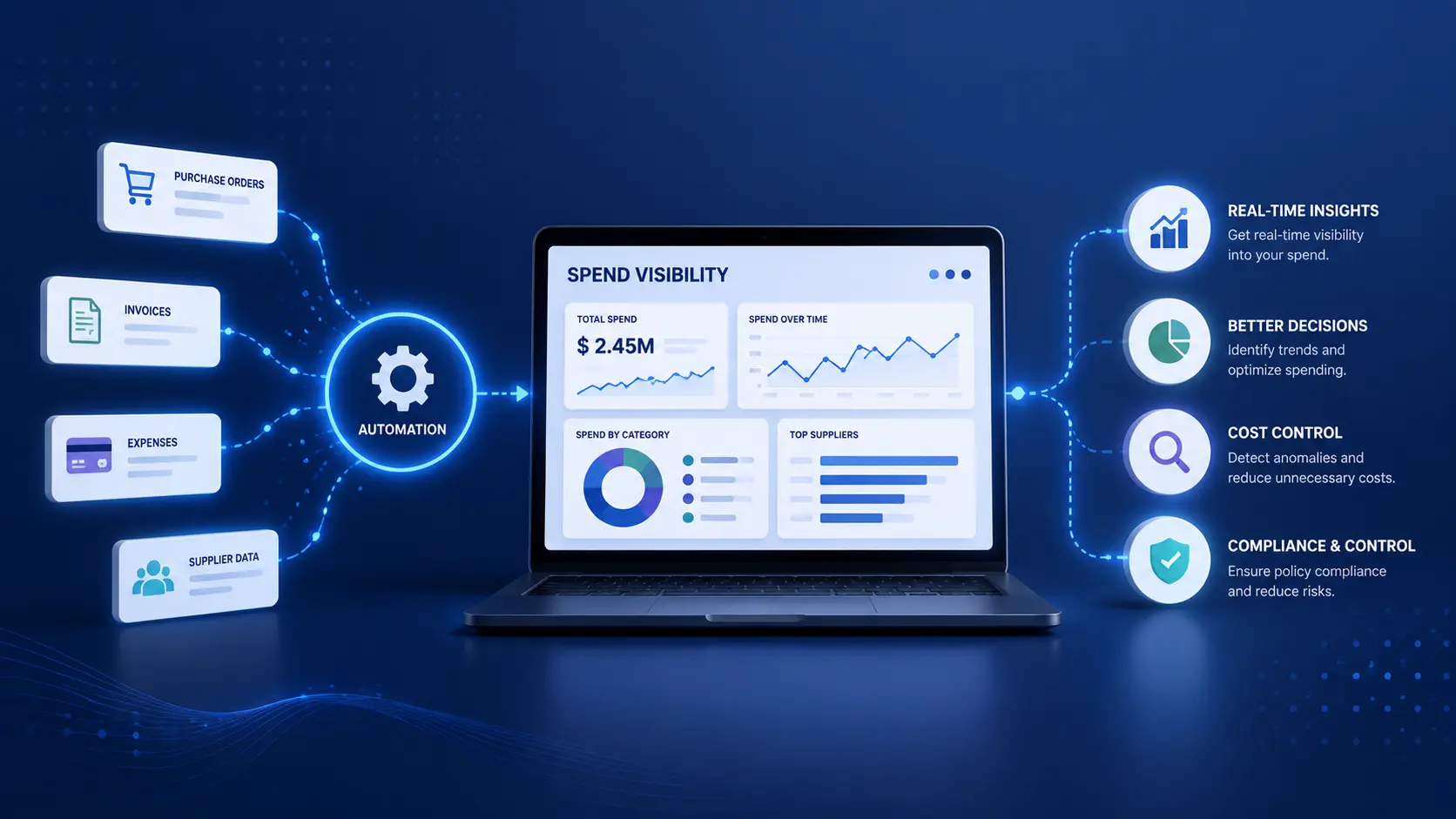
Key Takeaways
- Spend visibility is not achieved by dashboards alone; it depends on trusted, accurate, and actionable data.
- Most spend analytics initiatives fail because of implementation issues such as poor data governance, weak categorization strategies, and limited stakeholder adoption.
- Tail spend, expense data, and P-card transactions must be included to create a complete picture of organizational spending.
- Continuous maintenance of taxonomies, supplier data, and AI classification models is essential to sustain long-term accuracy and user trust.
- The greatest value of spend analytics comes when procurement, finance, and business units use a single source of truth to drive real purchasing and budgeting decisions.
Every procurement leader wants spend visibility. Most organizations have tried to build it. Yet the gap between a working spend analytics system and an expensive data aggregation exercise is wider than vendors admit — and the difference lies not in the technology but in four specific decisions made during implementation.
Talk to any CPO who has been in their role for more than two years, and you will hear a version of the same story: “We bought a spend analytics platform. The first board presentation looked impressive. Eighteen months later, the team stopped using it.”
The technology rarely failed. What failed was the assumption that connecting data sources and building dashboards was the same as achieving real spend visibility. It is not. Effective procurement analytics goes beyond dashboards to create a trusted, unified view of organizational spend, one that helps procurement leaders understand where money is going, identify savings opportunities, and make better decisions. Without reliable spend analysis, even the most sophisticated spend management strategy can be undermined by inaccurate categorization, duplicate supplier records, or numbers that do not match the ERP. And when procurement teams cannot trust the data flowing through their procure-to-pay processes, those dashboards do not provide visibility. They are a liability.
This distinction matters enormously when you are evaluating your next move. The question is not whether we should automate spend analytics. The answer to that is almost certainly yes. The question is, “What does it take to achieve spend visibility in a way that actually sticks?” That is what this article addresses.
The real benchmark to track: Don’t measure spend analytics success by dashboard adoption or data coverage. Measure it by the number of procurement decisions in a quarter that were directly informed by spend visibility, renegotiations triggered, consolidation actions taken, budget overruns caught before month-end, and cost savings opportunities identified and realized. That number, not report usage, tells you whether your investment is working.
Where does your organization sit today? The spend visibility maturity model
Before evaluating solutions, it is worth an honest assessment of where you are. The five stages below are not vendor-defined aspirations; they reflect the operational reality we see across procurement functions at different scales, with each stage representing a different level of procurement analytics maturity, from fragmented spend data and limited visibility to mature capabilities that deliver consistent, actionable spend visibility.
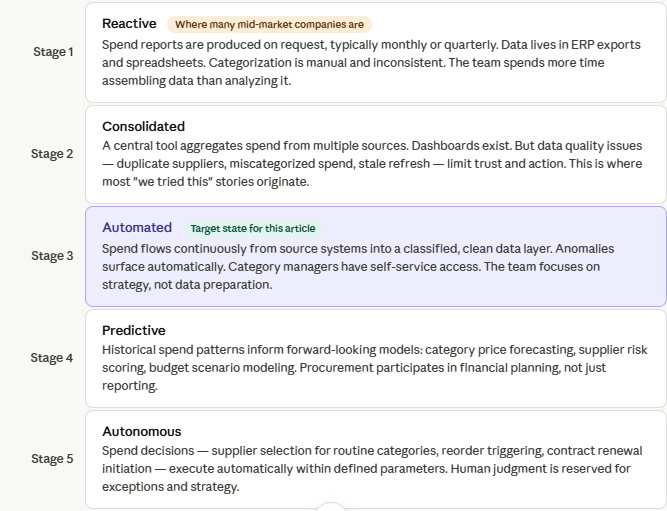
The gap between Stage 2 and Stage 3 is where most organizations stall. The technology exists to bridge it. The obstacle is almost always one of four implementation mistakes, each of which is both common and preventable.
Four implementation mistakes that turn spend analytics into a shelf product
These are the failure patterns we see most consistently—not in theory, but in the post-mortems of spend analytics projects that didn’t deliver. A strong implementation starts with understanding existing processes, data flows, and operational gaps before introducing new technology. For a practical perspective on this approach, see Business Automation Consulting: Revolutionize Your Approach to Process Analysis.
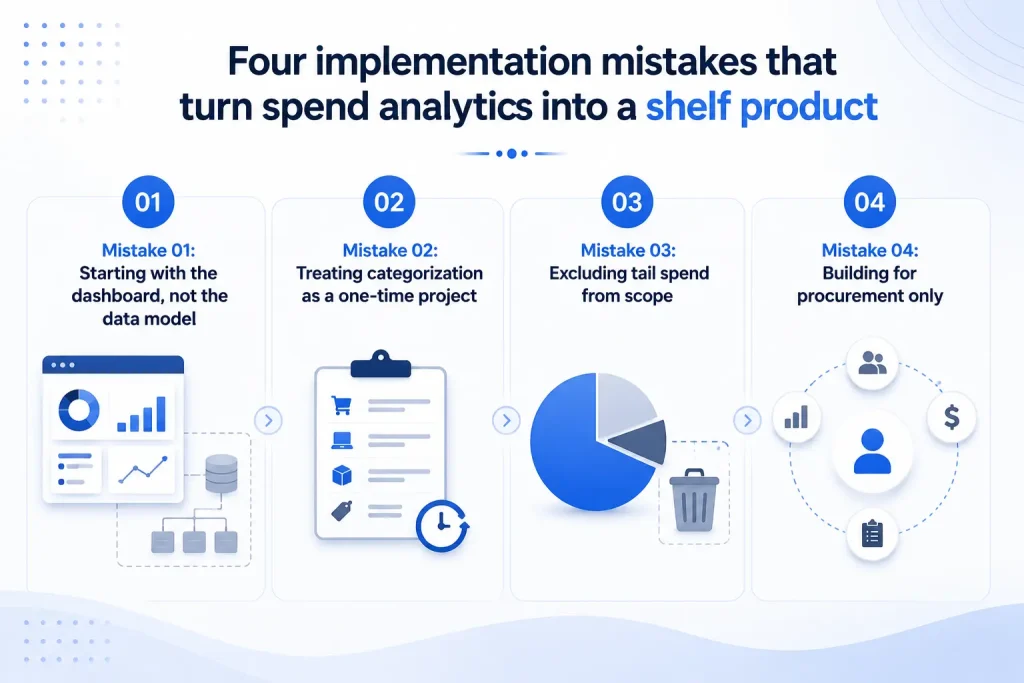
Mistake 01: Starting with the dashboard, not the data model
Teams get excited about visualizations and invest heavily in BI tooling before resolving the underlying category taxonomy, supplier master, and data refresh architecture. The result is a beautiful dashboard built on shifting sand—numbers that look authoritative but can’t withstand scrutiny.
Fix: Define your category taxonomy and supplier hierarchy first. The taxonomy is your contract with the business about what ‘spend’ means—get that wrong, and every downstream analysis is wrong too.
Mistake 02: Treating categorization as a one-time project
Organizations invest significant effort in an initial classification exercise, then let the model drift. New suppliers, new cost centers, acquisitions, and changed purchasing patterns gradually erode accuracy. Within 12 months, a 90% accuracy rate has often fallen to 70% – enough to undermine trust in the entire system.
Fix: Build ongoing model retraining into the operating model from day one, not as a future phase. Budget for it.
Mistake 03: Excluding tail spend from scope
Implementation teams often scope out low-value transactions to manage complexity. This is logical for project delivery but creates a persistent blind spot: tail spend in most organizations represents 20–35% of total spend value and nearly 80% of transaction volume. Excluding it means your “complete” spending picture is structurally incomplete.
Fix: Include tail spend in scope from the start, even at lower classification granularity. An approximate picture of all spend is better than a precise picture of some spend.
Mistake 04: Building for procurement only
When spend analytics is positioned as a procurement tool, finance and operations leaders never adopt it. This creates a political problem: procurement cites data that finance doesn’t trust and that business unit heads haven’t seen. In the same meeting, different versions of the truth lead to decisions.
Fix: Design the access model for cross-functional use from the start. Finance, category managers, and BU heads should each have a view built for their questions, not just read-only access to the procurement dashboard.
What good actually looks like: industry-specific proof points
Generic benchmarks, such as “organizations save 8–12% through spend visibility,” are useful for building a business case but insufficient for evaluation. For a more structured approach to quantifying savings, costs, and payback, see our guide on How to Build an AP Automation Business Case (With ROI Benchmarks). What matters is whether the outcomes are plausible for your industry, your spend profile, and your organizational context. The scenarios below reflect the specific value patterns that emerge in different sectors, including opportunities for supplier consolidation where fragmented supplier bases create unnecessary costs and reduce purchasing leverage.
1. Manufacturing & industrial
A mid-sized industrial manufacturer with operations across three countries had 14 ERP instances following a series of acquisitions. Spend reporting required a four-person finance team to spend approximately 60% of their time on data extraction and reconciliation. Category-level visibility lagged 6–8 weeks behind actual spend.
After implementing automated spend analytics with direct ERP connectors and AI-driven categorization, the immediate impact was not savings—it was the discovery of 47 overlapping MRO supplier relationships across sites that procurement had no visibility into. The consolidation of those relationships, negotiated from a position of credible volume data for the first time, reduced indirect materials cost by 14% within two contract cycles.
What made the difference: The value wasn’t in the platform’s dashboards—it was in having accurate, consolidated supplier spend data that made a renegotiation credible to suppliers who had previously been able to play regional teams against each other.
2. Retail & consumer goods
A specialty retailer found that 23% of its marketing and agency spend was flowing through personal credit cards and expense reports rather than purchase orders, invisible to procurement, untracked against contracts, and effectively unmanaged. The discovery happened not through an audit but through a spend analytics implementation that, for the first time, connected P-card and expense data to the same category taxonomy as PO-based spend. This visibility helped procurement identify opportunities to reduce leakage, improve supplier control, and drive measurable cost savings.
The response wasn’t to restrict card spending – it was to create preferred vendor catalogs and punch-out capabilities for the categories most commonly purchased off-contract, reducing maverick spend by 31% over 18 months while improving compliance without adding approval friction.
The insight that matters for evaluation: If your current spend analytics implementation doesn’t include expense and P-card data at the same classification depth as PO data, you are systematically blind to a significant share of your spend — and the gap is almost certainly larger than you think.
The five pillars and what actually breaks each one
Most descriptions of spend analytics automation list capabilities in ways that sound comprehensive. What they rarely include is the specific failure mode for each capability, the thing that causes it to stop delivering value in practice. That matters because effective spend management depends not just on having the right capabilities but on ensuring they work reliably in day-to-day procurement operations. That is what this section addresses.
01 Unified data ingestion
Automated connectors pull transactions from ERP, P-cards, expense tools, and supplier invoices into a single classified data layer. The architecture matters as much as the coverage.
What breaks it: Relying on scheduled batch exports rather than event-driven or API-based integration. A nightly batch process that fails silently—no alert, no data gap indicator—is worse than no automation because it creates false confidence in data completeness
02 AI-driven spend categorization
ML models perform spend classification at ingestion, classifying transactions against your taxonomy. Accuracy of 90–95% is achievable, but only with sufficient training data and active model governance. For a more profound look at how AI-powered automation works and where it can create business value, see what are AI Automation Services and why should you care?
What breaks it: Treating classification accuracy as a deployment metric rather than an ongoing operational metric. Ask any vendor for their median classification accuracy at 12 months post-deployment, not just at go-live; the gap between those two numbers tells you everything about their model governance approach.
03 Supplier master data management
Automated entity resolution identifies duplicate supplier records and consolidates spend under canonical supplier entities — making consolidated volume visible for negotiation.
What breaks it: Entity resolution works well on exact-match duplicates but fails on fuzzy cases, such as different legal entities for the same parent company, subsidiary relationships, and DBA names. The duplicates that cause the most procurement damage are the ones that require business context to resolve, not just string matching.
04 Continuous monitoring and alerting
Rule-based and anomaly-detection alerts surface spend deviations – policy violations, budget overruns, and duplicate payments – as they happen rather than in retrospective reports.
What breaks it: Alert fatigue. Systems tuned to catch everything generate so many notifications that finance teams start ignoring them within weeks. Effective alerting requires intelligent noise filtering — the ability to distinguish a genuine anomaly from routine variance. This is a product design problem, not just a threshold configuration problem.
05 Self-service analytics
Business users, category managers, finance BPs, and cost center owners, can access actionable spend insights and answer their own spend questions without IT or data analyst involvement.
What breaks it: Self-service tools that are powerful enough for data analysts but too complex for business users. The test is not whether a power user can build any analysis — it’s whether a category manager who uses the tool once a week can answer a new question independently. If the answer is “They’d need to ask the data team,” the self-service goal has not been met.
Spend analytics automation is not a technology purchase. It is an organizational capability that a technology enables. The organizations that get the most from it are not those that bought the best product—they are those that were most honest about their data quality, most disciplined about their taxonomy, and most deliberate about ensuring the insights connected to actual decisions. The technology is the easier part.
Ready to go beyond the vendor pitch? Whether you’re evaluating your first spend analytics platform or trying to understand why your current one isn’t delivering, at Auxiliobits, we can help you run a spend data diagnostic, build a category-level business case, or pressure-test a vendor shortlist.
Spend Analytics ROI: What to Expect
Spend analytics turns fragmented purchasing data into measurable savings, compliance, and supplier-management opportunities. The benchmarks below are directional targets, not guaranteed outcomes; actual results vary by spend profile, data quality, supplier complexity, and implementation scope. For a broader framework on measuring automation value, see our automation ROI guide.
| Metric | Before spend analytics | After spend analytics | Source |
| Maverick spend | 15–25% of total spend | 5–8% | Industry benchmark / target |
| Supplier consolidation | Fragmented supplier base | 10–20% reduction | Post-implementation target |
| Cost savings identified | Reactive, ad hoc | 3–8% of addressable spend | Directional benchmark |
| Categorization accuracy | 60–70% | 90–95% | Auxiliobits client data |
| Spend visibility | Quarterly reporting | Real-time dashboards | Post-implementation |
| Compliance rate | 70–80% | 95%+ | Post-implementation target |
The broader value of spend analytics is supported by Spend Matters’ procurement benchmarking research, which provides procurement data and benchmarking resources for decision-making. Ardent Partners’ Metrics That Matter research provides procurement, P2P, AP, and finance leaders with performance and operational benchmarks for measuring and improving performance.
Ardent Partners also emphasizes the importance of visibility, accurate data, metrics, reporting, and analytics in improving procurement and P2P performance.
The real ROI comes from moving from reactive reporting to continuous decision support, helping finance and procurement teams identify savings, reduce maverick spend, consolidate suppliers, and improve purchasing compliance.
Ultimately, the goal is simple: turn previously invisible spend into measurable, actionable, and governed spend.
How to Implement Spend Analytics in 6 Steps
Implementing spend analytics does not require a complete procurement transformation upfront. A structured rollout can help organizations establish reliable data foundations, improve visibility, and progressively automate spend management.
- Audit your current spend data—Identify every relevant source, including ERP systems, AP platforms, P-cards, expense reports, purchase orders, and contracts. Document gaps, duplicates, and inconsistent data fields.
- Build a unified data model—Consolidate spend data into a single classified dataset with standardized supplier names, categories, business units, and transaction attributes.
- Apply AI-driven spend classification—Use machine learning to automate category mapping, classify transactions, and continuously improve classification accuracy as new spend data enters the system.
- Set up real-time dashboards—Create role-based views for CFOs, procurement leaders, AP teams, and department heads so each stakeholder can monitor the metrics relevant to their decisions.
- Establish continuous monitoring—Configure alerts for maverick spend, duplicate payments, unusual purchasing patterns, supplier concentration, and budget overruns so teams can act before issues escalate.
- Review and refine quarterly—Update taxonomies, clean supplier master data, address new spend categories, and tune classification models to maintain accuracy as the business and spending patterns evolve.
Spend Analytics vs. Spend Visibility: What’s the Difference?
Spend analytics is the process of collecting, classifying, analyzing, and reporting on organizational spending. It combines data from sources such as ERP systems, AP, P-cards, expenses, and procurement platforms to identify patterns, savings opportunities, supplier risks, and compliance issues.
Spend visibility is the outcome of that process: the ability to see where, how, and with whom money is being spent, ideally through accurate, real-time dashboards and reporting. Spend management is the broader strategy that puts both into action—using spend analytics and visibility to control costs, negotiate better supplier terms, reduce maverick spending, and improve policy compliance.
In simple terms: spend analytics provides the intelligence, spend visibility provides the transparency, and spend management turns both into action.