





- Accounts payable issues are often symptoms of upstream procurement inefficiencies, making end-to-end P2P transformation more effective than AP automation alone.
- P2P transformation connects requisitioning, sourcing, purchasing, receiving, invoicing, and payments into a unified process with stronger controls and visibility.
- Organizations can reduce maverick spending, improve three-way match rates, optimize working capital, and lower procurement costs through structured P2P processes.
- A mature P2P environment strengthens compliance, reduces supplier and fraud risks, and provides valuable spend intelligence for strategic decision-making.
- Successful P2P transformation requires more than technology; it depends on executive sponsorship, process redesign, supplier enablement, and cross-functional collaboration.
Most organizations that struggle with late payments, maverick spending, or supplier disputes are quick to blame their accounts payable team. The real issue, however, sits much further upstream.
By the time an invoice lands on an AP clerk’s desk, a dozen decisions have already been made — or avoided. A purchase was approved informally. A vendor was onboarded without proper due diligence. A contract was signed without visibility into existing pricing. A delivery was accepted without a corresponding purchase order.
Accounts payable is where these upstream failures become financially visible. That is why patching the AP function alone — adding headcount, automating invoice capture, or accelerating payment runs — rarely solves the more profound problem. It treats symptoms, not causes.
This is the foundational argument for P2P transformation: the recognition that accounts payable is not a standalone process but the final stage of a longer, interconnected value chain that begins the moment someone inside your organization identifies a business need.
What “P2P Transformation” Actually Means
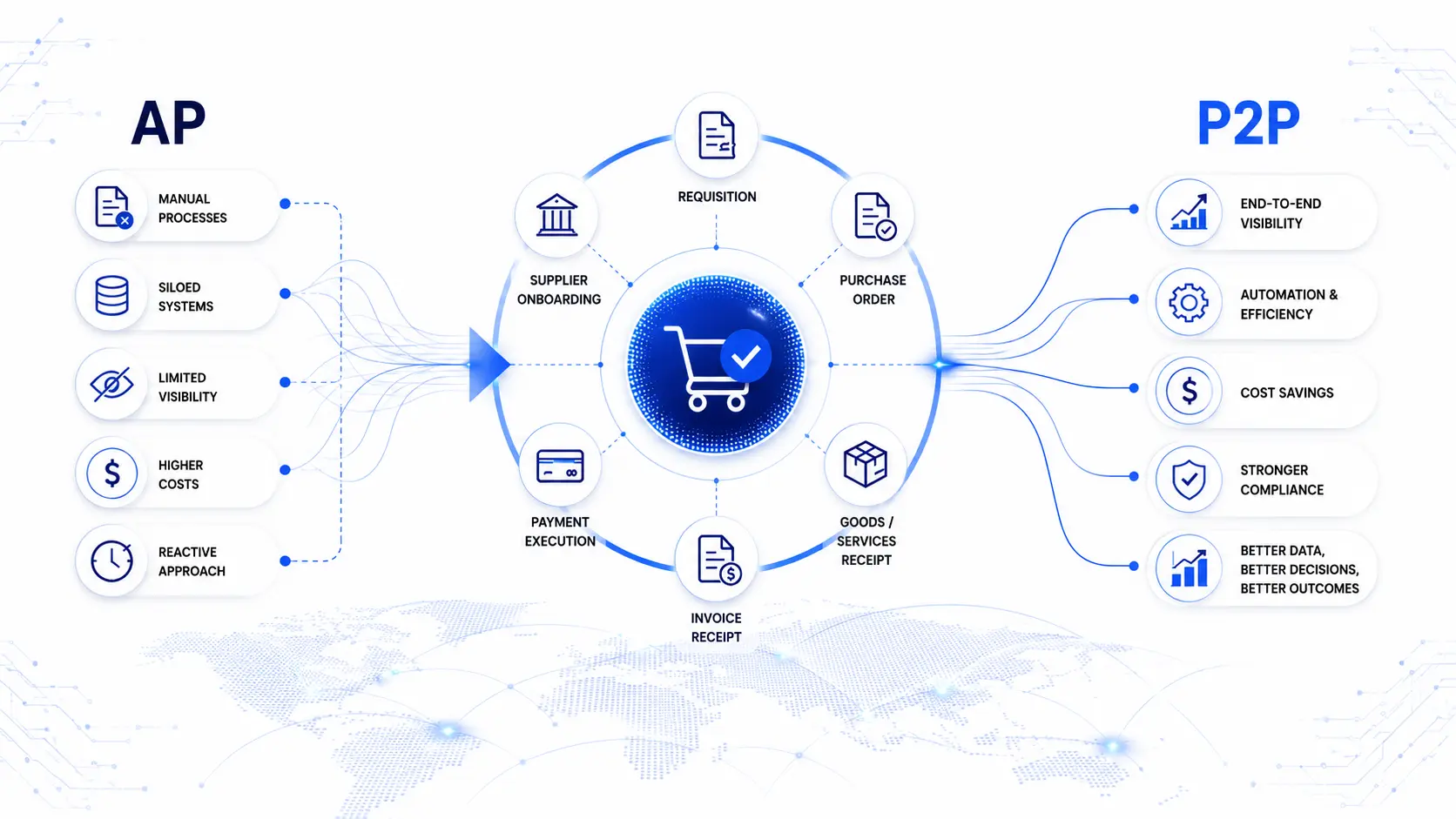
Procure-to-pay (P2P) refers to the full cycle of activities that starts with procurement requisition and ends with supplier payment. In a transformed P2P environment, these activities are unified — not merely digitized individually — into a single, governed workflow with shared data, consistent controls, and real-time visibility.
A true P2P transformation involves:
- Process unification: Requisition, sourcing, purchase order creation, goods receipt, invoice matching, approval, and payment all operate within a connected framework rather than siloed systems.
- Policy enforcement at the point of decision: Spending controls apply when someone requests a purchase, not after the fact when finance tries to reconcile.
- Data continuity: Every downstream step (invoice matching, payment terms, tax treatment) inherits context from upstream decisions (approved supplier, negotiated contract, agreed delivery terms).
- Supplier experience: Vendors interact through structured portals rather than unmanaged email chains, reducing errors and disputes before they affect cash flow.
The distinction from basic AP automation is significant. AP automation makes invoice processing faster. P2P transformation makes the entire purchasing process smarter, more controlled, and more strategic.
Why AP-Only Fixes Have a Ceiling
Before evaluating P2P transformation, it helps to understand why AP-centric improvements eventually plateau.
1. The Three-Way Match Problem
Most AP teams rely on three-way matching — verifying that the purchase order, goods receipt, and supplier invoice align before approving payment. When this match fails, someone has to investigate, chase down approvals, or hold payment. In high-volume environments, a match failure rate of even 15–20% creates a significant bottleneck.
The root cause of most match failures is not an AP problem. It is a procurement problem: POs raised after the fact, quantities not recorded at receipt, invoices referencing contracts that have been superseded. AP automation can accelerate the processing of clean invoices, but it cannot fix the structural gaps that create dirty ones.
2. Maverick Spending Undermines Negotiated Value
Organizations spend significant resources negotiating preferred supplier agreements and volume pricing. When employees bypass approved vendors — even with good intentions — they immediately erode that negotiated value.
Research consistently shows that 20–40% of enterprise spending occurs outside contracted channels. This maverick spending does not disappear when you automate invoice processing. It continues to generate invoices from unapproved vendors, at unapproved prices, without matching POs.
A P2P transformation addresses this at the source: guided buying experiences, preferred vendor catalogs, and requisition workflows that make compliance the path of least resistance.
3. AP Automation Cannot Deliver Strategic Insights
Finance and procurement leadership increasingly need visibility into spending patterns, supplier concentration risk, payment term optimization, and working capital efficiency. AP automation systems can tell you how quickly invoices are processed. They cannot tell you whether the organization is spending strategically.
P2P transformation, by contrast, generates structured data across the entire purchasing lifecycle — from category spend analysis to supplier performance metrics to contract utilization rates. This data becomes the foundation for strategic decision-making rather than just operational reporting.
Where P2P Transformation Creates Value
Organizations that have completed P2P transformations typically report value across five dimensions. Understanding these helps frame the internal business case.
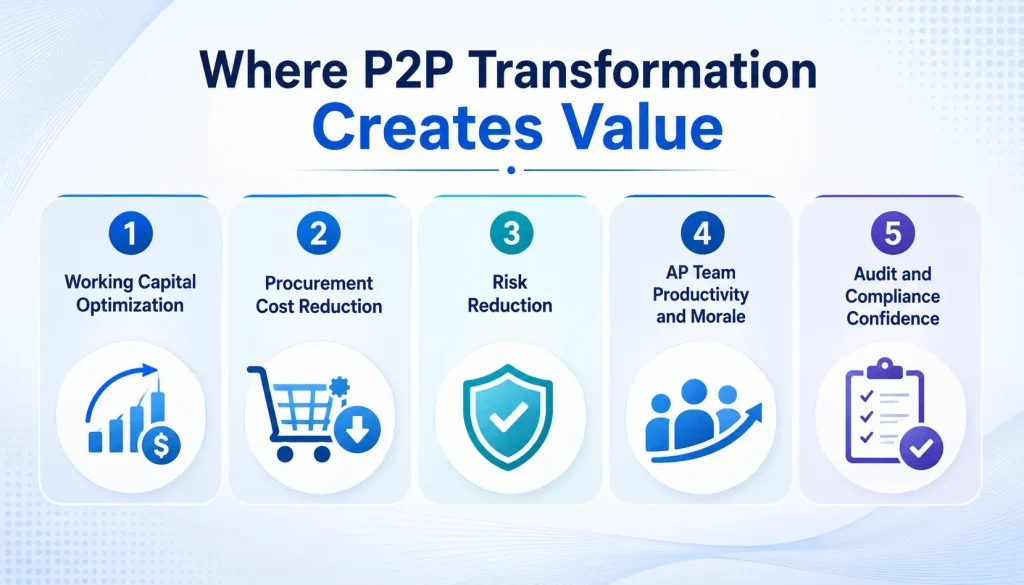
1. Working Capital Optimization
When payment terms are consistently applied and early payment discount opportunities are systematically captured, the financial impact is measurable. A 2% discount on invoices paid within 10 days instead of 30 annualizes to approximately 36% — a return that dwarfs most short-term investment alternatives.
P2P transformation makes this possible by ensuring that approved invoices reach the payment queue quickly, with dynamic discounting decisions made systematically rather than manually.
2. Procurement Cost Reduction
End-to-end P2P visibility exposes spending fragmentation. When procurement leaders can see that the organization is using 14 different office supply vendors across regions, they have the data to consolidate and negotiate. Organizations typically identify 10–25% addressable cost reduction opportunities within 12–18 months of completing a P2P transformation, simply through spend consolidation that was previously invisible.
3. Risk Reduction
Supplier risk takes multiple forms: financial instability, compliance failures, and single-source dependency. A unified P2P process creates the data infrastructure to monitor and manage these risks systematically — through supplier scorecards, diversity tracking, and contract expiry alerts — rather than discovering them during a crisis.
Fraud risk also decreases substantially when purchasing controls are embedded in workflow rather than enforced through manual review. Ghost vendors, duplicate invoices, and unauthorized transactions are significantly harder to execute in a governed P2P environment.
4. AP Team Productivity and Morale
Finance and AP teams in non-transformed environments spend a disproportionate share of their time on exception handling: chasing missing POs, resolving invoice disputes, and manually routing approvals. This work is frustrating, low-value, and difficult to scale.
P2P transformation shifts AP teams from reactive exception processors to proactive analysts. When 80% of invoices match automatically and flow to payment without intervention, the team’s time and energy can be directed toward supplier relationship management, payment term optimization, and process improvement.
5. Audit and Compliance Confidence
Regulatory environments are tightening. Tax authorities in many jurisdictions now require detailed, structured transaction data. Internal audit functions demand evidence of policy compliance. External audits require the ability to trace any payment back to an approved requisition and contract.
A unified P2P process creates this audit trail by design. When every purchase flows through a governed system, the compliance documentation is generated automatically rather than reconstructed after the fact.
How to Assess Your P2P Maturity
Before designing a transformation roadmap, it is useful to assess where your organization currently sits on the P2P maturity curve. Most organizations fall into one of four stages:
- Stage 1 — Fragmented: Purchasing happens through informal channels. POs are created after the fact or not at all. AP processes invoices reactively. Spend data is incomplete and unreliable.
- Stage 2 — Partially Controlled: A PO policy exists but is inconsistently followed. AP automation handles invoice capture and some matching. Reporting is available but requires manual aggregation.
- Stage 3 — Managed: Procurement and AP systems are integrated. Most spending goes through approved channels. Three-way match automation rates are high. Spend analytics are accessible and used for decision-making.
- Stage 4 — Optimized: P2P is a strategic function. Supplier relationships are actively managed. Working capital is dynamically optimized. The P2P process generates continuous insights that inform category strategy, sourcing decisions, and supplier development.
Most mid-market and enterprise organizations reading this report are somewhere between Stages 1 and 3. Most P2P transformation investments are made between Stage 2 and Stage 3, where the returns are most significant.
What a Successful P2P Transformation Looks Like in Practice
To ground this case in reality, consider the experience of a mid-size manufacturing company with 800 employees, operations across three regions, and approximately $120M in annual indirect spend.
Before transformation, the organization had 12 AP staff processing roughly 4,000 invoices per month. Match failure rates exceeded 30%. The organization was capturing fewer than 10% of available early payment discounts. Spend outside contracted channels ran at approximately 28%.
After an 18-month P2P transformation — which included supplier enablement, a guided buying catalog, and integrated three-way match automation — the picture changed materially:
- AP headcount was redeployed rather than reduced, with staff shifting to supplier management and analytics roles
- Match failure rates dropped below 5%
- Early payment discount capture increased to over 60%
- Maverick spending fell to under 8%
- Annual value realized exceeded the transformation investment within 14 months
This outcome is not unusual. What made it possible was not the technology alone, but the combination of executive sponsorship, process redesign, change management, and supplier enablement that a serious P2P transformation requires.
The Next Step
P2P transformation is not a technology purchase. It is an organizational decision to treat purchasing as a controlled, data-driven, strategically aligned function rather than a cost of doing business that manages itself.
The question for finance and procurement leaders is not whether P2P transformation creates value — the evidence on that is consistent. The question is whether the organizational conditions are in place to pursue it seriously: executive alignment, cross-functional ownership, and a realistic assessment of where the barriers and quick wins are.
If you are evaluating P2P transformation for your organization, the most useful next step is a structured maturity assessment — an honest inventory of where your current process generates cost, risk, and missed value. That assessment will define the scope of your opportunity and the shape of a credible transformation roadmap. So wait no more, and contact us today without any delay.