






- AP automation delivers the highest ROI when it aligns solutions with industry-specific workflows, compliance requirements, and invoice complexities.
- Manufacturing organizations benefit significantly from automated 3-way matching, supplier financing opportunities, and higher touchless invoice rates.
- Healthcare providers use AP automation to strengthen compliance controls, improve audit readiness, and standardize processes across multiple facilities.
- Retail and e-commerce companies leverage automation to manage seasonal invoice surges, non-PO spending, and vendor complexity without increasing headcount.
- Construction firms reduce compliance risks and accelerate subcontractor payments by automating lien waiver collection, project coding, and approval workflows.
e’ve sat on both sides of the AP automation table, first as a controller manually reconciling 6,000 invoices a month, then as a finance VP who led four automation implementations across manufacturing, healthcare, and professional services. What we’ve learnt: the generic “AP automation saves time” pitch is nearly useless when you’re actually trying to decide whether to invest. What matters is whether the AP automation use cases match your reality. This guide breaks down exactly how AP automation plays out by industry, including real outcomes.
Why Industry Context Changes AP Automation ROI
AP automation isn’t a single switch you flip. The workflows, compliance requirements, vendor structures, and approval chains differ dramatically between a healthcare network, a hotel group, and a mid-market manufacturer. A platform that delivers 80% touchless invoice rates for a manufacturer can fail badly at a construction firm if it doesn’t handle lien waivers — leaving the AP team doing more exception management than before.
The smartest finance teams evaluate AP automation through an industry lens first: not, “Does this automate invoices?” But “does this platform handle the specific invoice types, exceptions, and compliance checkpoints we deal with daily?” The benchmarks below come from IOFM’s 2023 AP research, Ardent Partners’ State of ePayables report, and my own implementation experience.
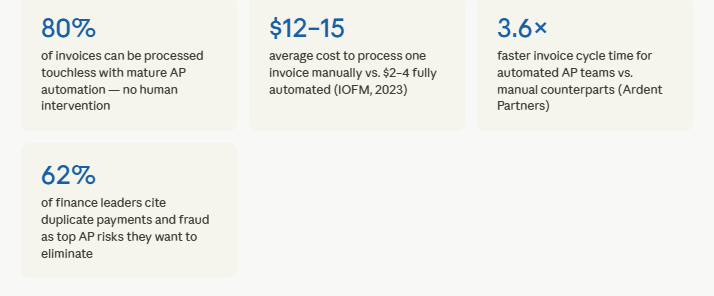
These are industry averages. Actual impact depends on your invoice volume, vendor mix, PO complexity, and ERP stack. The industry breakdowns below give you the specifics.
Industry 1: Manufacturing & Supply Chain
The AP challenge in manufacturing
High-volume POs · Multi-tier supplier networks · Tight margins
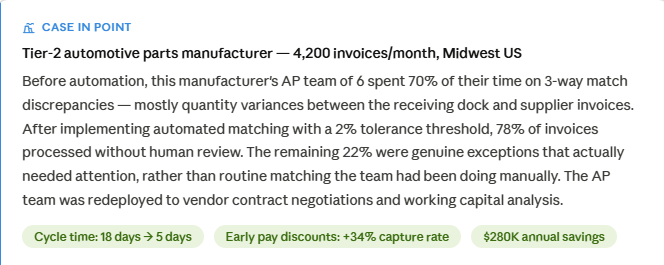
- Hundreds or thousands of PO-backed invoices per month requiring 3-way match (PO, receipt, invoice)
- Supplier invoices arriving in 6+ formats: PDF, EDI, portal submissions, email, paper
- Discrepancies between goods received notes and invoiced quantities causing payment delays
- Early payment discount opportunities routinely missed due to slow manual processing
Typical outcome: 70–85% touchless invoice rate
Core use case: automated 3-way matching
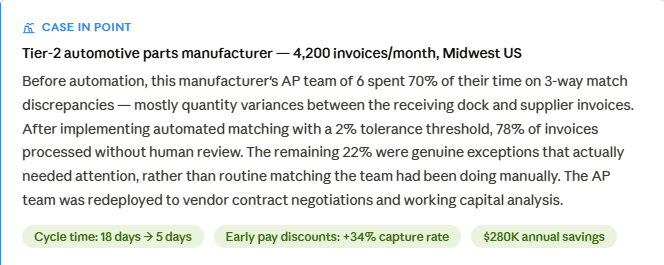
In manufacturing, a 3-way match is the backbone of invoice processing. An AP automation platform ingests the invoice, pulls the purchase order from the ERP, checks the goods receipt from the warehouse system, and compares all three. If they match within tolerance, the invoice auto-approves and queues for payment — no human touch required. When they don’t match, the system flags the discrepancy and routes it to the right buyer, tracking resolution time automatically.
Dynamic discounting and supplier financing
hen a supplier offers 2/10 net 30 terms, manual AP processes almost never capture the discount — the invoice is still being routed for approval on day 11. Automated AP triggers a real-time alert when an invoice is approved, letting treasury decide whether to pay early for the discount or extend payment terms through a supply chain financing facility. For manufacturers with high invoice volumes, the discount alone can generate significant returns that offset the cost of automation.
Industry 2: Healthcare & Life Sciences
The AP challenge in healthcare
Regulatory compliance · High invoice complexity · Multi-entity structures
- Invoices must comply with anti-kickback statutes, Stark Law, and GPO contract terms
- Capital equipment, supplies, pharma, and professional services each require different approval workflows
- Multi-entity hospital systems managing AP across dozens of facilities with consolidated reporting needs
- Audit trails are non-negotiable — every approval must be documented with user, timestamp, and justification
Typical outcome: 99%+ audit trail completeness, 50% reduction in compliance exceptions
Compliance-aware invoice routing and GPO contract verification
Healthcare AP automation use cases can be configured with business rules that flag invoices where contract compliance checks are required. When a hospital has a GPO contract with a medical supply vendor, the automation layer verifies the invoiced price against the contracted rate before routing for approval — catching GPO leakage that routinely goes undetected in manual environments. For pharmaceutical suppliers, capturing lot numbers and DEA schedule classifications at ingestion creates audit-ready records without manual data entry.
We went from 14 different invoice processing workflows across our facilities to one unified platform. Our AP team didn’t get smaller — they got redeployed to vendor contract analysis instead of data entry.
— CFO of Finance, Regional Health System
Industry 3: Retail & E-Commerce
The AP challenge in retail
Seasonal volume spikes · Marketing vendor proliferation · Returns complexity
- Invoice volume spikes 3–5× during Q4 and major sale events with the same AP headcount
- Hundreds of marketing, logistics, and technology vendors submitting non-PO invoices
- Credit memos and returns processing creates reconciliation complexity at high volumes
- Drop-ship and marketplace models generate invoice formats outside standard PO workflows
Typical outcome: handles 5× volume spikes without headcount increase
Non-PO invoice management for marketing and operations spend
Retailers carry a large category of spend that never goes through procurement: agency retainers, social platforms, SaaS tools, logistics partners, and professional services. These non-PO invoices are the hardest to automate because there’s no purchase order to match against. AP automation handles these invoices through intelligent coding suggestions – predicting GL code, cost center, and approver based on vendor history – and smart routing to the department head who authorized the spend.

Industry 4: Construction & Real Estate
The AP challenge in construction
Project-based costing · Lien waivers · Subcontractor complexity
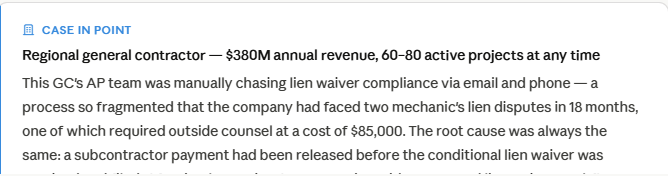
- Every invoice must be coded to a specific job number, cost code, and phase — errors cause undetected overruns
- Conditional and unconditional lien waivers must be collected before payment to subcontractors
- Retainage calculations, partial payment schedules, and AIA billing formats require specialized handling
- Project managers approve subcontractor invoices but rarely know whether compliance documents are collected
Typical outcome: 90%+ lien waiver compliance, 60% faster subcontractor pay cycles
Lien waiver automation: the construction-specific use case
Lien waivers are uniquely a construction AP problem, and manual lien waiver management is a significant source of legal and financial risk. AP automation platforms built for construction automatically request lien waivers from subcontractors when payment is initiated, track receipt, and hold payment release until conditional waivers are received. This removes a critical compliance burden from the AP team and gives project managers real-time visibility into which subs are compliant.
AP Automation Use Cases: Capability Matrix by Industry
Not all AP automation platforms work wonders. They usually do not support all AP automation use cases equally. Use this matrix to understand what capabilities matter most for your industry when evaluating solutions.
| Capability | Manufacturing | Healthcare | Retail | Construction | Prof. Services |
| Automated 3-way match | Critical | Important | Important | Useful | Rarely needed |
| Non-PO invoice management | Moderate | Critical | Critical | Moderate | Critical |
| Multi-entity / multi-site | Important | Critical | Critical | Important | Moderate |
| Compliance document mgmt (lien waivers, certs) | Low priority | Critical | Low priority | Critical | Low priority |
| Dynamic discounting / SCF | Critical | Moderate | Important | Low priority | Low priority |
| Client billback allocation | Not relevant | Not relevant | Not relevant | Useful | Critical |
| Mobile receiving integration | Important | Low priority | Important | Important | Not relevant |
How to Evaluate AP Automation for Your Organization
The use cases above make the value clear — but every AP automation evaluation fails or succeeds based on how well you specify your requirements before talking to vendors. Here’s a practical framework for moving from interest to informed decision.
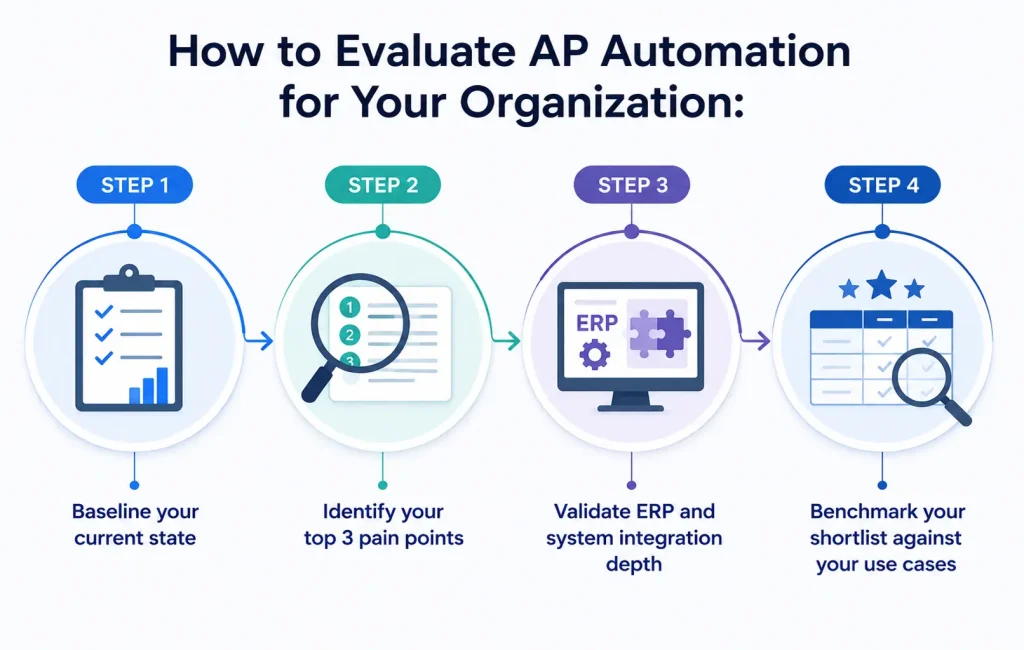
Step 1 — Baseline your current state
Before any demo, calculate your current cost per invoice (AP headcount cost ÷ annual invoice volume), average cycle time (invoice date to payment date), and exception rate (% of invoices requiring manual intervention. These become your baseline metrics to evaluate ROI claims against.
Step 2 — Identify your top 3 pain points
Look at the industry breakdowns above. Are you losing early payment discounts? Struggling with lien waiver compliance? Drowning in seasonal volume spikes? Your top 3 problems should drive your must-have requirements list — not the vendor’s feature sheet.
Step 3 — Validate ERP and system integration depth
An AP automation platform that only exports CSVs to your ERP is not truly integrated — it just moves the manual work to import reconciliation. Demand native, bidirectional integration with your specific ERP version, and ask for reference customers on the same ERP.
Step 4 — Benchmark your shortlist against your use cases
- Ask vendors to demonstrate your specific invoice types – not generic demos
- Test exception handling workflows with real edge cases from your AP team
- Evaluate the vendor portal experience — your suppliers will use this too
- Validate compliance and audit trail capabilities against your regulatory environment
- Get total cost of ownership, including implementation, training, and ongoing support
The evaluation mistake that costs teams months: Focusing exclusively on invoice capture accuracy (OCR quality) while underweighting workflow flexibility. A system that reads invoices with 99% accuracy but can’t accommodate your 4-level approval hierarchy for capital expenditures will still require significant manual workarounds.
What “good” looks like 12 months in
A successfully implemented AP automation solution at 12 months should show a touchless invoice rate above 70%, an invoice cycle time under 7 days for PO-backed invoices, a measurable reduction in duplicate payment incidents, and — critically — an AP team that is spending more time on vendor relationship management and spend analysis than on data entry and email follow-up.
Ready to map AP automation to your specific workflows? Contact us today. We will help you identify our experts who can handle your industry’s specific AP automation use cases.