






Key Takeaways
- Most AP automation failure cases stem from poor processes, weak governance, bad data quality, and unclear success metrics—not from the software itself.
- Automation accelerates existing workflows. If approval chains, exception handling, and invoice routing are inefficient today, automation will simply make those inefficiencies happen faster.
- Duplicate vendor records, inconsistent PO information, and incomplete supplier data create large volumes of exceptions that can quickly undermine automation ROI.
- Successful AP automation initiatives have a committed executive sponsor who can align finance, procurement, IT, and operations around common objectives and remove roadblocks.
- Track meaningful KPIs such as cost per invoice, straight-through processing rates, approval cycle times, exception rates, and early payment discount capture to demonstrate real business value and prevent AP automation failure.
You approved the budget. You sat through the demos. You onboarded the vendor. Six months later, your team is still manually keying invoices, exceptions are piling up, and the ROI your CFO expected is still not visible.
You’re not alone — and you’re not the problem.
Industry research consistently shows that 50–70% of AP automation projects either fail outright or significantly underdeliver on their promised outcomes. And yet, the same vendors keep selling the same platforms with the same promises. The issue isn’t that automation doesn’t work. It’s that most organizations walk into these projects repeating the same critical mistakes — mistakes that are entirely avoidable once you know what to look for.
This isn’t a list of generic “lessons learned”. This is a frank breakdown of why AP automation failure happens, drawn from real implementation patterns — and what high-performing finance teams do differently.
The 5 Root Causes of AP Automation Failure
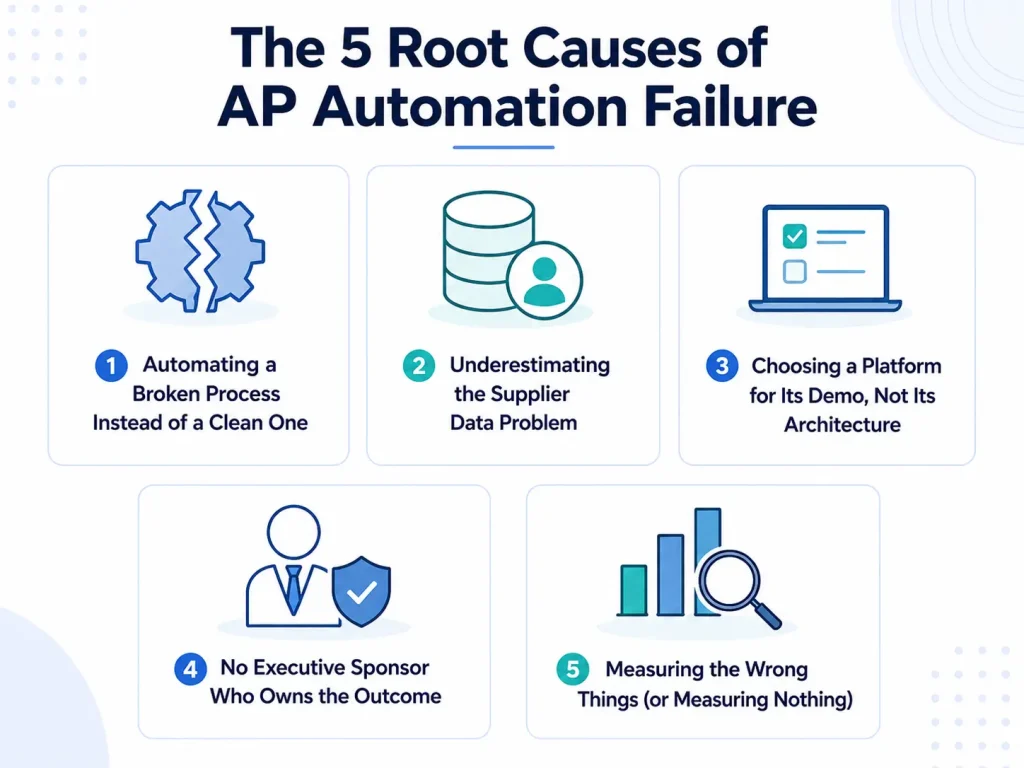
1. Automating a Broken Process Instead of a Clean One
The most seductive lie in AP automation is this: “The software will fix your process.”
It won’t.
AP automation amplifies whatever process you already have. If your invoice approval workflow has five unnecessary handoffs, your automated system will execute those five unnecessary handoffs — just faster, and with less visibility into where things are stuck.
Before you automate, ask:
- Have we mapped every exception type our team handles manually?
- Do we know which exceptions are systemic (caused by our own process gaps) vs. vendor-caused (wrong PO, missing data)?
- Are approval hierarchies documented and agreed upon across departments?
What successful teams do: They spend 4–6 weeks in process discovery before selecting a vendor. They document current-state workflows, identify the top 10 exception categories by volume, and calculate true cost per invoice, including exception handling. This groundwork becomes the blueprint on which automation is built, rather than being retrofitted around it.
2. Underestimating the Supplier Data Problem
Your AP automation is only as clean as your supplier master data — and most supplier master data is a mess.
Duplicate vendor records. Missing remittance emails. PO numbers that don’t match naming conventions. Tax IDs that haven’t been validated in years. When automation encounters these gaps, it creates exceptions. When exceptions spike, teams abandon the system and fall back to manual processing. This is one of the most common triggers of AP automation failure, and it’s almost never flagged in a vendor’s pre-sales process.
A useful diagnostic: before any implementation, run a supplier data audit. If more than 15% of your active vendor records have missing or conflicting fields, your automation project will fail within 90 days of go-live.
What successful teams do: They treat supplier onboarding as a parallel workstream to the technology implementation — not an afterthought. They assign ownership of vendor data cleanup to a specific team member and set data quality thresholds as go-live criteria, not nice-to-haves.
3. Choosing a Platform for Its Demo, Not Its Architecture
Modern AP automation platforms are exceptionally good at one thing: looking great in a 45-minute demo.
The vendor shows you a clean invoice flowing through a perfect approval chain and hitting your ERP in seconds. What they don’t show you is what happens when:
- An invoice arrives as a scanned PDF from a vendor who doesn’t use a standard template
- A three-way match fails because the goods receipt is delayed in your warehouse system
- An approver is out of office and the delegation rules weren’t configured
- Your ERP goes down for maintenance during end-of-month close
These aren’t edge cases. For most mid-market finance teams, exceptions represent 20–35% of total invoice volume. The platforms that handle exceptions gracefully — with configurable routing, smart escalation, and clear audit trails — are fundamentally different from those that make exceptions a human-managed afterthought.
What successful teams do: They design a structured “exception stress test” for every platform they evaluate. They send vendors a batch of their 20 most problematic invoice types and watch how the system handles them — not a curated sample of clean invoices. The vendor’s response to this request is itself revealing.
4. No Executive Sponsor Who Owns the Outcome
AP automation sits at the intersection of finance, IT, procurement, and operations. That means it belongs to everyone — and often, to no one.
When a project has a project manager but no executive sponsor who is personally invested, it becomes all too simple for departments to deprioritize their deliverables. IT delays ERP integration work. Procurement is slow to provide PO matching rules. Department heads resist changing their approval workflows. Each delay compounds, stretching the implementation timeline from 3 months to 9 months, and then to “We’re still working on it.”
This organizational drift is one of the leading causes of AP automation failure. It’s not a technology problem. It’s a governance problem.
What successful teams do: They assign a named executive sponsor — typically the CFO or VP of finance — who chairs a steering committee that meets bi-weekly throughout implementation. This person has authority to resolve cross-departmental conflicts and accountability to the board for the project’s ROI. The technology can only do what the organization allows it to do.
5. Measuring the Wrong Things (or Measuring Nothing)
“We’ll know it’s working when invoices process faster.”
That’s not a metric. That’s a hope.
AP automation failure often isn’t noticed until months after go-live, precisely because teams don’t establish baseline measurements before implementation. If you don’t know your current cost per invoice, your average days to pay, your exception rate by vendor, and your early payment discount capture rate — you have no way to prove (or disprove) that your automation is delivering value.
Worse, teams sometimes measure the inputs (invoices processed through the system) rather than the outcomes (working capital impact, vendor satisfaction, audit readiness). When a CFO asks, “What did this cost us?” and the answer is “the system processed 10,000 invoices last month”, that’s not a defensible ROI conversation.
What successful teams do: Before go-live, they baseline five core KPIs:
- Cost per invoice (fully loaded, including exception handling)
- Straight-through processing rate (invoices processed without human touch)
- Average days-to-approve
- Early payment discount capture rate
- Exception rate by category
These become the scoreboards. Every quarterly business review with the vendor maps back to movement in these numbers.
The Pattern Underneath All Five Failures
Look carefully at these five root causes, and a pattern emerges: AP automation failure is almost never caused by the technology itself.
It’s caused by organizations treating AP automation as a software purchase rather than a business transformation initiative. The platform is the smallest variable. The process maturity, the data quality, the governance model, and the measurement discipline — these are what determine whether your project becomes a success story or a cautionary tale.
This is a crucial distinction because it means failure is largely preventable. But it requires a different kind of preparation than most vendors will recommend — because most vendors want to close the deal, not slow down the sales cycle with a six-week process audit.
How to Know If Your Organization Is Ready
Before committing to (or restarting) an AP automation initiative, run your organization against this readiness checklist:
Process Readiness
- Current-state AP process is mapped end-to-end, including all exception types
- The invoice approval matrix is documented and signed off by all department heads
- Top 10 exception categories are identified with root causes
Data Readiness
- Supplier master data audit completed; duplicate/incomplete records resolved
- PO naming conventions and matching rules documented
- ERP chart of accounts reviewed for coding consistency
Governance Readiness
- Executive sponsor identified with clear accountability
- Cross-functional steering committee established
- Change management plan in place for AP team and approvers
Measurement Readiness
- Baseline KPIs captured and documented
- Success criteria defined and agreed upon with vendor
- Quarterly business review cadence committed to in contract
If you can check every box above, your AP automation project has a fundamentally different probability of success than the average initiative. If you’re missing several, you now know exactly where to focus before signing a contract.
What This Means for Your Next Steps
the ones that fail. They’re better prepared. They do the unglamorous work — the process mapping, data cleanup, governance alignment — that most teams skip in the rush to go live.
If you’re currently evaluating AP automation vendors, the most valuable thing you can do right now is stress-test your readiness — not the vendor’s platform.
If you’ve already gone live and aren’t seeing the results you expected, the checklist above will often tell you exactly where the gap is. AP automation failure is rarely fatal. Most underperforming implementations can recover with targeted interventions in process, data, or governance—if you’re willing to be honest about where the real problem lies.