





Key Takeaways
- Audit findings are often process and system failures—not people failures.
Many AP audit issues stem from disconnected systems, incomplete documentation, and weak controls rather than employee performance. - Purpose-built AP software strengthens compliance through control enforcement.
Unlike basic workflow tools, compliance-grade AP platforms actively prevent policy violations, segregation-of-duties breaches, and unauthorized transactions. - Complete audit trails dramatically reduce audit effort and response times.
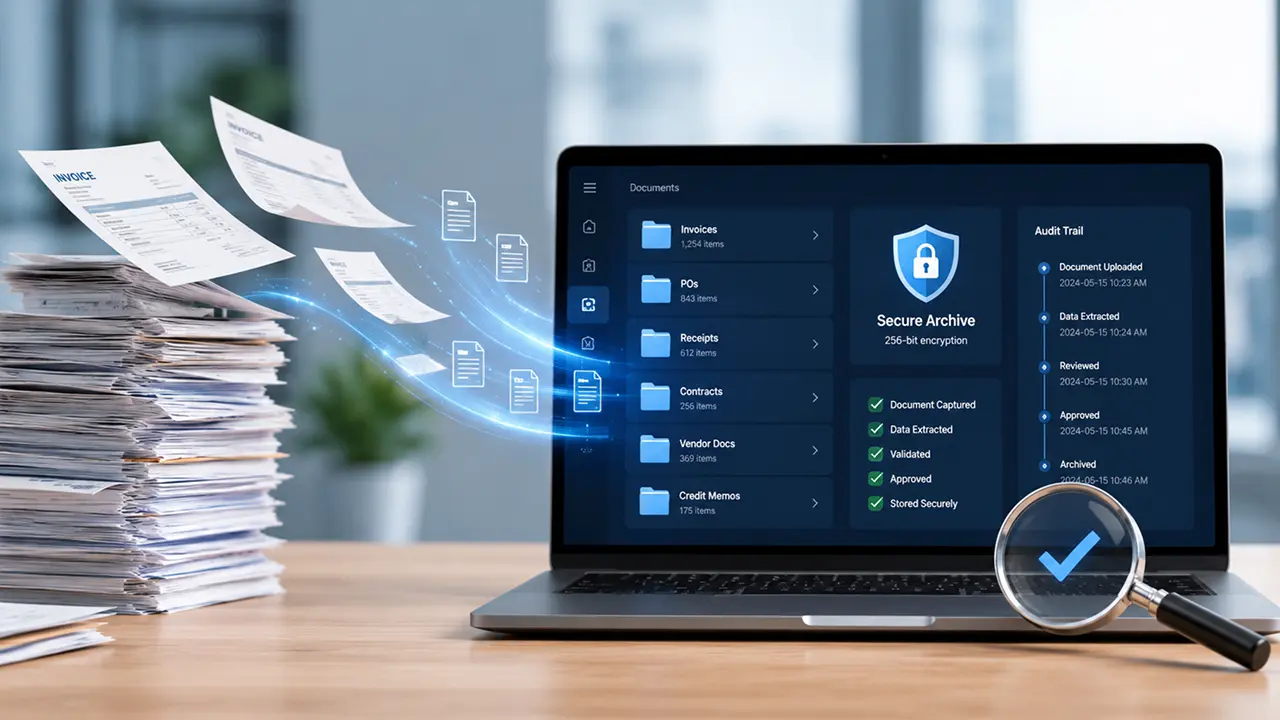
Every invoice, approval, exception, and payment action is automatically documented, making audit evidence available in minutes instead of days. - Strong AP controls reduce fraud, payment errors, and regulatory risk.
Automated duplicate detection, vendor validation, approval governance, and sanction screening help protect organizations from financial and compliance exposure. - Audit readiness should be a continuous operating model, not a last-minute project.
Organizations that maintain real-time compliance reporting, clean vendor data, and automated controls can approach audits with confidence rather than scrambling for documentation.
In Q3 last year, the AP Controller at a $400M logistics company received a 72-hour notice for an unplanned internal audit. What followed was four days of frantic email threads, missing invoice PDFs, and staff manually reconstructing approval chains from memory across three disconnected systems.
The audit passed — barely. The findings report listed 11 process deficiencies. Three were elevated to material weaknesses. The remediation project that followed cost the team six months and over $180,000 in combined auditor time, consulting fees, and staff overtime.
The Controller’s post-audit assessment was blunt: “Every single finding was a systems failure, not a people failure. We had good people doing the best they could with tools that were never designed for audit accountability.”
Six months later, after implementing purpose-built accounts payable software, the same team cleared a follow-up audit with zero AP-related findings – and produced every requested document within the audit window without a single after-hours scramble.
That gap — between 11 findings and zero — is what the right accounts payable software actually delivers.
Why AP Is the Highest-Risk Function in a Compliance Audit
Accounts payable sits at the intersection of cash outflow, vendor relationships, and financial reporting – making it a primary focus for both internal and external auditors. The compliance risks are not theoretical:
- Duplicate payments cost organizations an average of 0.1%–0.5% of total AP spend (APQC benchmarking)
- Segregation of duties (SoD) violations are among the top three findings in SOX audits year over year
- Incomplete audit trails are the single most common cause of extended audit timelines
- Vendor master data inconsistencies are a leading indicator of fraud risk flagged in forensic reviews
Legacy AP processes — built on email approvals, shared inboxes, and disconnected ERP modules — structurally cannot meet modern audit standards. They were not designed to. The question for any AP or finance leader reading this is no longer whether to modernize, but which accounts payable software will actually close these gaps — versus which will simply digitize the same broken process.
The Honest Competitive Landscape: Why “Good Enough” Isn’t
Before examining what best-in-class accounts payable software delivers, it is worth being direct about what the alternatives actually cost you in audit terms.
Your ERP’s Native AP Module
ERP-native AP modules (SAP, Oracle, NetSuite, Dynamics) were built for transaction recording, not control enforcement. They process invoices. They do not enforce segregation of duties dynamically; they do not run continuous vendor sanction screening; and their audit logs — while they exist — are rarely structured for rapid retrieval by auditors without significant IT involvement.
The audit reality: Organizations relying solely on ERP-native AP consistently report the highest rates of SoD findings and the longest audit response times. When auditors ask for an approval chain on a specific invoice, the answer often requires an IT ticket and 48–72 hours.
Standalone Automation Tools (OCR + Basic Workflow)
A step up from ERP-native, standalone AP automation tools handle invoice capture and route approvals. Many are positioned as “AP automation” solutions. What they typically lack: immutable audit log architecture, system-enforced SoD (they route approvals but do not prevent violations), and compliance-grade reporting that auditors can access directly.
The audit reality: These tools reduce manual effort significantly but do not meaningfully improve audit readiness. You will process invoices faster, but when the auditor arrives, you will still be manually compiling evidence from multiple systems.
Purpose-Built, Compliance-Grade Accounts Payable Software
This is the category that delivers audit readiness as a designed outcome — not a byproduct of automation. The architectural difference is controls enforcement versus workflow assistance. The platform does not just route approvals; it prevents non-compliant transactions from completing. It does not just log activity; it logs it immutably. Not only does it store vendor data, but it also continuously validates it.
The audit reality: Organizations on compliance-grade AP platforms report audit response times measured in minutes, not days, and AP-related findings that drop to zero or near-zero within one to two audit cycles.
What “Audit Ready” Means in AP
Audit readiness is not a state you achieve once before an audit. It is an ongoing operational posture — the ability to produce complete, accurate, and tamper-evident documentation at any point, without a fire drill.
Practically, this means your AP function must demonstrate:
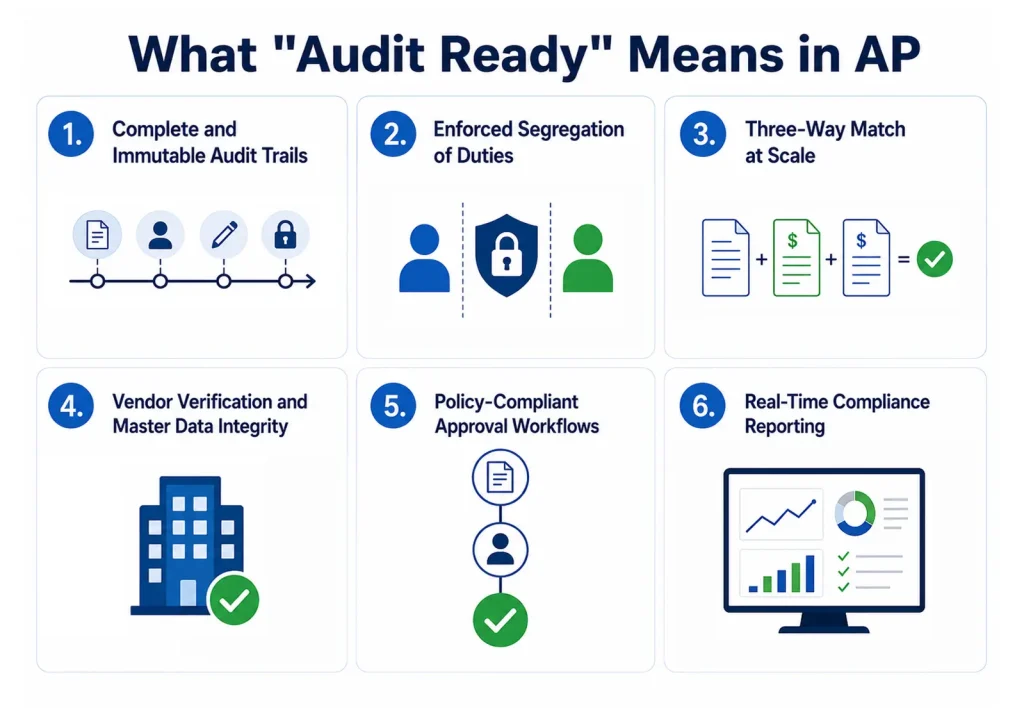
- Complete and Immutable Audit Trails Every invoice, approval, exception, and payment is logged with timestamps, user identity, and system-of-record linkage. Auditors trace a single transaction from PO issuance to payment posting in minutes.
- Enforced Segregation of Duties No single user can create a vendor, approve an invoice, and release a payment. SoD is enforced by system configuration – not by organizational convention.
- Three-Way Match at Scale PO, goods receipt, and invoice reconcile automatically. Exceptions route through a documented workflow — creating an auditable chain even for non-standard transactions.
- Vendor Verification and Master Data Integrity Clean, continuously validated vendor master with change logs. Banking detail changes require secondary approval. Sanction screening runs automatically.
- Policy-Compliant Approval Workflows Approval limits, escalation paths, and delegation rules configured in the system. When auditors ask, “Who approved this $250,000 invoice?”, the answer comes from the platform — with a timestamp — in under 60 seconds.
- Real-Time Compliance Reporting On-demand data exports. If producing a vendor payment history requires 48 hours, that delay itself becomes an audit finding.
Compliance Gap Diagnostic: Where Does Your AP Stand?
If more than three of these describe your current state, your AP process carries material audit risk:
- Invoice approvals happen primarily via email or chat
- No automated duplicate detection runs before payment release
- Vendor banking details can be changed without a secondary approval
- Approval delegation is handled informally, not system-enforced
- Your team cannot produce a complete invoice audit trail in under 10 minutes
- Payment runs include manual overrides that are not logged
- Vendor master has not been comprehensively cleaned in the past 12 months
- No systematic detection for invoices from blocked or sanctioned vendors
Each unchecked box is a real finding in a real audit — and a real financial or reputational risk.
Ready to See What Audit-Ready AP Looks Like in Your Environment?
A compliance-focused demo — scoped to your industry, audit requirements, and specific control gaps — will show you exactly where your current AP process stands and what it costs to close the gap.
Wait no more, and book your demo today. See immutable audit trails, SoD enforcement, vendor validation, and real-time compliance reporting in action – against your own AP scenarios.
The best time to become audit-ready was before the last audit. The second-best time is now.