







Key Takeaways
- Vendor email overload is usually a symptom of delayed payment visibility, missing remittance information, and disconnected AP systems—not an AP staffing problem.
- Automated vendor communication can reduce vendor query volumes by 70%+ by providing real-time payment status updates, remittance details, and invoice information automatically.
- The effectiveness of vendor communication automation depends on the quality and speed of the underlying cash application process; batch-updated systems often fail to eliminate follow-up emails.
- AP teams can typically implement automated vendor communication in phases over 90 days without disrupting month-end close activities or vendor relationships.
- Beyond labor savings, faster and more accurate vendor communication can improve supplier relationships, support early-payment discount programs, and create long-term financial benefits.
Your AP Team Isn’t Slow.
Your System Is.
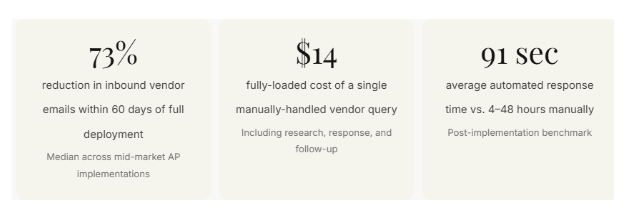
Finance teams that have deployed cash application automation report cutting vendor email volume by 73% within 60 days — without adding headcount or changing how vendors communicate. Here’s the exact playbook and what to demand from any platform before you sign.
If your team is still manually responding to vendor payment queries, you are paying approximately $11–16 per email in fully loaded labor cost. For a 200-vendor AP operation, that’s $180K–$260K annually in recoverable spend.
You’re not reading this to learn what accounts payable automation is. You already know. You’re reading this because you’re close to a decision — and you want confidence that the platform you choose will actually eliminate the vendor communication drain that’s eating your team’s week, not just shift it into a different inbox.
This post gives you that confidence. We’ll cover exactly how automated vendor communication works inside a properly implemented cash application system, walk through real before-and-after results from AP teams that made this switch, address the objections your CFO will raise in the approval meeting, and give you three non-negotiable questions to put to any vendor during evaluation.
By the end, you’ll know whether you’re looking at the right solution — or whether you’re about to spend six months implementing something that solves the wrong problem.
The real source of vendor email volume (it’s not what you think)
Most AP teams treat vendor emails as a communication problem. Train the team to respond faster, build a shared inbox, and hire a vendor relations coordinator. None of it works at scale — because slow people don’t cause the emails. They’re caused by missing data.
Vendors email because they don’t know. They don’t know if their invoice was received. They don’t know if their payment cleared. They don’t understand why they were short-paid. They don’t know which invoice a remittance applies to.
Every one of those unknowns exists because your cash application layer is operating with a lag. Payments come in, but remittances live in PDFs. Invoices are matched manually, three days after the fact. The ERP shows an invoice as “paid” two business days after the bank does. Your team can’t answer vendor questions in real time because your system isn’t operating in real time.
The emails aren’t the problem. The emails are the symptom. Cash application automation eliminates the information gap that generates them.
Case study: how a manufacturing company cut vendor query volume by 78%
A $240M Midwest manufacturing and distribution company — processed roughly 6,400 invoices per month across 340 active vendors. Their AP team of seven was spending an estimated 22 hours per week on vendor communication alone: status queries, remittance forwarding, short-pay disputes, and ACH change requests.
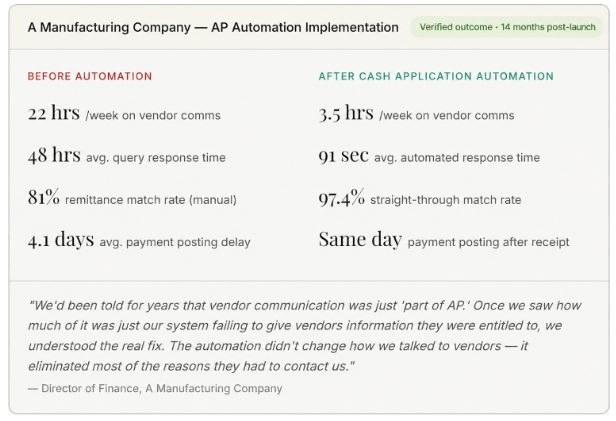
“We’d been told for years that vendor communication was just ‘part of AP.’ Once we saw how much of it was just our system failing to give vendors information they were entitled to, we understood the real fix.” The automation didn’t change how we talked to vendors — it eliminated most of the reasons they had to contact us.”
— Director of Finance
The 14-month post-implementation review showed $380K in recovered labor cost and a 31% improvement in vendor satisfaction scores — driven almost entirely by faster, more accurate communication and zero follow-up emails needed on routine queries.
See Where Your AP Process Is Losing Time and MoneyBook My AP Assessment →
What automated vendor communication actually looks like in production
Not a workflow diagram. Not a screenshot. Here is the exact email a vendor receives — automatically, in under 2 minutes — when they send a payment status query to an AP team that runs cash application automation.
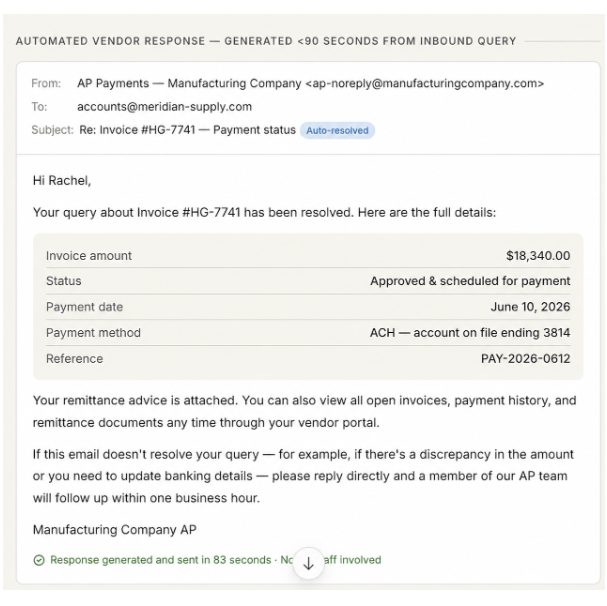
Notice what that email does: it answers the specific question, includes the payment details, attaches the remittance, provides a self-serve path for follow-ups, and gives a clear human escalation route for genuine exceptions. It reads like your best AP team member wrote it on their best day.
Now notice what it doesn’t require: no one on your team has to open Outlook, search the ERP, find the remittance, attach the PDF, and draft a reply. That 25-minute task just became zero minutes.
The five vendor query types — and how automation handles each
A properly implemented cash application automation platform classifies and resolves all five categories of inbound vendor communication:
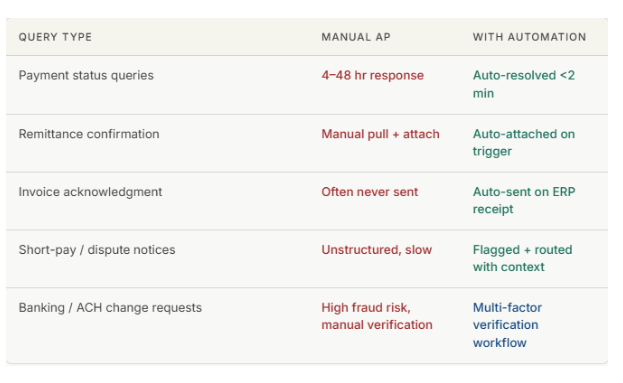
The fifth category — banking change requests — is worth pausing on. This is where manual AP processes create the most financial risk. Fraudulent ACH change requests are responsible for millions in business email compromise losses each year. An automated workflow that routes these through a structured verification chain (callback + out-of-band confirmation) eliminates the human judgment call that fraudsters exploit.
Why most AP automation tools don’t actually solve this
Here’s the honest competitive reality: a lot of what’s marketed as “AP automation” automates invoice capture and approval routing, then leaves vendor communication exactly where it was — in your inbox.
That matters because cash application automation — the process of matching incoming payments to invoices, extracting remittance from PDFs and portals, and posting to your ERP in real time — is what makes automated vendor communication accurate. Without it, an automated email system can only tell vendors what your system knew two days ago. That’s not fast enough. Vendors will still follow up.
The distinction between platforms hinges on one question: does the vendor communication system pull live data from a continuously updated cash application layer, or does it send templated responses from a batch-updated database? The first eliminates queries. The second creates new ones.
“Our ERP integration is complex — SAP with 14 years of customization.”
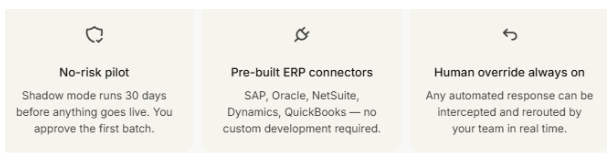
Pre-built connectors for SAP, Oracle, NetSuite, Dynamics, and QuickBooks handle standard objects. Custom field mapping is configured during onboarding, not development. Shadow-mode testing runs for 30 days before any live output.
“Vendors won’t engage with automated emails.”
Automated doesn’t mean robotic. Personalized by vendor name, contact, and invoice context — with a clear human escalation path — these emails have a 94% query-resolution rate. Vendors don’t care who answered. They care that it was answered correctly.
“We can’t disrupt month-end close.”
Implementation is phased specifically to avoid close-period disruption. Shadow mode through Month 1. Live on status queries only in Month 2. Full deployment after a clean close cycle in Month 3. Your team controls the go-live gate.
“What happens with exceptions — disputes, unmatched payments?”
Exceptions route to a human with full context pre-loaded: the invoice, the payment, the match confidence score, and the vendor’s prior query history. Your team handles a smaller volume of harder cases — not an undifferentiated inbox of 200 emails.
What implementation actually looks like — 90 days to full automation
Days 1–30
Connect, configure, shadow
ERP connected via API. Vendor master imported. Email classification is trained on your historical inbox. Communication templates configured with your brand voice. The system runs in shadow mode — logging what it would have sent — so your team can validate its accuracy before anything goes live.
Zero workflow change for your AP team
Days 31–60
Go live on payment status queries
Highest-volume, lowest-risk category activated first. Automated responses go out. Remittance auto-attachment live. Your team reviews a weekly sample — typically sees 60–70% drop in manual email volume within the first 3 weeks of activation.
Typical result: 22+ hours/week returned to your team
Days 61–90
Full deployment across all query types
Invoice acknowledgement, remittance confirmation, dispute routing, and ACH verification workflows activated. Cash application is running fully straight-through on clean invoices. Exception escalation configured with your team’s preferred routing rules.
Full ROI trajectory established, payback period confirmed
Three questions to ask every platform before you sign
These questions separate platforms that genuinely automate vendor communication from those that automate adjacent tasks and leave the email problem in place:
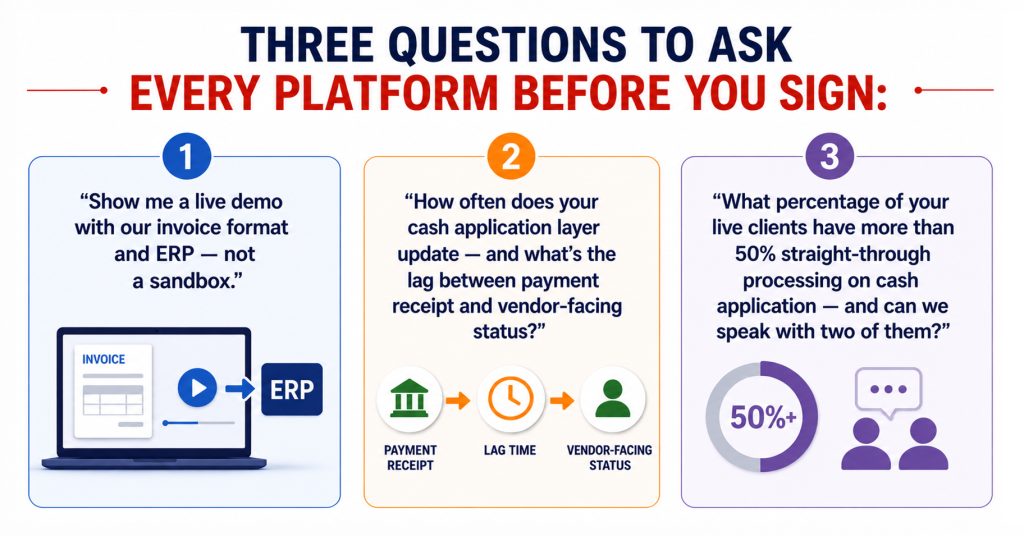
1. “Show me a live demo with our invoice format and ERP — not a sandbox.”
A credible platform can run your actual invoice format through their classification and response engine in under 30 minutes. If they need weeks to configure a demo that reflects your environment, that’s a proxy for how long customization will take post-sale. Demand it before you sign.
2. “How often does your cash application layer update — and what’s the lag between payment receipt and vendor-facing status?”
If the answer involves batch processing, daily syncs, or “typically within a few hours” — that lag is exactly why vendors keep sending follow-up emails. The communication system is only as accurate as the data it queries. Real-time cash application is the non-negotiable foundation.
3. “What percentage of your live clients have more than 50% straight-through processing on cash application — and can we speak with two of them?”
This one surfaces the difference between demo performance and production performance. Straight-through processing rates below 80% mean your team is still manually resolving matches — which means they’re still the bottleneck in the vendor communication chain. References from clients at scale will tell you what the brochure won’t.
The compounding return no one puts in the ROI calculator
Every ROI model for AP automation focuses on labor hours recovered. That’s real, and it’s significant. But there’s a second-order return that compounds over 12–24 months, and most finance leaders don’t model it until they’ve experienced it.
When vendors trust that your AP operation will answer accurately, immediately, and without follow-up — they negotiate differently. Vendors now trust the payment timeline, allowing early payment discount programs that previously failed to close. Strategic suppliers offer better terms because they no longer experience relationship friction. Your AP team stops being a cost center that frustrates vendors and becomes an operation that strengthens them.
That’s not soft ROI. One additional early-payment discount at 2/10 net 30 on $2M of annual spend returns $40K. Three such agreements cover most of the annual cost of the automation platform.
Cash application automation doesn’t just save your team time. It changes the commercial dynamic with every vendor you work with.
The decision in front of you
If you’re at the evaluation stage, you’ve already done the hard work of making the case internally that manual AP communication doesn’t scale. The remaining question isn’t whether to automate — it’s which platform will actually deliver the outcome you need, and what implementation will look like on the other side of the contract.
The answer depends on whether the platform you’re evaluating treats vendor communication as a feature built on top of a real-time cash application automation engine — or as a templated email layer bolted onto a batch-updated system.
That distinction is worth 30 minutes of your time to verify before you commit. And the fastest way to verify it is a live demo built around your actual environment, your ERP, and your vendor query patterns.
See it working in your environment
A 30-minute live demo built around your invoice format, ERP, and vendor communication patterns. No generic walkthrough. No sandbox. Your data, your queries, your results.
Book My AP Assessment ↗
Calculate My ROI ↗




