





Key Takeaways
- 2-way matching compares the PO and invoice; 3-way matching adds receipt verification.
- 2-way matching is ideal for services, subscriptions, and recurring spend.
- 3-way matching provides stronger controls for physical goods and inventory purchases.
- P2P automation applies matching rules automatically and reduces manual AP effort.
- The best approach is to use both methods based on spend category and risk level.
You’ve heard both terms thrown around in every P2P automation pitch. But the difference between them isn’t just a number — it’s a fundamentally different control philosophy. Here’s how to think it through.
Imagine your accounts payable team processes 3,000 invoices a month. Each one needs to be verified, approved, and paid — accurately, on time, and without creating a liability on the books. Now imagine doing that manually, cross-referencing spreadsheets, calling vendors for clarifications, and chasing down department heads for PO confirmations.
That’s the reality for most mid-market AP teams before P2P automation. And when they finally evaluate automation solutions, the first real fork in the road is the question: do we implement 2-way or 3-way matching?
The answer depends on what you buy, how you buy it, and how much financial risk your business can absorb. This guide breaks it down practically — not theoretically.
What is invoice matching, really?
Invoice matching is the process of verifying that a supplier’s invoice aligns with what your company actually ordered and received before releasing payment. It’s a foundational control in any procure-to-pay process, and the number in “2-way” or “3-way” refers to how many documents you’re comparing in that verification.
The core documents in play: Purchase Order (PO) — the formal commitment your company made to a vendor. Goods Receipt Note (GRN) — internal confirmation that goods or services were actually delivered. Vendor Invoice — the payment request from the supplier.
The matching process checks whether these documents agree on quantities, prices, line items, and terms. Discrepancies trigger exceptions. Exceptions require human review. And unresolved exceptions cause payment delays, strained vendor relationships, and audit headaches.
P2P automation doesn’t just speed up this process — it fundamentally shifts the focus of human attention.
2-Way matching: how it works in practice
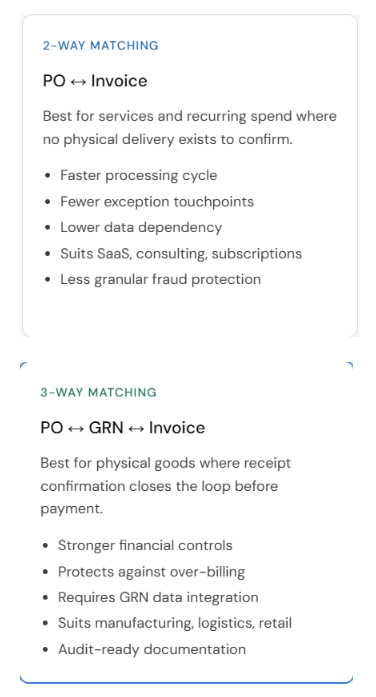
Two-way matching compares exactly two documents: the purchase order and the vendor invoice. If the invoice quantities, unit prices, and line items match the PO within your configured tolerance, the invoice is approved automatically and queued for payment.
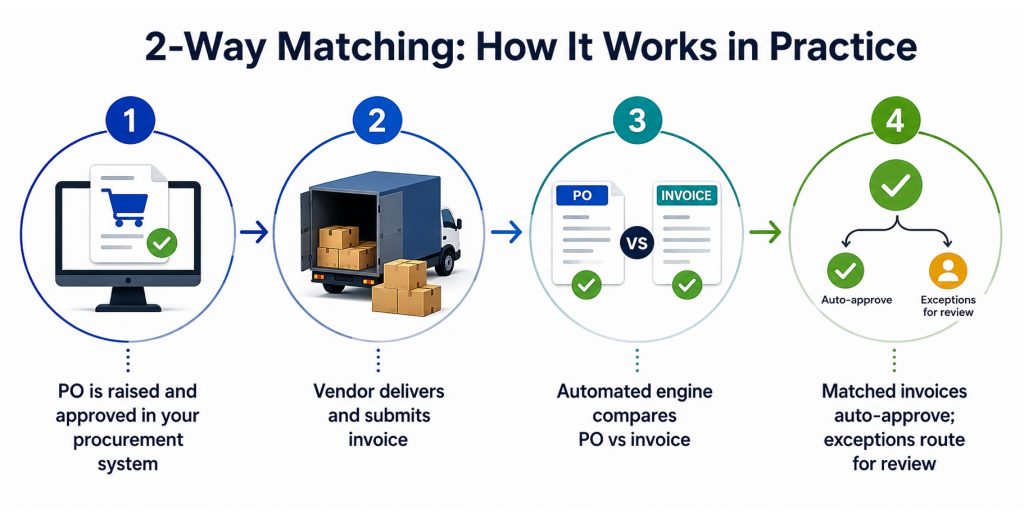
1. PO is raised and approved in your procurement system
Finance commits to a vendor for a defined scope, quantity, and price.
2. Vendor delivers and submits invoice
The invoice enters your AP system — via email capture, OCR, or vendor portal.
3. Automated engine compares PO vs invoice
Line-by-line matching happens in seconds. Tolerances are configured by category or vendor.
4. Matched invoices auto-approve; exceptions route for review
Your team only touches invoices that don’t match — which, in a well-configured system, is typically under 15%.
Two-way matching is the right fit for services, subscriptions, and recurring spend — categories where there’s no physical delivery to confirm. Think SaaS contracts, professional services retainers, consulting engagements, or maintenance agreements. For these categories, a GRN is conceptually impossible, so 3-way matching would just add friction without adding control.
3-Way matching: the additional layer
Three-way matching adds a third document to the comparison: the goods receipt note (GRN). Before an invoice is approved, the system verifies that not only does the invoice match the PO, but also that your warehouse, operations, or receiving team has confirmed actual delivery.
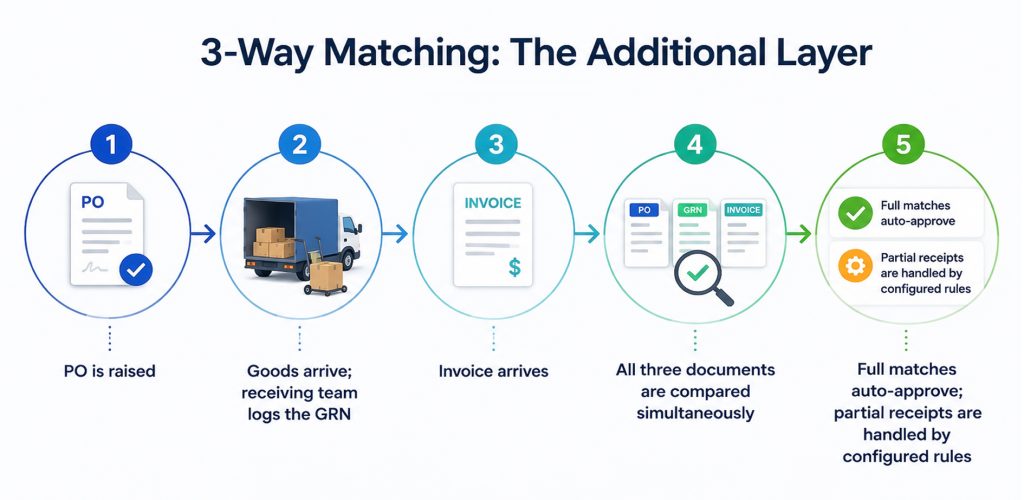
- PO is raised
Same as 2-way — your team commits to a vendor for defined goods. - Goods arrive; receiving team logs the GRN
Quantities, conditions, and delivery details are recorded — ideally in your ERP or inventory system, triggering an automaticdata feed into your P2P system. - Invoice arrives
Captured and parsed just like 2-way. The system now has three data sources to compare. - All three documents are compared simultaneously
Quantities on the invoice must match both what was ordered (PO) and what was received (GRN). A discrepancy on either comparison triggers an exception. - Full matches auto-approve; partial receipts are handled by configured rules
Modern P2P systems can handle partial delivery scenarios — approving payment for received quantities and holding payment for outstanding items.
Three-way matching is essential for physical goods procurement — raw materials, hardware, equipment, and inventory. Any category where a vendor could theoretically bill for goods not yet delivered, or where short deliveries are common, benefits from this extra layer of verification.
“Without receipt confirmation in the matching process, you’re trusting that every vendor is billing accurately for every delivery — and that’s a risk no CFO should be comfortable accepting at scale.”
Side-by-side: what actually changes
The role of P2P automation in making both work
Here’s what changes when you implement P2P automation: matching stops being a manual, document-by-document chore and becomes a real-time, rules-driven engine. But the sophistication of that engine matters enormously.
A basic automation tool might simply flag mismatches. A mature P2P automation platform will:
1. Ingest invoices automatically
Via OCR, e-invoicing standards (EDI, PEPPOL), or vendor portal submissions, it eliminates manual data entry and the errors that come with it.
2. Apply category-level matching rules
Run 2-way for your SaaS stack and 3-way for your raw material suppliers — all within the same platform, automatically routed by spend category or vendor type.
3. Handle tolerances intelligently
Define acceptable variance thresholds — for example, auto-approve invoices within 2% of PO value — so minor rounding differences don’t create unnecessary exceptions.
4. Route exceptions with context
When a mismatch occurs, the right reviewer sees the discrepancy in full document context — not just a notification to “check invoice #4821.”
5. Maintain a full audit trail
Every match, every exception, and every approval is timestamped and logged — without anyone having to manually update a spreadsheet.
80%
of invoices can auto-approve in a well-configured P2P system
3.5×
faster invoice cycle time with automated matching vs manual
60%
reduction in AP headcount hours spent on exception handling
Where most teams get this wrong
The most common mistake we see during P2P automation implementations is applying a single matching method across all spend categories. Companies either go too lenient (2-way on everything, leaving physical goods vulnerable) or too rigid (3-way on everything, creating processing backlogs for service invoices that can never generate a GRN).
The second mistake is underestimating the GRN dependency in 3-way matching. If your receiving team logs deliveries in a disconnected system – or on paper – your P2P automation can’t complete the 3-way match. The value of the third document only materializes when that data is captured digitally and flows into your matching engine in close to real time.
This is why ERP integration is not an optional add-on in serious P2P automation deployments — it’s the backbone of reliable 3-way matching.
How to choose: a practical decision framework
| Scenario | 2-Way | 3-Way |
| SaaS / subscription services | Yes | No |
| Consulting or professional services | Yes | No |
| Physical goods / inventory | No | Yes |
| Manufacturing raw materials | No | Yes |
| Capital equipment purchases | Maybe | Yes |
| High-value, one-time vendor engagements | Evaluate risk | Preferred |
| Recurring low-value utility bills | Yes | Over-engineered |
| Complex, mixed-spend portfolio | Both — configured by category in your P2P system | |
A word on compliance and audit readiness
For organizations operating under SOX, ISO 27001, or sector-specific procurement compliance requirements, the question of 2-way vs 3-way is often partially answered by your compliance team before your AP team even enters the conversation.
3-way matching creates a documented chain of evidence: someone ordered it, someone confirmed receipt, and then someone released payment. That three-point verification is exactly the paper trail auditors look for when reviewing high-value transactions.
P2P automation platforms that log every match decision — including which rule set was applied, what the variance was, and who approved exceptions — make audit preparation a reporting exercise rather than a document reconstruction project.
Key insight for compliance teams: The value of automated matching for audit purposes isn’t just accuracy — it’s consistency. A human AP processor might apply different judgment on different days. An automated matching engine applies the same rules every time, creating a defensible, consistent record.
Implementation reality: what to expect
If you’re evaluating P2P automation vendors right now, here’s the practical implementation landscape:
2-way matching can often be implemented and producing value within a few weeks. The main dependencies are ERP data access for PO sync and a clean invoice ingestion setup (OCR or portal). Configuration of tolerance rules takes a few days of calibration with your finance team.
3-way matching requires everything above plus a reliable, real-time feed of GRN data from your warehouse or operations system. If that integration doesn’t exist, it needs to be built — and that’s where timelines extend. Budget 6–12 weeks for a full 3-way matching deployment that covers your major goods categories.
The most resilient implementations start with 2-way matching across all categories, establish the baseline automation benefit, and then layer in 3-way matching for physical goods once the GRN integration is solid.
The bottom line
Two-way and three-way matching aren’t competing approaches — they’re complementary tools in a mature P2P automation strategy. The organizations getting the most value from invoice automation aren’t choosing one or the other; they’re applying the right method to the right spend category, automatically, within a unified platform.
If your AP team is still spending significant hours on manual invoice verification, the more important question isn’t which matching method to use — it’s whether your current process is leaving you exposed to payment errors, duplicate invoices, and audit risk that automated matching would eliminate entirely.
The matching method is a configuration decision. The bigger decision is whether your P2P infrastructure can support intelligent, category-aware automation at all.
Evaluating P2P automation for your AP team?
Wait no more and contact us today. Get a structured comparison of how leading platforms handle 2-way and 3-way matching — including integration requirements, exception workflows, and compliance reporting capabilities.