







Key Takeaways
- Visibility alone doesn’t create control. Real-time orchestration closes the coordination gap.
- Cognitive Control Towers move from alerts to action. They predict impact and trigger cross-functional workflows.
- Manufacturing complexity now exceeds manual coordination capacity. Human expertise needs intelligent augmentation.
- Execution—not dashboards—determines success. Detection, decision, and action must be tightly integrated.
- Adaptive plants outperform reactive ones. Cognitive orchestration builds resilience, not just efficiency.
Today’s large manufacturing plants are visually dominated by dashboards: production, maintenance, quality, and logistics—all displaying data, alerts, and KPIs. This proliferation of screens suggests control.
Yet, a sense of constant reaction persists: orders are expedited, suppliers are chased, breakdowns are escalated, lines are rescheduled, and customers require apologies.
The true issue isn’t a shortage of data; it’s the critical lack of real-time orchestration. This fundamental gap is why manufacturing needs Cognitive Control Towers.
This is not about adding another reporting layer or a better-looking dashboard. It requires a fundamentally different approach.
Also read: Why Manufacturing Needs Decision Automation, Not Just Process Automation
The Illusion of Visibility
Most plants already have some form of “control tower”. It’s usually a centralized room—or more often a virtual dashboard—pulling data from ERP, MES, WMS, and maintenance systems.
The ERP might be something like SAP S/4HANA. The MES could be Siemens Opcenter.
Logistics may sit inside Oracle SCM Cloud.
Each system works. Individually.
But they operate in silos of responsibility:
- Production optimizes output.
- Maintenance reduces downtime.
- Supply chain protects inventory.
- Quality reduces defects.
- Finance guards working capital.
No one is optimizing the system as a whole in real time.
So what happens? A planner reschedules a line to meet an urgent order. Maintenance isn’t informed that the machine due for preventive service is now running an extended shift. Two days later, it fails mid-cycle. The urgent order is delayed anyway.
Visibility was there. Coordination wasn’t.
What Makes a Control Tower “Cognitive”?
A traditional control tower aggregates data. A Cognitive Control Tower interprets it, predicts downstream impact, and orchestrates action across functions.
The difference is subtle but powerful.
Instead of: “Machine 4 has stopped.”
It understands: “Machine 4 has stopped. If it remains down for 2 hours, Order #1843 will miss dispatch. That affects a Tier-1 automotive customer. Overtime cost will increase by 12%. Alternative routing to Line B reduces impact but raises scrap risk by 3%. Recommend: route 70% to Line B, expedite tool change, notify logistics.”
That’s not reporting. That’s decision intelligence embedded in operations.
Cognitive Control Towers sit at the intersection of:
- Real-time plant telemetry
- Planning data
- Historical performance
- AI-based predictive models
- Workflow automation
They don’t just alert humans. They orchestrate workflows across systems and teams.
Real-Time Orchestration: The Missing Capability
‘Orchestration’ is a word that gets thrown around casually. In manufacturing, it’s often implemented poorly.
Here’s what real-time orchestration involves:
- Coordinating machines, labor, materials, and schedules simultaneously.
- Triggering cross-functional workflows automatically.
- The system continuously recalculates optimal states as conditions change.
Not every decision needs AI. But every major deviation needs a coordinated response.
Consider three common plant scenarios.
1. Unplanned Downtime
A CNC machine fails at 2:13 PM.
Traditional approach:
- Alert maintenance.
- Production supervisor reschedules manually.
- Planner updates ERP later.
- Logistics finds out when shipment slips.
Cognitive orchestration:
- Failure detected through IoT telemetry.
- Remaining useful life model recalculates impact.
- Production plan dynamically rebalanced.
- Alternative routing is evaluated based on capacity constraints.
- Customer delivery risk flagged.
- Automated notifications triggered only where necessary.
Notice something important: The system doesn’t spam everyone. It routes the right action to the right role at the right time.
That’s orchestration—not notification overload.
2. Supplier Delay
A shipment of critical components is delayed at port.
Plants usually respond by:
- Calling the supplier.
- Reviewing safety stock.
- Adjusting production schedules manually.
- Escalating to procurement leadership.
But the real impact is systemic:
- Line starvation risk
- Idle labor
- Overtime shifts later in the week
- Revenue deferral
A Cognitive Control Tower models all of this instantly.
It can:
- Re-sequence orders to consume alternate materials.
- Trigger partial builds.
- Evaluate substitute component viability.
- Calculate margin impact per scenario.
- Propose trade-offs explicitly.
Sometimes it will recommend absorbing short-term cost to protect a strategic customer. Other times, it may advise delaying lower-margin orders.
Not every plant is comfortable with that level of algorithmic guidance. But the ones that adopt it stop firefighting and start steering.
3. Quality Deviations
A spike in defect rates appears during second shift.
Traditional quality systems log the issue. Engineers investigate next day.
A cognitive layer:
- Correlates defect spike with environmental data (temperature, humidity).
- Cross-references operator changes.
- Detects tool wear patterns.
- Identifies similarity to prior incidents.
- Suggests immediate parameter adjustment.
More importantly, it simulates downstream effects:
- Scrap volume increase.
- Rework capacity impact.
- Delivery delays.
- Financial exposure.
Quality isn’t isolated. It cascades. Real-time orchestration prevents small deviations from compounding into systemic disruption.
Why Manufacturing Complexity Has Outgrown Manual Coordination
Plants used to operate within predictable variability. Not anymore.
Today’s environment includes:
- Shorter product lifecycles
- Higher SKU proliferation
- Custom configurations
- Just-in-time delivery expectations
- Globalized supply chains
- Workforce skill variability
Add Industry 4.0 technologies—such as IoT (Internet of Things) sensors, robotics, and advanced analytics—and you get data abundance without systemic intelligence.
The human brain cannot continuously optimize a plant with thousands of dynamic variables.
Spreadsheets won’t save you. And hiring more planners simply increases coordination overhead.
Cognitive Control Towers are not about replacing people. They reduce cognitive load so experts can focus on exceptions requiring judgment.
What a Mature Cognitive Control Tower Looks Like
There’s a misconception that this is just a software purchase.
It’s not.
A mature implementation usually includes:
Data foundation
- Unified data fabric across ERP, MES, WMS
- Near-real-time data ingestion
- Clean master data governance
Predictive intelligence
- Machine failure prediction
- Demand variability forecasting
- Inventory optimization models
- Quality anomaly detection
Decision modeling
- Constraint-based optimization
- Scenario simulation engines
- Trade-off analysis frameworks
Workflow automation
- Cross-functional task routing
- Automated approvals
- System updates without manual re-entry
Human-in-the-loop controls
- Escalation logic
- Override capabilities
- Governance thresholds
And yes, the hardest part is cultural, not technical.
Supervisors who’ve been running plants for 20 years don’t immediately trust algorithmic recommendations. Nor should they. Systems must earn credibility.
When Cognitive Control Towers Fail
Not every implementation succeeds.
Common failure patterns:
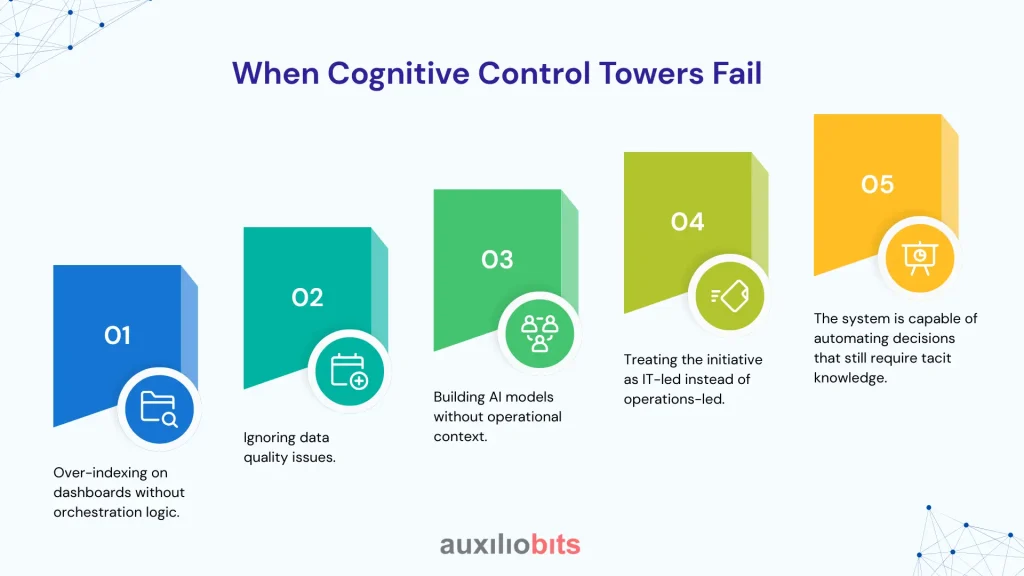
- Over-indexing on dashboards without orchestration logic.
- Ignoring data quality issues.
- Building AI models without operational context.
- Treating the initiative as IT-led instead of operations-led.
- The system is capable of automating decisions that still require tacit knowledge.
Subtle but Powerful Shifts
When plants adopt Cognitive Control Towers, several behavioral changes emerge:
- Planning meetings shrink from hours to minutes.
- Exception management becomes structured instead of emotional.
- Firefighting decreases—not eliminated, but contained.
- KPIs become predictive instead of retrospective.
There’s also a psychological shift. Teams move from reactive urgency to controlled responsiveness.
That matters more than most executives admit.
The Economics of Real-Time Orchestration
Let’s talk money.
The ROI typically manifests across:
- Reduced downtime
- Lower scrap and rework
- Inventory reduction
- Working capital optimization
- Improved on-time delivery
- Labor productivity gains
But the compounding effect is where it gets interesting.
When orchestration improves schedule reliability, customer trust increases. When trust increases, order volatility decreases. When volatility decreases, planning accuracy improves.
It’s a reinforcing loop.
However, organizations expecting immediate miracles will be disappointed. Cognitive maturity builds progressively.
A Practical Maturity Path
Most plants don’t leap into full autonomy. They evolve.
Stage 1: Visibility
Basic real-time dashboards.
Stage 2: Predictive Alerts
Early warnings for maintenance, quality, supply risks.
Stage 3: Assisted Decisions
Scenario modeling with recommended actions.
Stage 4: Orchestrated Execution
Automated cross-system workflows.
Stage 5: Semi-Autonomous Optimization
System-initiated rebalancing within governance thresholds.
Jumping straight to Stage 5 is unrealistic. Skipping foundational data hygiene is dangerous.
But staying at Stage 1 while competitors advance? That’s riskier.
Why This Matters Now
Manufacturing margins are tightening. Energy costs fluctuate. Supply chain shocks haven’t disappeared—they’ve normalized.
Plants can no longer afford:
- Latent decision cycles
- Disconnected systems
- Human bottlenecks in coordination
Real-time orchestration isn’t about futuristic ambition. It’s about operational resilience.
And resilience increasingly determines competitiveness.
A Final Observation
A better question might be, “How long can we operate without systemic coordination?”
The complexity curve isn’t flattening. If anything, electrification, sustainability mandates, and regional supply strategies will increase interdependencies.
Cognitive Control Towers aren’t a trend. They’re an architectural response to industrial complexity.
Plants that embrace them don’t become perfect. They become adaptive.
And in manufacturing, adaptability quietly beats brute efficiency over the long run.