





Key Takeaways
- Google’s A2A protocol shifts automation from static APIs to dynamic, goal-based inter-agent communication.
- It addresses gaps in context transfer, brittle workflows, and human-dependent escalation.
- A2A enables agentic AI to function as a coordinated and collaborative system, rather than isolated bots.
- Enterprises must invest in agent infrastructure, semantic goal modeling, and trust mechanisms to ensure effective collaboration.
- Intent protocols, such as A2A, will define the architecture of tomorrow’s enterprise automation.
In enterprise automation, traditional technologies are starting to show their limitations. While Robotic Process Automation (RPA) and API orchestration have offered substantial efficiency improvements, these solutions remain fundamentally brittle, limited in their context awareness, and highly dependent on static workflows. As enterprises strive to automate more complex, interdependent, and exception-heavy processes, there’s a clear need for systems that can think, plan, and adapt autonomously. This is where agent-to-agent communication protocols like Google’s A2A (Agent-to-Agent) come into play.
More than just an upgrade to how agents communicate, A2A represents a paradigm shift in enterprise automation. It moves us from simple task automation to dynamic, intent-driven collaboration between autonomous software agents. In this blog, we dive deep into how A2A works, why it matters, and how it sets the stage for a new era of intelligent automation.
Also read: Building Autonomous AI Agents for Manufacturing Control Systems
What Is Google’s A2A Protocol?
Google’s A2A protocol is designed to facilitate intelligent communication between autonomous software agents. Instead of merely sending commands or data, A2A allows agents to share intentions, negotiate roles, plan together, and even resolve conflicts in real-time. This is a significant leap from conventional message-passing protocols, which typically focus on predefined data formats and endpoints.
By enabling intent sharing and dynamic role assignment, A2A transforms the way digital agents interact. Agents become not just executors of functions but intelligent collaborators capable of making decisions, adjusting plans, and delegating tasks to better-suited peers. This is especially powerful in large-scale enterprise environments, where workflows cross departments, systems, and data boundaries.
A2A is a foundational technology for systems like Bard and internal orchestration engines at Google. The protocol supports emergent behaviors, such as fallback planning, priority negotiation, and outcome resolution—all essential for building autonomous enterprise ecosystems.
Why the Future Is Protocol-Driven?
As enterprise automation evolves from static workflows to dynamic, intelligent systems, one foundational shift is becoming clear: protocols, not APIs, will power the future of automation. Traditional automation relies on rigid APIs and hard-coded pathways, which work well for repetitive, predictable tasks but break down in environments that require adaptability and scalability.
Enter protocol-driven communication, particularly Agent-to-Agent (A2A) protocols. These enable intelligent software agents to interact based on shared goals, rather than just low-level instructions. Instead of tightly coupled integrations, agents use a common language of intent and constraints, unlocking genuine autonomy and collaboration across systems.
Here’s how this protocol-driven paradigm is reshaping the foundation of automation:
From API Calls to Intent-Based Communication
- Traditional enterprise systems rely on APIs, requiring knowledge of specific endpoints and tightly coupled logic.
- This model becomes rigid and unscalable as agent complexity increases.
- A2A (Agent-to-Agent) shifts communication from calling functions to expressing goals with constraints (e.g., “I need this done within these parameters”).
From Control Flow to Goal Flow
- Control flow follows fixed, sequential logic defined by humans.
- Goal flow enables agents to collaborate and dynamically choose optimal paths to achieve shared objectives.
- This introduces greater flexibility, adaptability, and resilience in complex systems.
From Stateless/Stateful to Goalful Systems
- Stateless systems do not remember past actions.
- Stateful systems retain memory of data and interactions.
- Goalful systems understand purpose and operate intelligently to achieve outcomes.
- Goalful architecture empowers agents to act autonomously based on overarching objectives, rather than relying solely on reactive logic.
Scalability Through Protocol Abstraction
- Protocol-driven models decouple logic and execution.
- Agents don’t need detailed knowledge of each other’s internals—just a shared understanding of goals and communication protocols.
- This abstraction dramatically improves scalability, interoperability, and system agility.
The Gaps in Today’s Automation Systems
Today’s automation solutions fall short in several ways. First, they are brittle—they break when unexpected exceptions occur or when process conditions change. Second, they are tightly coupled, which means business logic is hard-coded into scripts and cannot adapt dynamically. Third, there is an excessive dependence on human “stitching,” where humans must intervene to resolve issues, approve escalations, or manually coordinate cross-system workflows.
A significant gap is in context transfer. Agents or bots typically do not share memory or understanding. Each one starts from scratch, even if it’s working on a related subtask. This leads to inefficiencies and inconsistency.
A2A solves these gaps by enabling context-aware, goal-based communication. With shared memory graphs and semantic understanding, agents can reason more effectively and reduce dependency on human oversight. They can also dynamically hand off tasks, escalate decisions, or negotiate timelines, all through a unified protocol.
A2A’s Architecture: A Deeper Look
While Google hasn’t fully disclosed the A2A architecture, available patents and internal documentation offer some insights. The protocol likely includes the following components:
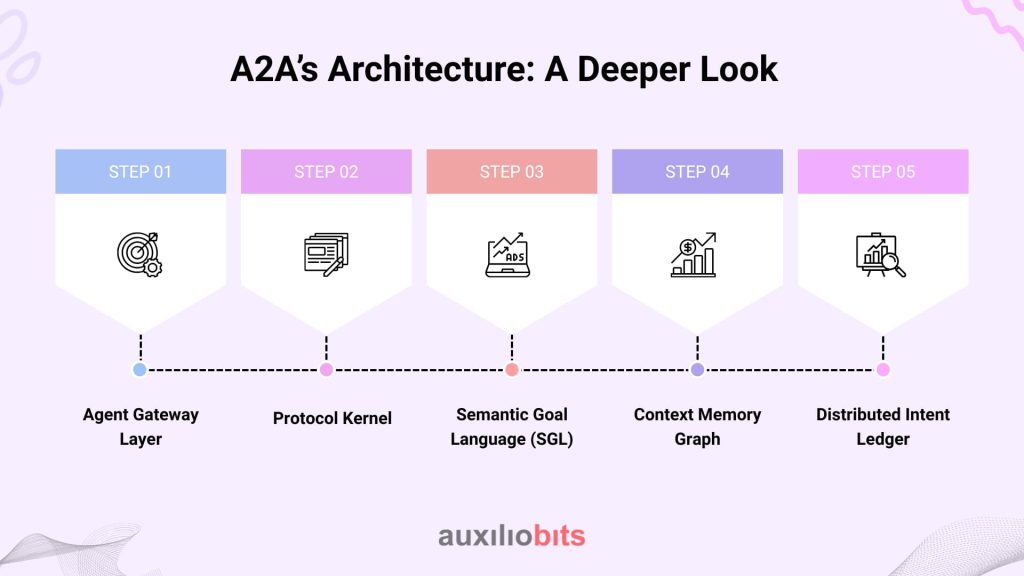
1. Agent Gateway Layer
This is the interface where agents register themselves, verify their identities, and obtain trust scores. It ensures only verified agents can participate in the network.
2. Protocol Kernel
The logic engine that interprets goals and matches them to available agent capabilities. It handles message translation, capability mapping, and fallback planning.
3. Semantic Goal Language (SGL)
A structured format for representing goals, constraints, and context. It enables agents to communicate intentions in a way that’s both machine-readable and LLM-compatible.
4. Context Memory Graph
A distributed memory system that stores previous interactions, decisions, and outcomes. It allows agents to learn from experience and coordinate using shared context.
5. Distributed Intent Ledger
A blockchain-inspired record of goals, tasks, and results. This ensures traceability and accountability in multi-agent operations, which is essential for compliance-driven industries.
Together, these components allow for scalable, auditable, and truly autonomous multi-agent coordination.
How does A2A advance Agentic AI?
Agentic AI is defined by agents that are capable of reasoning, planning, and acting toward goals with minimal human supervision. However, most current agents operate in silos. They lack the infrastructure to coordinate at scale, which limits their ability to tackle large, interdependent workflows.
A2A changes this by enabling autonomous delegation. An agent handling an invoice approval task, for instance, can delegate fraud-checking to a compliance agent and payment validation to a finance agent. These agents can further delegate subtasks, creating a dynamic web of task fulfillment that is adaptive and resilient.
A2A also enables contextual collaboration, where agents can share partial outputs, request clarifications, and adjust their strategies mid-execution based on peer feedback. This level of cooperation mirrors human teamwork more than any current automation solution.
Lastly, the concept of intent fusion allows multiple agents to converge their goals into a unified strategy. For example, agents responsible for compliance, finance, and legal can collaborate to fulfill a vendor onboarding process, ensuring that all stakeholder requirements are met simultaneously.
Real-World Implications Across Industries
The shift to Agent-to-Agent (A2A) communication is a fundamental change in how industries can operate with greater intelligence, speed, and resilience. Unlike traditional automation, which relies on static rules and brittle APIs, A2A empowers autonomous software agents to reason, plan, and act based on intent. These agents don’t just execute tasks—they collaborate, negotiate, and adapt based on context and goals.
This has significant implications across industries that suffer from fragmented systems, manual interventions, and latency between decision points. A2A removes the human “glue” currently required to stitch together workflows, empowering industries to automate high-stakes, high-complexity processes with far greater fluidity and autonomy.
Manufacturing: Smarter, Autonomous Supply Chains
- Use Case: Agents represent systems such as production planning, supply chain logistics, and inventory control.
- Real-World Impact:
- When a raw material shipment is delayed, a supply chain agent can autonomously notify a production planning agent.
- The agents can collaboratively evaluate constraints, such as deadlines and alternative sourcing.
- A procurement agent may renegotiate terms with the supplier or initiate a switch to a backup vendor without waiting for human approval or manual re-entry.
- This enables real-time Just-In-Time (JIT) adjustments, reduces downtime, and ensures production continuity.
- When a raw material shipment is delayed, a supply chain agent can autonomously notify a production planning agent.
Healthcare: Faster, More Coordinated Patient Journeys
- Use Case: Agents support processes like clinical decision support, treatment authorization, and compliance validation.
- Real-World Impact:
- A diagnostic agent detects a condition and communicates with an insurance verification agent to authorize treatment.
- Simultaneously, a compliance-checking agent ensures all documentation meets regulatory requirements (e.g., HIPAA).
- Agents can coordinate approvals in parallel, drastically reducing the typical 3–5 day lag caused by manual back-and-forth.
- This accelerates care delivery, improves outcomes, and reduces administrative burden on providers.
- A diagnostic agent detects a condition and communicates with an insurance verification agent to authorize treatment.
Banking: Real-Time Decision-Making with Lower Risk
- Use Case: Agents handle KYC checks, loan underwriting, risk assessment, and fraud detection.
- Real-World Impact:
- A customer applies for a loan. The KYC agent validates identity documents and communicates findings to a credit underwriting agent.
- A risk agent scores the applicant in real time, while a fraud detection agent cross-references activity patterns with known red flags.
- Rather than being sequential, these actions occur concurrently through A2A protocols, enabling instant decision-making.
- The result is faster loan approvals, improved compliance with regulatory requirements, and lower exposure to fraud.
- A customer applies for a loan. The KYC agent validates identity documents and communicates findings to a credit underwriting agent.
These examples are not hypothetical. Protocol-driven agent collaboration is already being piloted and deployed in real enterprise settings. A2A enables agents to cooperate with purpose, make intelligent decisions, and eliminate the inefficiencies of traditional API-based orchestration. It marks the beginning of a new era in enterprise automation—one where software not only executes but also collaborates to achieve business goals.
What Enterprises Must Prepare For?
Enterprises looking to embrace A2A must undergo several foundational shifts:
- Agentification: Re-engineer bots and workflows into autonomous agents that can operate independently and make decisions.
- Goal Modeling: Define business needs in terms of outcomes and constraints, not tasks or APIs.
- Trust Infrastructure: Implement mechanisms for agent identity, access control, and trust scoring.
- Composable Repositories: Maintain registries of available agents, their capabilities, and interoperability protocols to facilitate seamless integration.
Organizations should also invest in semantic modeling, LLM integration, and intent translation layers to future-proof their automation investments.
Comparing A2A to Traditional Orchestration
| Capability | Traditional Orchestration | Google A2A Protocol |
| Communication | Static API Calls | Dynamic Intent Messaging |
| Coordination | Central Workflow Engine | Distributed Multi-Agent Planning |
| Adaptability | Low | High |
| Context Sharing | Minimal | Shared Memory Graphs |
| Error Handling | Manual or Predefined | Autonomous Fallback Mechanisms |
While traditional orchestration tools are helpful for linear, predictable processes, A2A is designed for adaptive, autonomous environments that are constantly in flux.
Final Thoughts: Beyond APIs to Intent Protocols
Google’s A2A protocol isn’t just a technical innovation; it’s a foundational rethinking of how intelligent systems interact. By moving beyond static APIs and embracing intent protocols, A2A unlocks a new paradigm of enterprise automation—one where software agents are capable of collaboration, negotiation, and continuous adaptation.
As we move toward this goal-driven future, enterprises must prepare not just technologically but culturally. Business users, IT teams, and process owners will need to think in terms of goals, trust, and capabilities rather than tasks, scripts, and functions.
In a world where agents talk, reason, and act on their own, the enterprise becomes a living ecosystem—self-regulating, self-healing, and exponentially more intelligent.