







Key Takeaways
- APA shifts automation from rigid task execution to adaptive goal fulfillment, enabling software agents to handle complex, exception-heavy processes with minimal human oversight and real-time decision-making.
- Agentic autonomy transforms process ownership, allowing intelligent agents to manage business outcomes across functions, boosting efficiency, consistency, and cross-system coordination.
- APA-ready processes often exhibit fragmentation, such as frequent manual escalations or human “stitching,” indicating opportunities for intelligent agents to bring cohesion and context-aware automation.
- Practical APA adoption begins by modeling intent, integrating observability, utilizing prompt libraries, and treating digital agents as accountable contributors with metrics and key performance indicators (KPIs).
- The actual value of APA lies in operational intelligence, not just efficiency, measured by autonomy levels, agent resilience, and their ability to self-improve, collaborate, and fulfill enterprise-wide goals.
Autonomy in business isn’t a future state—it’s becoming a competitive necessity. Organizations that continue to rely on fragmented automation strategies are reaching a ceiling in terms of speed, adaptability, and decision-making agility. They struggle to respond to unstructured data, cross-platform workflows, and real-time exceptions. The answer lies in a paradigm shift: Agentic Process Automation.
APA isn’t about replacing humans with robots. It’s about designing systems that can self-navigate, self-adapt, and self-resolve. Think of APA not as a technology layer, but as a strategic architecture where autonomous software agents manage business operations with judgment, collaboration, and intent, much like your best employees do.
In this blog, we explore how APA builds autonomous business processes, provide new perspectives on its architecture, and share practical guidance you can implement today.
Also read: RPA in 2025: Trends, Tools, and What CIOs Should Prepare For
Redefining Process Ownership Through Autonomy
Traditionally, ownership of business processes resides with specific departments or roles—finance owns payables, HR owns onboarding, and IT owns ticket triaging. While effective in hierarchical organizations, this model doesn’t scale well when processes are:
- Cross-functional (e.g., customer onboarding touches sales, legal, risk, and IT)
- Exception-prone (e.g., procurement in emerging markets)
- Volatile (e.g., pricing workflows during global supply chain disruptions)
APA redefines ownership. With APA, goal-driven agents take operational responsibility. These agents are not assigned to departments but rather to specific business outcomes and objectives. For instance:
- An APA agent owns the goal of “onboarding vendor X within compliance guidelines.”
- Another agent owns “Ensure orders from Region Y are delivered within 3 days.”
This shift from process ownership to goal ownership is the first step in building autonomy into enterprise operations.
What Makes APA Fundamentally Different from AI-Enabled Automation?
AI-powered automation often adds intelligence to rule-based systems—e.g., using OCR to read documents or chatbots to respond to FAQs. But APA is fundamentally different in three key ways:
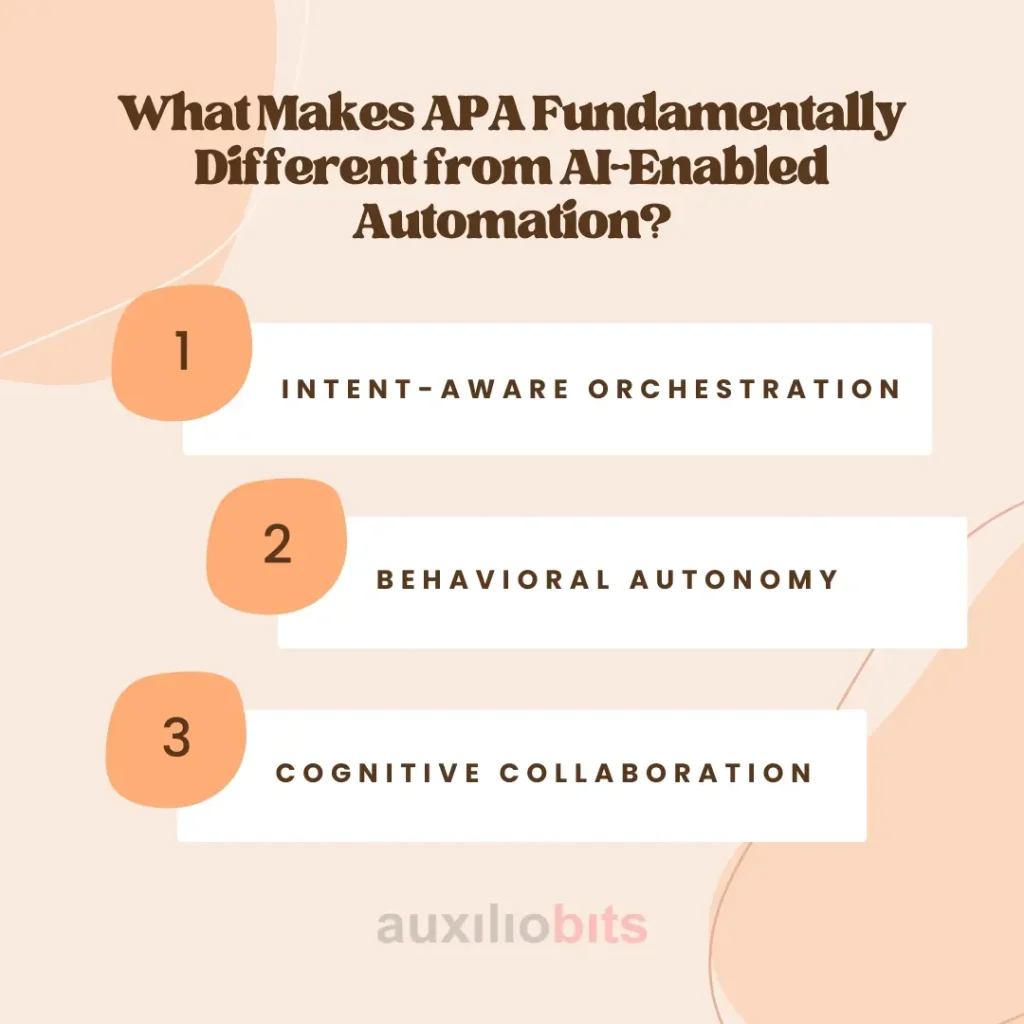
1. Intent-Aware Orchestration
APA agents are orchestrated based on their understanding of intent, not just workflow steps. If the goal changes due to external factors (e.g., a change in compliance rules), the agent recalibrates its execution.
2. Behavioral Autonomy
APA agents act proactively. Unlike RPA bots that await triggers, APA agents monitor changes (in data, systems, customer behavior) and initiate actions based on predefined or learned behavior models.
3. Cognitive Collaboration
APA agents do not operate in silos. They communicate via structured messages (using internal agent communication protocols) and can negotiate, escalate, or reallocate tasks among themselves, much like teams do in a physical workspace.
Emerging APA Design Models (2025 and Beyond)
Enterprises looking to scale APA must look beyond monolithic implementations. Here are three APA design patterns gaining traction:
1. Reactive-Monitoring APA
Agents continuously monitor high-volume transactional systems (like ERPs or ticketing platforms) and respond to anomalies (e.g., spike in failed orders). These agents use event-stream processing rather than batch triggers.
2. Mission-Oriented Multi-Agent Collectives
Instead of assigning an agent per task, a collective of agents is assigned a mission, such as “launch new product in 3 regions.” Agents self-organize, take roles, and coordinate using planning protocols like Teamwork Theory or Distributed Constraint Optimization.
3. Layered APA Mesh Architecture
Inspired by Zero Trust security models, APA is being deployed as a mesh layer between enterprise systems—sitting invisibly between frontends (like CRMs) and backends (like ERPs), mediating requests, decisions, and escalations via agent interactions.
These models allow APA to be scalable, resilient, and invisible, thereby enhancing—not disrupting—existing IT investments.
How to Identify APA-Ready Processes in Your Organization?
Before diving into implementation, it’s critical to identify which workflows are best suited for APA. Look for processes that show these indicators:
| APA Readiness Signal | Description |
| Human “stitching” | Processes where humans copy-paste across apps or interpret unclear cases |
| Contextual escalation | Scenarios needing human review because bots can’t decide |
| Data diversity | Inputs from documents, emails, PDFs, APIs, and calls |
| Multi-system dependency | Workflows touching 3+ systems with no single owner |
| Goal drift | Business outcomes vary based on time, geography, or context |
These are the prime candidates where APA can take over and deliver superior results.
Tips for Integrating APA into Everyday Operations
Adopting APA doesn’t require a full-stack overhaul. It requires intentional, strategic integration. Here’s how to begin:
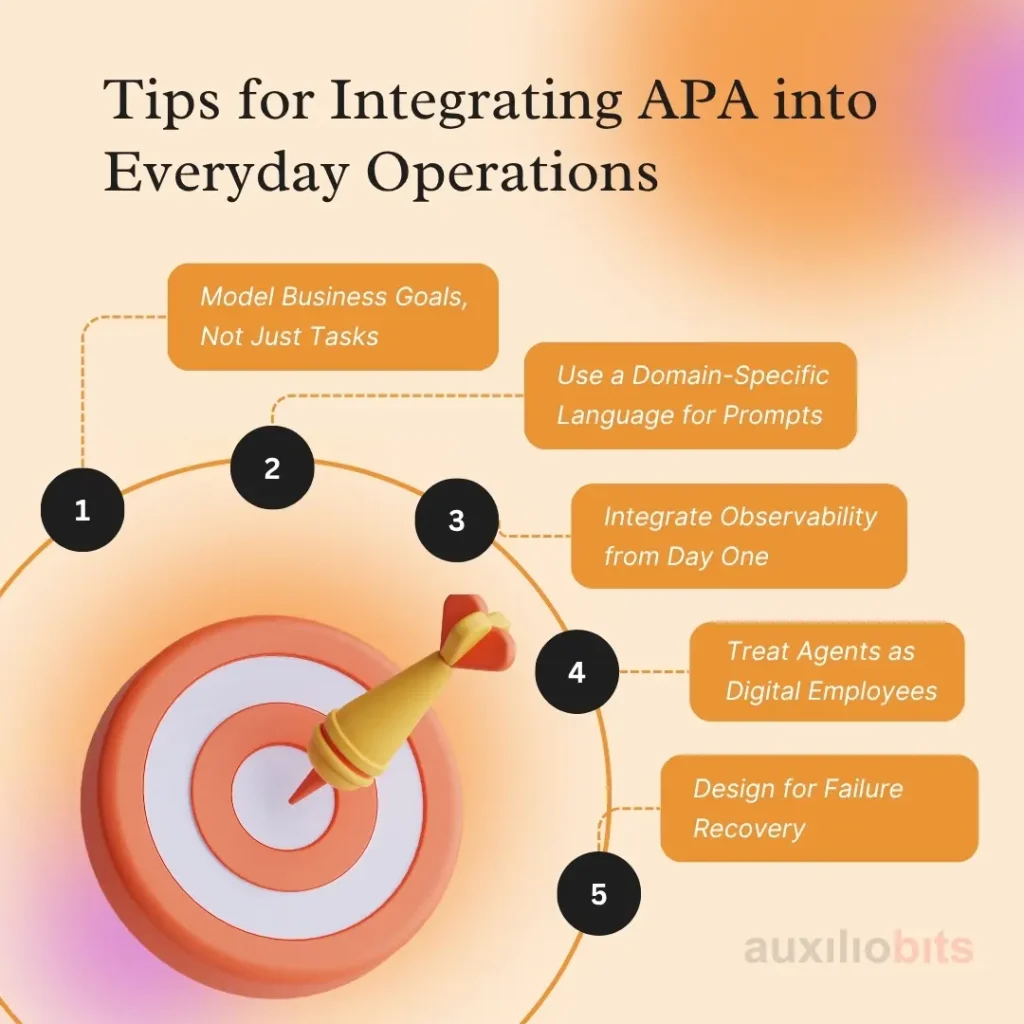
1. Model Business Goals, Not Just Tasks
Replace flowcharts with goal graphs. A goal graph breaks down business outcomes into sub-goals and tasks, allowing for a clear understanding of the overall objectives. Each node can then be mapped to an agent.
Tip: Use frameworks like Goal-Oriented Requirements Language (GRL) to translate process maps into agent goals.
2. Use a Domain-Specific Language for Prompts
Generic prompts (“summarize this invoice”) produce erratic results. Use structured prompting templates specific to your industry (e.g., “Extract PO number, item description, and due date from invoice; cross-check with GRN”).
Tip: Build prompt libraries tailored to processes (claims, orders, compliance checks).
3. Integrate Observability from Day One
APA agents must be observed like microservices. Set up dashboards for agent activity logs, intent success rates, and decision traceability.
Tip: Use tools like OpenTelemetry for agent observability across distributed systems.
4. Treat Agents as Digital Employees
Assign APA agents KPIs—like First Contact Resolution (FCR), Cycle Time, and Accuracy %—and include them in your operational dashboards.
Tip: Have a “Digital Workforce Review” every month, just like employee performance reviews.
5. Design for Failure Recovery
Even autonomous agents can hit unknowns. Build fallback strategies—e.g., “If supplier tax ID is unrecognized, send to compliance agent, not to human.”
Tip: Utilize decision trees and LLM-based recovery strategies for enhanced resilience.
Business Impact Metrics That Matter for APA
When measuring APA impact, don’t just track cost savings. Focus on strategic outcomes:
| Metric | Why It Matters |
| Agent Cycle Time | Measures end-to-end time from intent to outcome |
| Autonomy Index | % of process completed without human intervention |
| Exception Resolution Time | Time taken for agents to resolve unexpected scenarios |
| Agent Reusability Ratio | Tracks how many processes reuse the same agent module |
| Business Goal Fulfillment Rate | % of agent goals achieved successfully in production |
These KPIs move you from measuring efficiency to measuring enterprise intelligence.
Future Outlook: APA in the Self-Driving Enterprise
Just as self-driving cars handle speed, lanes, and signals independently, the self-driving enterprise will rely on APA to:
- Process invoices without AP involvement
- Onboard customers while aligning with compliance
- Fulfill orders without logistics micromanagement.
- Monitor threats without manual triage.
APA lays the groundwork for this vision. It turns automation from a back-office enhancement into a core operational capability.
Conclusion: It’s Time to Rethink How Work Gets Done
Agentic Process Automation is not a replacement for automation—it’s a reimagination of enterprise work. It allows organizations to delegate not just tasks, but intent and responsibility to autonomous agents. By doing so, businesses move closer to operational systems that can honestly think, adapt, and execute at scale.
If you’re still automating steps instead of outcomes, it’s time to pause and rethink. Because in the world ahead, work won’t be automated—it will be autonomously governed.