





Key Takeaways
- AI Sales Co-Pilots = decision support layer, not just another sales automation tool.
- In manufacturing, better decisions matter more than faster tasks—constraints drive everything.
- The strongest use cases sit around pricing, capacity alignment, and customer prioritization.
- Adoption depends less on AI accuracy and more on trust, usability, and workflow integration.
- The real ROI shows up in decision speed, margin protection, and cross-functional allgnment—not flashy automation metrics.
Manufacturing sales has never really been about selling products. It’s about navigating constraints.
You’re balancing production capacity, fluctuating raw material costs, distributor relationships, delivery timelines, and increasingly—customer expectations shaped by digital-first industries. The “sales process” is less of a funnel and more of a negotiation between what the business can deliver and what the customer needs right now.
Despite these changes, the majority of sales teams continue to rely on fragmented CRM notes, Excel sheets, email threads, and instinct.
AI Sales Co-Pilots are beginning to transform the equation by not replacing salespeople, but by enhancing the feedback loop between data and decision-making. Manufacturing is particularly challenging, as decisions are seldom straightforward and almost always interconnected.
The Real Problem: Decision Latency in Manufacturing Sales
If you sit with a manufacturing sales manager for a day, one thing becomes obvious: decisions are delayed—not because people lack expertise, but because the information required is scattered or outdated.
A typical scenario: A customer requests a bulk order with customized specifications and a tight delivery window. Before responding, the sales rep needs to check:
- Current production capacity
- Inventory levels across warehouses
- Supplier lead times
- Pricing thresholds and discount policies
- Historical relationship with the customer
- Credit limits and payment behavior
None of this data sits in one place. And even if it did, interpreting it quickly is another challenge altogether.
So what happens?
- Responses are delayed
- Quotes are conservative (or sometimes overly aggressive)
- Opportunities quietly slip away
This issue isn’t a tooling problem—it’s a decision support gap. And that’s precisely where manufacturing solutions for sales co-pilotsal value.
What AI Sales Co-Pilots Do
There’s a tendency to lump everything under “AI in sales”, but most implementations fail because they focus on automation rather than augmentation.
AI Sales Co-Pilots, when done right, are not task bots. They’re decision companions embedded into the sales workflow.
They help answer questions like:
- Can we realistically commit to this delivery timeline?
- Is this pricing aligned with margin targets given current cost fluctuations?
- Which customers are likely to convert this quarter based on behavioral signals?
- What’s the risk of stockout if this order is approved?
Instead of pulling reports or calling three different teams, the sales rep receives contextual recommendations in real time. Not perfect answers. But informed ones.
And that distinction matters.
Also read: Designing an Agentic Automation Roadmap for Manufacturing
Why Manufacturing Is Uniquely Positioned for Co-Pilots
Interestingly, manufacturing is both behind and ahead when it comes to adopting AI in sales. Behind—because legacy systems and siloed data make implementation harder. Ahead—because the complexity of decisions creates a stronger need for intelligent support.
Unlike SaaS or retail, manufacturing sales involves:
- Configurable products (not just SKUs)
- Variable pricing structures
- Long sales cycles with multiple stakeholders
- Tight coupling between sales and operations
Such complexity makes intuition alone unreliable. Even experienced salespeople struggle when variables change rapidly—like during supply chain disruptions or sudden demand spikes. An AI co-pilot doesn’t eliminate complexity. It makes it navigable.
Decision Support in Practice: Where Co-Pilots Help
Let’s move away from theory and look at where these systems deliver tangible value.
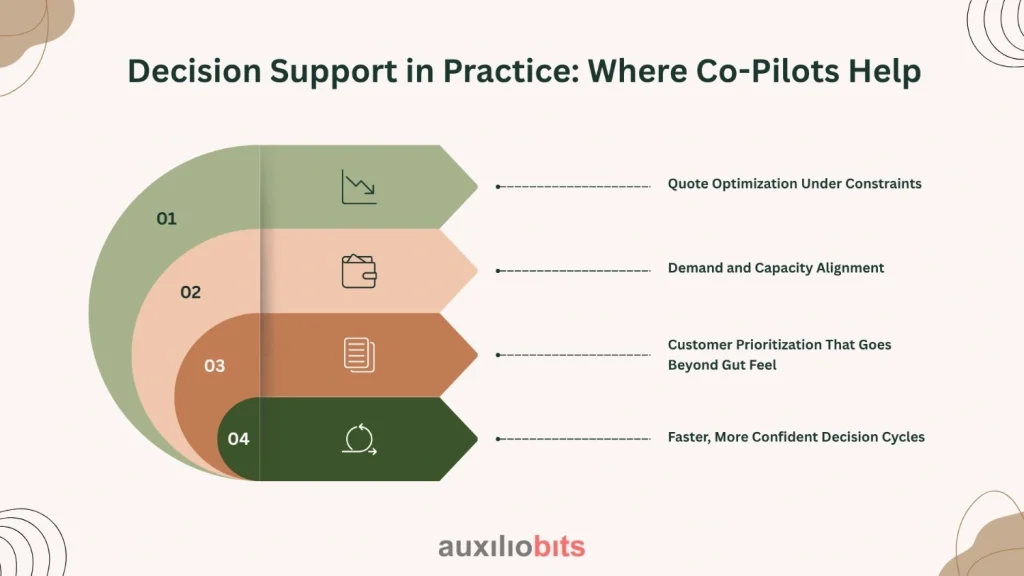
1. Quote Optimization Under Constraints
Pricing in manufacturing isn’t just about competitiveness—it’s about protecting margins without losing deals.
AI Sales Co-Pilots can:
- Analyze historical deal data to suggest optimal pricing ranges
- Factor in raw material cost trends
- Recommend discount thresholds based on customer segmentation
- Flag deals that are likely to erode margins
But here’s the nuance: these recommendations aren’t always followed. And that’s okay.
Sales teams often override suggestions based on relationship context or strategic priorities. The value lies in making the trade-offs explicit, not enforcing rules.
2. Demand and Capacity Alignment
One of the more painful realities: sales teams often oversell, promising what operations can’t deliver on time.
Co-pilots bridge this gap by:
- Pulling real-time production schedules
- Highlighting capacity constraints
- Suggesting alternative delivery timelines or split shipments
Occasionally, they even recommend not pursuing a deal. That’s a challenging pill to swallow. But in industries where delayed delivery damages long-term trust, it’s often the right call.
3. Customer Prioritization That Goes Beyond Gut Feel
Every sales team claims to “know their customers”. And to be fair, they usually do—at a relationship level.
But when it comes to prioritizing accounts at scale, intuition breaks down.
AI Sales Co-Pilots bring in signals like:
- Order frequency trends
- Payment behavior
- Engagement patterns across channels
- Industry-specific demand indicators
Such analysis enables:
- Smarter pipeline prioritization
- Early identification of churn risks
- Focused upsell and cross-sell strategies
It’s not about replacing judgment—it’s about augmenting it with patterns humans can’t easily see.
4. Faster, More Confident Decision Cycles
This area is where the real impact shows up.
When sales reps don’t have to:
- Manually gather data
- Validate assumptions
- Wait for approvals
And in manufacturing, speed is often the difference between winning and losing a deal. Not because customers are impatient (though they are), but because competitors are getting faster.
A Quick Reality Check: Where AI Co-Pilots Fall Short
It’s tempting to paint an overly optimistic picture. But AI Sales Co-Pilots are not magic.
There are real limitations:
- Data quality issues: Garbage in, garbage out still applies
- Over-reliance risk: Some reps blindly trust recommendations without questioning them
- Integration complexity: Connecting ERP, CRM, and supply chain systems is rarely straightforward
- Change resistance: Sales teams don’t always welcome “advice” from a system
In fact, some early implementations fail because they try to force adoption rather than earning trust. A co-pilot that interrupts workflows or provides generic suggestions quickly becomes irrelevant.
What Makes a Co-Pilot Useful?
After seeing multiple deployments (some successful, some not), a few patterns stand out.
Effective AI Sales Co-Pilots:
- Surface insights within existing tools (CRM, email, etc.)
- Provide explainable recommendations—not black-box outputs
- Allow easy overrides without friction
- Learn from user behavior over time
- Focus on decision points, not just data presentation
There’s also a subtle but important point: the best systems don’t try to do everything. They focus on a few high-impact decisions and do them well.
A Real-World Scenario
A mid-sized industrial equipment manufacturer was struggling with inconsistent deal margins.
Sales reps were offering discounts based on experience, but:
- Raw material costs had become volatile
- Procurement delays were affecting delivery timelines
- Finance teams were flagging margin erosion
They introduced an AI Sales Co-Pilot that:
- Suggested pricing ranges based on current cost inputs
- Highlighted deals below target margin thresholds
- Recommended alternative configurations when needed
The result?
Not a dramatic overnight transformation—but within a few months:
- Margin consistency improved
- Approval cycles shortened
- Sales and finance alignment got… less painful
Interestingly, the biggest win wasn’t accuracy. It was confidence. Sales reps felt more comfortable making decisions because they had data-backed support.
The Subtle Shift: From Automation to Augmentation
There’s been a lot of noise around automating sales tasks—email generation, CRM updates, and lead scoring.
Useful? Sure. Transformational? Not really. The real shift is happening in decision augmentation.
AI Sales Co-Pilots are not about doing the work for sales teams. They’re about:
- Reducing cognitive load
- Highlighting trade-offs
- Enabling faster, better-informed decisions
This shift is particularly impactful in manufacturing, where operational realities tightly link decisions.
Where This Is Heading
We’ll likely see deeper integration between sales co-pilots and:
- Supply chain intelligence systems
- Predictive maintenance data (for aftermarket sales)
- Market demand forecasting models
The vision is compelling: a fully connected ecosystem where real-time enterprise data informs every sales decision. However, it’s important to acknowledge that the majority of organisations have not yet reached this level.
Legacy systems, data silos, and organizational inertia don’t disappear overnight. So while the long-term potential is significant, the near-term value lies in targeted, practical implementations.
A Few Practical Takeaways for Manufacturing Leaders
If you’re considering AI Sales Co-Pilots, a few grounded observations:
- Start with one decision area (pricing, prioritization, or capacity alignment)
- Don’t wait for perfect data—but don’t ignore data quality either
- Involve sales teams early; adoption is as much cultural as technical
- Measure impact in terms of decision speed and confidence, not just revenue
- Accept that some recommendations will be ignored—and that’s fine’
And perhaps most importantly: Don’t treat co-pilots as a technology project. They’re a decision support layer for your sales organization.
Where It Connects to Broader Automation Strategy
There’s a natural alignment between AI Sales Co-Pilots and broader enterprise automation initiatives—especially those focused on Agentic AI and intelligent workflows.
In fact, organizations investing in agentic process automation are better positioned to:
- Integrate co-pilots with operational systems
- Enable autonomous data flows between sales and execution layers
- Create feedback loops that continuously improve decision quality
But—and this point is worth emphasising—the goal isn’t to replace human decision-making. The goal is to make it sharper, faster, and more consistent.
There is no denying that manufacturing sales has always been complex. That’s not changing.
What is changing is how decisions are made. And in a world where speed, precision, and adaptability matter more than ever, relying solely on instinct feels… increasingly risky.
AI Sales Co-Pilots don’t eliminate that risk.
But they make it a lot more manageable.