


Key Takeaways
- Marketing data in manufacturing is often fragmented because critical information lives across ERP, CRM, partner systems, and service platforms.
- The CRM–ERP disconnect is a major barrier preventing marketers from linking campaigns directly to revenue and product performance.
- Distributor and partner ecosystems create visibility gaps, making it difficult to track how leads convert into actual orders.
- Technology alone doesn’t solve silos—organizational alignment, data governance, and shared ownership are equally important.
- Manufacturers that unify their customer data gain clearer market insights, stronger campaign targeting, and better revenue attribution.
Manufacturing companies build complex machines, operate global supply chains, and manage engineering processes that involve thousands of variables. Yet many of them still struggle with something that seems far simpler: connecting their marketing data.
It sounds strange at first. Manufacturing is one of the most technologically advanced industries in the world. Factories run on ERP systems, production planning software, and automated quality monitoring tools. But when you step into the marketing and sales operations side of the business, a very different picture appears.
Campaign performance data sits in one platform. Customer history lives somewhere else. Channel partners maintain their records. Product usage insights might be stored in a service management system that marketing rarely accesses, leading to missed opportunities for targeted campaigns and a lack of understanding of customer needs. The result is a fragmented view of customers and prospects.
And that fragmentation quietly erodes marketing effectiveness.
Manufacturing marketing teams often know something is wrong—leads stall, campaigns feel unfocused, and pipeline visibility is inconsistent—but the root problem isn’t always obvious. The issue isn’t necessarily poor strategy. More often, it’s disconnected information.
Data silos remain one of the most persistent barriers to effective marketing in the manufacturing sector.
The Structural Reality of Manufacturing Organizations
To understand why these silos exist, you have to start with the structure of manufacturing companies. Unlike many digital-first industries, manufacturing businesses evolved around operational systems rather than customer data platforms. Their core technology stack historically centered on production planning, inventory management, engineering documentation, and procurement.
Marketing systems came later. By the time CRM platforms and marketing automation tools arrived, the organization already had a complex ecosystem of operational software. These systems weren’t designed to share data easily with marketing platforms, which has created significant challenges for organisations trying to integrate their marketing efforts with existing operational software. In many cases, they still don’t.
A typical mid-sized manufacturer might operate with:
- An ERP system managing orders, pricing, and invoices
- A CRM used by the sales team
- Marketing automation software for campaigns
- Distributor portals for partner sales
- Product lifecycle management (PLM) tools for engineering
- Customer service platforms tracking support tickets
Each system captures valuable information. None of them were originally designed to talk to each other. So marketing teams often end up working with partial data while the rest sits buried in operational systems.
Also read: Designing an Agentic Automation Roadmap for Manufacturing
The CRM–ERP Divide
If you ask manufacturing marketers where data silos hurt the most, the conversation almost always circles back to one gap: the disconnect between CRM and ERP systems.
CRM platforms typically track leads, accounts, and opportunities. ERP systems track orders, pricing agreements, and billing history. In theory, combining these datasets should produce a complete customer picture.
In practice, it rarely happens.
Consider a typical scenario: a marketing team launches a campaign targeting automotive suppliers. Leads are captured in the CRM. Sales teams begin conversations with prospects and convert some opportunities into orders.
Once orders are placed, however, the detailed transaction history often moves entirely into the ERP system. Marketing no longer sees what customers actually purchase, how often they buy, or which product lines generate the most revenue.
Without that data, segmentation becomes guesswork. Marketing may assume certain industries respond best to campaigns, but the ERP might tell a different story—perhaps a niche vertical generates higher margins or repeat orders. That insight never reaches the campaign strategy.
This isn’t a technology limitation alone. Sometimes the barrier is organizational ownership. ERP systems belong to finance or operations. CRM systems belong to sales. Marketing sits somewhere in between, trying to piece together insights from systems they don’t control.
Channel Partners Create Additional Blind Spots
Manufacturing companies usually sell through intermediaries. Distributors, resellers, and regional partners play a significant role in many industries. While these partner ecosystems expand market reach, they also create additional data fragmentation. Distributors often manage their own CRM or sales systems. Some share sales reports regularly. Others provide only periodic updates—if at all.
Marketing teams trying to evaluate campaign effectiveness run into several problems:
- Leads passed to distributors disappear from visibility
- Sales conversions happen outside the company’s systems
- Customer interactions occur without centralized tracking
- Market demand signals remain incomplete
A manufacturer might generate thousands of leads through trade shows, webinars, and industry campaigns. But once those leads move into the partner network, tracking outcomes becomes difficult.
Marketing teams frequently hear vague updates like, “Some of those leads turned into orders.”
That’s not exactly actionable intelligence.
Legacy Technology Decisions Still Echo Today
Another reason data silos persist is historical technology adoption.
Manufacturing companies often implemented digital systems over decades rather than years. ERP platforms introduced in the early 2000s might still serve as the backbone of the business. CRM solutions were layered on later. Marketing automation tools arrived even later.
Each system solved a specific problem at the time. Integration was usually not a priority.
Many IT teams focused on keeping critical operational systems stable rather than building cross-platform data pipelines. Marketing integrations were often considered secondary compared to production or financial reporting.
Over time, this created what some technology leaders jokingly call a “digital patchwork”.
Systems work individually. Together, they’re less cooperative.
Replacing everything isn’t realistic either. Large ERP migrations can take years and cost millions. As a result, organizations keep adding new tools while legacy systems remain in place.
The data architecture becomes increasingly complex.
Sales and Marketing Alignment Challenges
Data silos don’t just come from technology—they also emerge from organizational habits.
Manufacturing sales teams often operate with strong independence. Many account managers maintain their contact lists, spreadsheets, or personal notes about customer relationships. Some rely heavily on email threads and informal conversations rather than structured CRM updates.
From a sales perspective, this approach feels efficient. Updating systems takes time, and experienced salespeople often trust their personal relationships more than digital records.
But from a marketing standpoint, the lack of consistent data creates problems.
Campaign planning requires accurate insights:
- Which industries generate the most pipeline?
- What messaging resonates with specific segments?
- Which accounts are expanding versus stagnating?
Without reliable input from sales activity, marketing strategies operate with partial information. The result? Campaigns may appear reasonable on paper, but they fail to account for subtle market realities.
Product Complexity Complicates Data Management
Manufacturing products aren’t simple consumer goods. Industrial offerings often involve hundreds—or thousands—of configurable components. Product lines evolve frequently. Customization plays a major role in many sectors.
Marketing teams trying to analyze product demand often encounter messy datasets.
Product naming conventions differ across systems. One platform might list an item using an engineering code, while another uses a sales catalog description. Customer service systems may reference yet another identifier.
Even something as basic as tracking “top-performing products” becomes surprisingly difficult when product data isn’t standardized.
And when marketing teams can’t clearly connect campaigns to specific product outcomes, optimization becomes guesswork.
Trade Shows and Offline Marketing Still Matter
Digital marketing dominates many industries, but manufacturing still relies heavily on offline engagement. Trade shows remain central to lead generation. Technical seminars, industry conferences, plant tours, and field demonstrations play a large role in building relationships.
These interactions generate valuable contacts—but capturing them digitally isn’t always smooth.
Lead data from events might be:
- Uploaded manually into CRM systems
- Stored in spreadsheets after trade shows
- Shared through partner networks
- Logged inconsistently across regions
Even something as straightforward as a badge scan can become messy when multiple teams manage events across different countries. Weeks later, marketing teams may struggle to determine which leads progressed into meaningful opportunities.
The Impact on Marketing Strategy
Data silos usually cause failures gradually. Their impact is slower and more subtle. Campaign targeting becomes less precise. Lead nurturing sequences rely on incomplete profiles. Personalization efforts stall because behavioral data lives in separate platforms, leading to a disjointed understanding of customer preferences and hindering the ability to tailor marketing strategies effectively.
Marketing teams may still generate leads, but conversion rates plateau. More importantly, leadership loses confidence in marketing metrics.
Executives start asking difficult questions:
- Why can’t we link campaign spend directly to revenue?
- Which vertical markets are growing fastest?
- Are we targeting the right accounts?
Without unified data, answering those questions becomes uncomfortable.
Some organizations respond by reducing marketing budgets—not because marketing lacks value, but because performance visibility is weak.
What Forward-Thinking Manufacturers Are Doing Differently
A growing number of manufacturers are starting to confront these issues directly.
Not by replacing every system overnight. That rarely works. Instead, they focus on creating data visibility across existing platforms.
Several approaches are gaining traction.
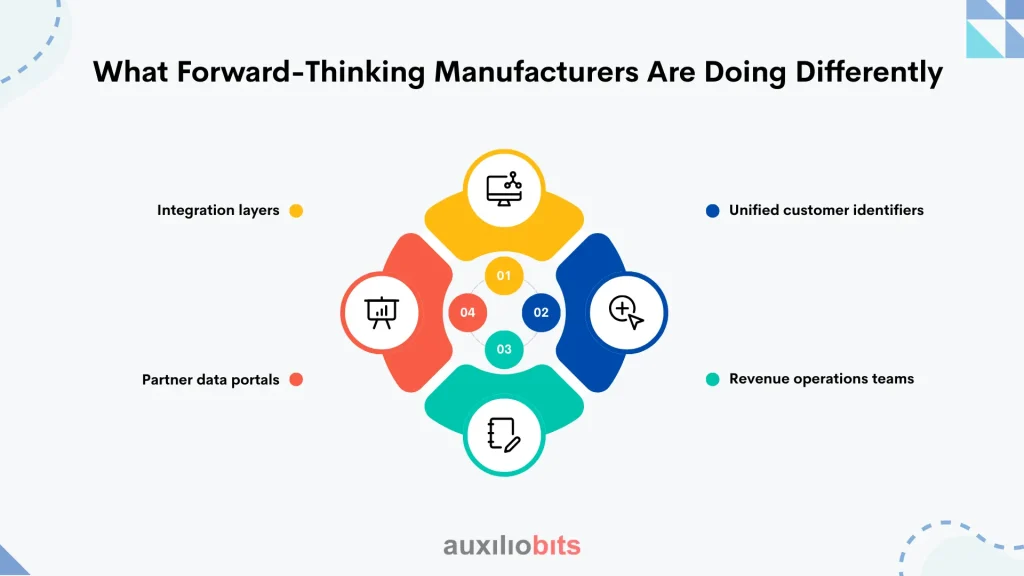
1. Integration layers
Modern integration platforms can connect ERP, CRM, and marketing systems without massive infrastructure changes. These tools create shared data pipelines while leaving core systems intact.
2. Unified customer identifiers
Some organizations establish consistent account IDs across systems, ensuring that customer records match even when stored in different platforms.
3. Partner data portals
Manufacturers working closely with distributors are building shared reporting environments where partner sales data feeds into centralized dashboards.
4. Revenue operations teams
Rather than separating sales operations and marketing operations, some companies are creating unified revenue operations functions responsible for data governance.
These initiatives don’t eliminate silos instantly. But they begin to chip away at them.
Automation Can Help—but It’s Not a Magic Fix
Automation technologies are often positioned as the answer to fragmented data. And they can help significantly when applied thoughtfully.
Automation tools can:
- Extract information from ERP systems
- Sync customer records across platforms
- Capture event data automatically
- Route leads between marketing and partner networks
However, automation alone doesn’t solve underlying governance problems.
If systems contain inconsistent data definitions or poorly maintained records, automated integrations simply move messy information faster.
Successful organizations usually combine automation with clear data ownership policies. Someone has to decide which system defines the “official” version of customer data. Otherwise integration just spreads confusion across multiple platforms, leading to inconsistent customer experiences and difficulties in data retrieval.
The Real Challenge Isn’t Technology
It would be convenient to blame outdated systems for data silos. But the truth is more complicated.
Most manufacturing organizations already possess the technology needed to connect their information environments. Integration tools exist. Cloud platforms simplify data pipelines. Automation can bridge many gaps.
The deeper challenge lies in coordination. Departments own different systems. Data governance responsibilities remain unclear. Historical habits shape how teams capture and share information.
Solving silos requires aligning operations, sales, marketing, and IT around a shared view of customer intelligence. That’s not purely a technical problem. It’s an organizational one.
And organizational changes move slowly—especially in industries built on decades of operational tradition. Still, the pressure to improve data visibility is growing. Marketing accountability expectations are rising. Digital customer journeys are becoming more complex. Leadership teams increasingly want clear connections between market activity and revenue outcomes.
Manufacturers that address these data challenges will gain a significant advantage.
Those that don’t will continue making marketing decisions based on fragments of the full picture—which, frankly, is how many campaigns end up missing the mark.