







Key Takeaways
- Investigation risk, rather than reporting needs, drives ESG as a board priority.
- Manual ESG processes fail under scrutiny due to weak audit trails and fragmented data.
- ESG automation manufacturing strengthens data lineage, validation, and defensibility.
- Boards are demanding audit-ready ESG systems, not just high-level dashboards.
- The real value of automation lies in improving data accuracy—not just generating reports.
There was a time—not that long ago—when ESG sat comfortably in annual reports. Include a few sustainability metrics, a section on diversity, and possibly a supply chain statement. It was important, yes, but not urgent. Not something that demanded real-time visibility or operational rigor.
That’s no longer the case.
Today, ESG as a board priority isn’t a slogan—it’s a reaction. Boards are reacting to regulatory tightening, investor scrutiny, and, more specifically, investigation risk. Boards aren’t asking, “Are we reporting ESG?” They’re asking, “Can we defend our ESG data under scrutiny?”
That’s an entirely unique question.
And it’s precisely why ESG automation manufacturing is gaining traction. Companies are not suddenly becoming more virtuous; rather, they are undergoing more aggressive and often unpredictable scrutiny.
Investigation Pressure Is Reshaping the Conversation
If you speak to compliance leaders in manufacturing today, a pattern emerges. The real anxiety isn’t around publishing ESG data—it’s around defending it when challenged.
Investigations—internal audits, regulator inquiries, investor probes—have become more frequent and less forgiving.
A few realities driving this:
- Regulatory bodies are cross-checking ESG claims against operational data
- Investors are requesting raw data trails, not summarized dashboards
- Whistleblower cases are increasingly tied to environmental or labor disclosures
- Supply chain transparency expectations are expanding beyond Tier 1 vendors
And here’s the uncomfortable truth: Most ESG reporting systems weren’t designed for investigation readiness. They were designed for presentation, not proof.
That gap—between what’s reported and what can be verified—is where automation becomes less of a convenience and more of a necessity.
Why Manufacturing Feels the Heat First
Manufacturing organizations sit at a difficult intersection. They have:
- Complex, multi-tier supply chains
- Energy-intensive operations
- Exposure to environmental regulations across jurisdictions
- Labor practices spanning geographies with varying standards
In other words, more surface area for ESG risk.
Take emissions reporting as a simple example. A global manufacturer might aggregate data from the following:
- Plant-level sensors
- ERP systems tracking energy usage
- Supplier disclosures (often in spreadsheets, sometimes… not at all)
Now imagine an investigation asking, “Show us how this Scope 3 number was calculated, and trace it back to source.” That’s where things start to unravel.
Manual reconciliations. Missing audit trails. Inconsistent methodologies across regions. The data is not defensible at scale, even if it is technically correct.
Also read: Agentic AI for Inventory Forecasting and Replenishment
Where Manual ESG Processes Break Down
It’s tempting to think ESG challenges are primarily about data availability. They’re not. Most organizations have plenty of data.
The issue is orchestration.
Manual ESG processes typically suffer from the following
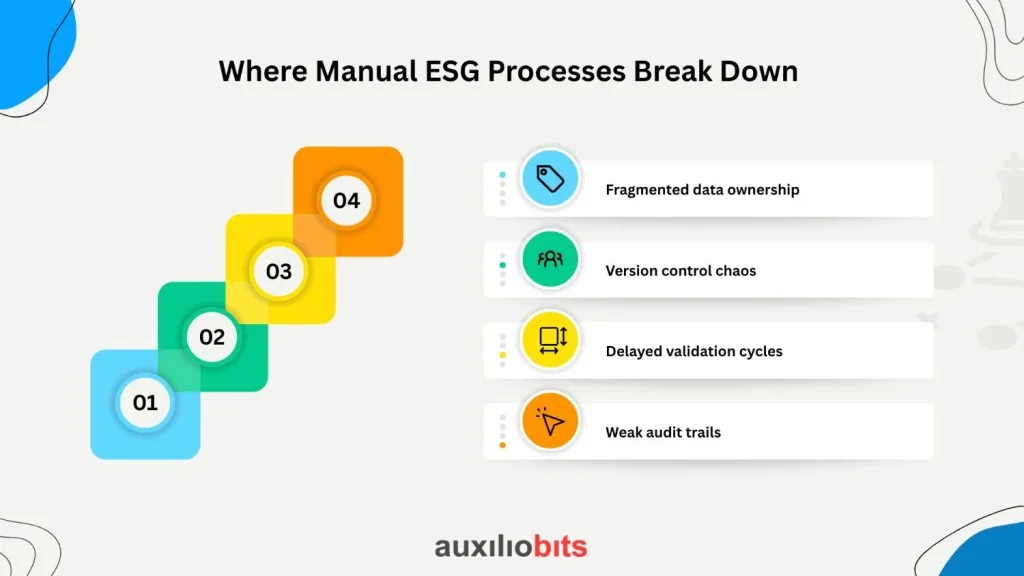
- Fragmented data ownership: Sustainability teams rely on operations, procurement, and finance—and none of them speak the same data language.
- Version control chaos: Multiple spreadsheets, local adjustments, undocumented assumptions.
- Delayed validation cycles: By the time discrepancies are caught, reporting deadlines are already in motion.
- Weak audit trails: You can show the final number, but not the transformation steps behind it.
And under investigation pressure, these weaknesses become liabilities. These are not hypothetical liabilities, but actual financial and reputational ones.
ESG Automation in Manufacturing: What Changes
When we talk about ESG automation manufacturing, it’s easy to default to dashboards and analytics. But the real shift happens underneath.
Automation changes the structure of ESG data flows. Some of the more meaningful transformations include:
- Data lineage tracking from source to report: Every metric can be traced back to its origin—sensor, system, or supplier.
- Standardized calculation logic: Emission factors, conversion methods, and assumptions are centrally governed.
- Continuous validation: Instead of quarterly reconciliation, anomalies are flagged in near real-time.
- Automated evidence collection: Supporting documents, logs, and approvals are captured alongside the data.
- Cross-system integration: ERP, MES, IoT platforms, and supplier portals feeding into a unified ESG layer.
This isn’t just efficiency. It’s defensibility. And defensibility is what boards care about when investigations are on the table.
The Boardroom Lens: Why This Isn’t Delegated Anymore
Boards don’t usually concern themselves with operational tooling. So why now? ESG failures are no longer confined to individual departments.
They escalate.
A misreported emissions figure can trigger the following:
- Regulatory penalties
- Investor lawsuits
- Public scrutiny
- Supply chain disruptions
And importantly, board accountability.
Directors are increasingly being held responsible for oversight failures in ESG disclosures. That changes behavior quickly.
So when ESG becomes a board-level topic, the questions shift:
- “Do we have visibility into ESG data quality?”
- “Can we withstand an external audit without disruption?”
- “Where are the gaps in our data controls?”
And eventually, “Why aren’t we automating this?”
Real-World Patterns
Across manufacturing organizations, a few recurring patterns show up.
1. The “Reporting Tool First” Approach
Some companies start by implementing ESG reporting platforms without fixing upstream data issues. The result? Beautiful dashboards… built on fragile foundations.
When investigation requests come in, teams still scramble to reconcile numbers manually. Automation at the surface doesn’t solve structural problems.
2. Over-Reliance on Supplier Declarations
Another common issue: trusting supplier ESG data without validation mechanisms.
In theory, suppliers provide standardized disclosures. In practice:
- Formats vary
- Assumptions differ
- Updates are inconsistent
Without automated validation and normalization, these inputs introduce risk rather than reduce it.
3. Treating ESG as a Sustainability Function Only
This one is subtle but significant. Sustainability teams’ sole ownership of ESG often leads to missed critical integrations with finance, procurement, and operations in automation efforts.
Effective ESG automation is cross-functional by design. Otherwise, you’re just moving inefficiencies around.
What Works—and Where It Fails
Automation isn’t a silver bullet. Automation is effective in certain areas, but less so in others.
Where it delivers value:
- High-volume, structured data flows: Energy usage, production metrics, and logistics data.
- Standardized calculations: Emissions factors, water usage conversions.
- Audit trail generation: Capturing evidence alongside data transformations.
Where it struggles:
- Unstructured supplier data: Particularly, this issue arises when dealing with smaller vendors who lack digital systems.
- Subjective ESG metrics: Social impact indicators and governance assessments.
- Rapid regulatory changes: Automation needs constant updating to stay compliant.
There’s also a human factor. Over-automating without understanding the process can create blind spots. Teams stop questioning outputs because “the system handles it”.
Building an ESG Automation Strategy That Holds Up Under Scrutiny
If investigation pressure is the driver—and it increasingly is—then ESG automation needs to be designed with that in mind.
Not just efficiency. Not just reporting. Scrutiny readiness.
Some practical considerations:
- Start with data lineage, not dashboards: If you can’t trace a number back to its source, automation won’t correct that later.
- Design for auditability from day one: Every transformation, adjustment, and approval should leave a trace.
- Integrate across functions early: Procurement, operations, finance—ESG data lives everywhere.
- Validate supplier inputs automatically where possible: Even simple consistency checks reduce risk.
- Keep humans in the loop for edge cases: Automation should assist, not replace, judgment.
And perhaps less obvious:
- Accept that not everything should be automated immediately. Some processes need to stabilize before they can be codified.
Final Observations from the Field
There’s a noticeable shift happening in how ESG is discussed at senior levels. It’s less about sustainability narratives and more about data integrity under pressure. That shift explains why ESG as a board priority is gaining momentum—and why ESG-automated manufacturing is no longer optional in large, complex operations.
Not every organization is there yet. Some are still in early stages, experimenting with tools and figuring out governance models. Others have already faced investigations and are now rebuilding their ESG infrastructure with a very different mindset.
If there’s one takeaway from observing these journeys, it’s this lesson: Companies don’t invest seriously in ESG automation because reporting is hard. They do it because defending their reporting is harder. Companies don’t invest seriously in ESG automation because reporting is hard. They do it because defending their reporting is harder. And once that realization sets in, the conversation changes—quickly, and often permanently.