


- Warranty Claims Automation reduces manual validation work while ensuring claims are processed quickly and accurately.
- Fraud detection becomes significantly more effective when claim patterns are analyzed across dealers, components, and service behavior.
- Low-risk claims can be approved automatically, allowing warranty teams to focus on suspicious or complex cases.
- Warranty automation manufacturing systems uncover operational insights that manual reviews often miss.
- Manufacturers gain stronger control over warranty spending, reducing unnecessary payouts while improving dealer and customer experience.
Manufacturers rarely talk openly about warranty claims in strategic meetings. The conversation usually centers around product innovation, supply chain resilience, or production efficiency. Warranty management sits quietly in the background—until the numbers start rising.
And when they do rise, the story is rarely simple. A spike in claims could mean a genuine product defect. It could indicate poor installation practices. Or something far less comfortable to admit: fraudulent claims slipping through the cracks.
In many manufacturing organizations, warranty teams still operate in a semi-manual environment—reviewing claim documents, validating serial numbers, checking service records, and approving reimbursements. The process might appear digital on the surface because everything lives in an ERP or warranty management system. However, humans perform the real work behind the screens.
This is precisely where warranty claims automation becomes transformative—especially when it’s designed not just for efficiency but for fraud detection and faster approvals.
Often, the distinction between an automated workflow and an intelligent one lies in the system’s ability to detect anomalies, such as unusual patterns in claims that may indicate potential fraud or errors in the submission process.
The Hidden Complexity of Warranty Claims in Manufacturing
Warranty claims may look straightforward on paper:
A customer reports a defect. The manufacturer validates the claim. Repair or replacement is approved. The claim is settled.
In practice, the workflow is much messier.
A typical manufacturing warranty claim can involve:
- Dealers or distributors submitting claims
- Serial number validation against production records
- Verification of warranty eligibility
- Labor cost approvals
- Parts replacement validation
- Service documentation checks
- Fraud review (if anyone has time for it)
A single claim may touch five to seven different systems: ERP, dealer portals, service platforms, parts inventory, and occasionally a CRM or ticketing tool.
The problem is not data availability. There’s plenty of data.
The problem is interpretation.
Humans are still tasked with figuring out whether something makes sense.
Also read: The Future of Manufacturing Work: Humans + Agents
Where Fraud Quietly Enters the Picture
Ask anyone who has worked in warranty operations long enough, and they will admit—though sometimes reluctantly—that fraud exists at multiple levels.
Not all fraud is malicious in the criminal sense. Some of it is opportunistic. Some of it is structural.
Common patterns include:
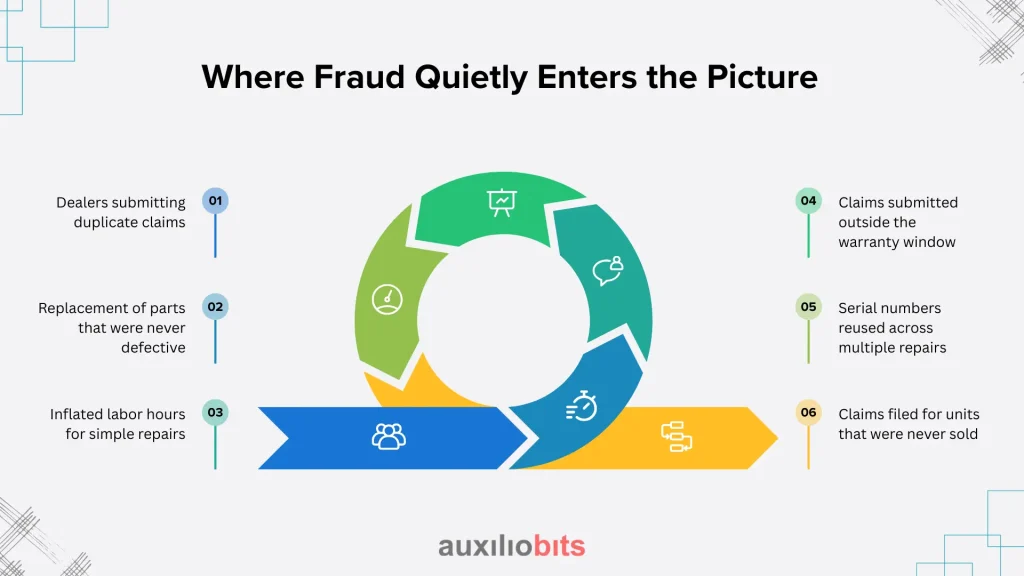
- Dealers submitting duplicate claims
- Replacement of parts that were never defective
- Inflated labor hours for simple repairs
- Claims submitted outside the warranty window
- Serial numbers reused across multiple repairs
- Claims filed for units that were never sold
A large automotive manufacturer once discovered that a small group of service centers had been submitting claims for parts replacements that never occurred. The documentation looked legitimate. The serial numbers matched real products.
What exposed the issue was something subtle: the replacement rate for a specific component at those service centers was five times higher than the national average.
No one noticed it for nearly two years. Manual oversight simply cannot track patterns at that scale.
This is where warranty automation manufacturing systems start delivering real value.
The Manual Review Bottleneck
Before talking about automation, it’s worth acknowledging why the traditional approach struggles.
Warranty teams typically face three constraints simultaneously:
- Volume: There are thousands of claims per month, sometimes tens of thousands in the automotive or heavy machinery sectors.
- Time pressure: Dealers expect rapid approvals to maintain customer satisfaction.
- Limited analytical tools: Most teams rely on spreadsheets, dashboards, or static reports.
The result is predictable. Teams prioritize speed over scrutiny. Claims that look “mostly correct” get approved. Exceptions get flagged. Suspicious claims occasionally slip through.
But the truth is that fraud rarely looks suspicious in isolation. Fraud becomes visible only when patterns are analyzed across large datasets. Humans aren’t good at doing that manually.
What Warranty Claims Automation Changes
When organizations talk about warranty claims automation, the immediate assumption is that the goal is efficiency.
And yes—efficiency matters. But the real shift happens when automation becomes analytical rather than procedural.
Instead of simply routing claims faster, automated systems begin to evaluate them.
A modern warranty automation architecture typically performs several layers of validation:
1. Data validation
- Serial numbers checked against production databases
- Warranty eligibility confirmed
- Claim completeness verification
2. Process validation
- Repair codes matched against product defect categories
- Labor hours compared against standard benchmarks
3. Pattern recognition
- Dealer behavior compared across the network
- Unusual frequency of certain repairs detected
- Duplicate or near-duplicate claims identified
In short, the system begins asking the questions that humans rarely have time to ask.
Fraud Detection: The Intelligence Layer
This is where things become intriguing. Fraud detection in warranty automation doesn’t rely on a single rule or threshold. Instead, it combines multiple signals.
Consider the following scenario. A claim arrives with valid documentation. Serial number checks out. Warranty coverage is still active.
Nothing appears wrong.
But the automation system notices:
- The dealer submitting the claim has three times the normal failure rate for the same component.
- The repair occurs unusually early in the product lifecycle.
- Field data shows the replaced part is very reliable.
Individually, none of these signals prove fraud. Together, they raise suspicion. An intelligent warranty claims automation platform can automatically flag such claims for deeper review.
Some flagged claims are not fraudulent. Sometimes the issue is genuine. But catching even a small percentage of fraudulent claims can significantly reduce warranty costs.
Faster Approvals Without Lowering Scrutiny
One of the most misunderstood aspects of automation is the fear that adding fraud detection will slow down approvals. Ironically, the opposite often happens. When routine validation tasks are automated, the majority of claims can be approved instantly.
Consider a typical distribution:
- 70–80% of claims follow normal patterns
- 15–20% require moderate review
- 5% show suspicious characteristics
In a manual process, every claim receives similar attention, even when unnecessary.
With automation:
- Standard claims are processed automatically
- Moderate claims get partial review
- High-risk claims trigger detailed investigation
This triage approach dramatically reduces processing time. Dealers receive faster responses. Customers get quicker repairs. Warranty teams spend time where it actually matters.
A Real Manufacturing Example
A heavy equipment manufacturer faced an unusual problem. Warranty costs were climbing, but engineering teams could not find any significant design defects. The products were performing well in field tests. Yet claims kept increasing.
After implementing a warranty automation manufacturing platform with fraud analytics, a pattern emerged. Several dealers were submitting claims for hydraulic pump replacements at unusually high rates. The investigation uncovered something unexpected. The pumps were not defective.
Dealers had discovered that replacing the pump resolved multiple unrelated issues quickly, and the warranty reimbursement covered the cost. It became a convenient repair shortcut.
Technically, the claims were not fraudulent—they were simply overused repairs.
Automation flagged the anomaly within weeks. Before that, it had gone unnoticed for years, indicating a significant gap in oversight and quality control within the warranty system, which allowed for the persistence of these overused repairs without detection.
Key Components of a Modern Warranty Automation System
Not all automation platforms deliver the same capabilities. Effective systems usually include several critical layers.
1. Intelligent Data Capture
Claims arrive through different channels: dealer portals, service systems, email submissions.
Automation tools extract and structure this information automatically.
- OCR for service documents
- Form validation
- Structured data ingestion
This eliminates manual data entry errors—an underrated source of claim delays.
2. Rule-Based Eligibility Checks
Basic validation still matters.
These checks include:
- Warranty coverage validation
- Product registration verification
- Service date checks
- Claim completeness confirmation
These rules act as the first line of defense.
3. Machine Learning for Fraud Patterns
Rule engines catch obvious issues. But fraud often evolves faster than static rules.
Machine learning models analyze historical claims to identify unusual patterns such as:
- Abnormal claim frequencies
- Geographic repair anomalies
- Dealer behavior outliers
These models improve continuously as more claims are processed.
4. Automated Workflow Orchestration
Once validation is complete, automation routes claims based on risk level.
Examples:
- Automatic approval for low-risk claims
- Escalation to warranty analysts
- Requests for additional documentation
The goal is not to eliminate human oversight—it’s to focus it where needed.
Why Manufacturing Needs This Now
Warranty costs are increasing across manufacturing sectors.
Several factors contribute to this:
- Complex products with interconnected components
- Larger global dealer networks
- Increased repair documentation requirements
- Growing fraud sophistication
Manual processes simply cannot keep pace with these dynamics. Furthermore, people often underestimate the financial impact of warranty fraud.
Industry estimates suggest that 3–10% of warranty claims may involve some level of misuse or fraud. For large manufacturers, that can translate into millions in avoidable payouts.
Automation is not merely about cost reduction. It’s about visibility.
Once patterns become visible, organizations can address root causes—whether they involve dealer behavior, service training, or genuine product issues.
When Automation Works Best
Automation delivers the strongest results under certain conditions.
It works well when:
- Claim volumes are high
- Dealer networks are large
- Product data is well structured
- Historical claim datasets are available
It struggles when:
- Data quality is poor
- Claims documentation is inconsistent
- Warranty policies vary widely across regions
In those cases, organizations often need to standardize data processes first before automation can fully deliver value, as inconsistent claims documentation can lead to errors and inefficiencies in the claims processing workflow.
Final Thought
Warranty claims are often treated as a back-office administrative function. Yet they sit at the intersection of product quality, dealer behavior, customer experience, and financial risk.
Ignoring fraud detection within this process is a bit like installing a security system that only checks the front door.
The real advantage of warranty automation manufacturing platforms is not just faster processing or reduced manual work.
It’s the ability to see patterns that humans miss.
And once those patterns become visible, organizations gain something far more valuable than efficiency.
They gain control over a part of the business that has quietly leaked money for years.