

Key Takeaways
- The autonomous supply chain reduces disruption impact by detecting and resolving problems early.
- Detection, diagnosis, and action must work together—visibility alone does not create resilience.
- Autonomous response significantly reduces recovery time and prevents operational escalation.
- AI-enabled diagnosis helps organizations fix the right problem instead of reacting blindly.
- Self-healing supply chains improve reliability by containing disruptions before they affect production or customers.
Supply chains rarely fail in dramatic, cinematic ways. Most breakdowns begin quietly. A supplier misses a shipment confirmation. An ASN never arrives. Inventory appears to be available, but the actual physical stock is not present. A carrier updates a delivery ETA too late for production planning to react.
Nobody notices immediately.
Hours pass. Then days. By the time someone investigates, the damage is already embedded in schedules, forecasts, and commitments.
This is why the idea of a self-healing or autonomous supply chain matters. This is not due to the popularity of automation, but rather because manual intervention often occurs too late. Humans are excellent problem solvers, but they’re terrible continuous monitors. We don’t watch thousands of signals simultaneously. Systems must do that.
Self-healing supply chains operate on a simple but powerful cycle:
Detection → Diagnosis → Action
Each stage matters. If you skip one stage, the system may either react blindly or not respond at all.
Also read: Coordinating Supply Chain Teams Using CrewAI Architecture
Why traditional supply chains struggle to recover quickly
Most organizations have visibility tools now. Dashboards everywhere. Control towers. Alerts. Notifications.
But visibility doesn’t equal recovery.
A logistics manager once described their operation this way: “We know exactly when something goes wrong. We just don’t know how to fix it fast.”
That gap—between knowing and fixing—is where supply chains stall.
Common structural problems include:
- Alert overload. Teams receive hundreds of alerts daily, most irrelevant.
- Fragmented systems. ERP, WMS, TMS, and supplier portals communicate unclearly.
- Manual decision-making bottlenecks.
- Batch-based monitoring contributes to late detection.
- The root cause of the problem remains unclear.
Many organizations assume disruption is the primary problem. It isn’t. Delayed response is.
Consider a late shipment scenario:
- Supplier delay occurs Monday morning
- ERP reflects issue Tuesday afternoon
- Planner notices Wednesday
- Alternative supplier contacted Thursday
- Production disrupted Friday
Five days lost—not because the delay was unavoidable, but because detection and response were slow.
Self-healing systems compress that timeline dramatically.
Sometimes to minutes.
Detection: finding problems before they become operational damage
Detection is the foundation. Without early awareness, diagnosis and action are meaningless.
Traditional detection relies on periodic checks:
- Daily inventory reconciliation
- Weekly supplier performance reviews
- Manual shipment tracking
These methods miss the critical early window when corrective action is easiest. Self-healing environments continuously monitor signals across multiple layers:
1. Transactional signals
- Purchase order confirmations missing or delayed
- Unexpected inventory consumption patterns
- Incomplete production order updates
2. Physical movement signals
- GPS deviations from planned routes
- Carrier ETA changes
- Yard dwell time anomalies
3. Behavioral patterns
- Supplier responsiveness trends
- Order processing delays within specific facilities
- Gradual degradation in fulfillment speed
4. External signals
- Weather disruptions
- Port congestion indicators
- Political or labor disruptions
What makes detection effective isn’t just monitoring more data. It’s monitoring intelligently.
For example, a global electronics manufacturer implemented real-time carrier monitoring integrated with their TMS. The system detected that a shipment deviated from its expected route—not significantly, just enough to miss a critical production window.
No human would have flagged it. The system triggered an early warning. Production planners rerouted alternate inventory from a nearby facility. Line stoppage was avoided entirely.
Detection worked because it was continuous, contextual, and automated. But detection alone doesn’t solve anything.
It only raises the question: what’s actually wrong?
Diagnosis: understanding cause, not just symptom
Detection produces alerts. Diagnosis produces understanding.
And this is where many supply chains still struggle.
A late shipment alert doesn’t explain why it’s late.
Is it:
- Supplier production delay?
- Carrier capacity constraint?
- Customs clearance issue?
- Incorrect documentation?
- Warehouse processing backlog?
Without diagnosis, responses are guesses. And guesses often make things worse. Diagnosis requires correlation across multiple systems and historical patterns.
Effective diagnostic systems evaluate
- Historical supplier performance
- Carrier reliability patterns
- Current network congestion
- Order prioritization rules
- Inventory buffer availability
This sounds straightforward. It isn’t. Data is inconsistent. Signals conflict. Causes overlap.
Sometimes the obvious explanation is wrong.
One manufacturing company repeatedly blamed carriers for late deliveries. Diagnostic analysis later revealed warehouse processing delays caused most issues. Orders sat unprocessed for hours before carrier pickup.
The carrier wasn’t the problem. Internal handling was.
Without proper diagnosis, the company would have continued optimizing the wrong area.
Self-healing supply chains perform diagnosis automatically by:
- Correlating multi-system signals
- Comparing current behavior to historical norms
- Identifying anomaly patterns
- Estimating probable root cause with confidence scores
They don’t just say, “Shipment delayed.” They say, “Shipment delayed due to supplier fulfillment delay exceeding historical average by 42%.”
That level of specificity changes how teams respond.
More importantly, it enables automated action.
Action: moving from awareness to autonomous response
Detection and diagnosis provide clarity. Action provides recovery.
This is the defining capability of an autonomous supply chain: it doesn’t wait for human approval for routine corrective decisions.
It responds. It responds not blindly, but rather on the basis of defined constraints, priorities, and policies.
Typical autonomous actions include:
1. Inventory adjustments
- Reallocating stock from alternate locations
- Prioritizing critical customer orders
- Triggering emergency replenishment
2. Logistics rerouting
- Switching carriers dynamically
- Redirecting shipments to alternate facilities
- Adjusting delivery sequences
3. Supplier adjustments
- Activating backup suppliers
- Splitting orders across multiple vendors
- Adjusting purchase timing
4. Production changes
- Resequencing production runs
- Substituting components when possible
- Delaying non-critical orders
Some actions happen instantly. Others require layered decision logic. A large automotive manufacturer implemented automated inventory reallocation logic across regional warehouses.
Previously, planners manually reviewed shortages and redistributed inventory. Response time: 6–24 hours.
After automation: Response time: under 10 minutes.
The system evaluated shortages, identified alternate inventory, and initiated transfer orders automatically.
Production continuity improved dramatically.
Interestingly, planners didn’t lose control. They gained it. They focused on strategic decisions rather than routine firefighting.
Why detection-only systems fail to create resilience
Many organizations stop at detection. They implement monitoring dashboards and assume resilience improves.
It doesn’t. Detection without diagnosis creates noise. Diagnosis without action creates delay.
All three layers must function together. Think of it like a medical system.
Detection is noticing symptoms. Diagnosis is identifying the disease. Action is treatment.
Imagine a hospital that detects illness but never treats patients. That’s how many supply chains operate today.
The autonomous supply chain closes that gap.
Real-world example: port congestion response
During recent port congestion disruptions, companies responded in dramatically different ways.
Company A relied on manual monitoring.
- Teams noticed delays days after occurrence
- Orders were already late
- Customers experienced fulfillment disruptions
Company B implemented automated disruption detection.
Their system continuously monitored port dwell times.
When dwell time exceeded thresholds:
- Alternative ports were evaluated
- Shipments rerouted automatically
- Inventory buffer transfers initiated
Customer impact was minimal. Both companies faced identical external disruption. Only one responded fast enough to mitigate it. The difference wasn’t visibility. It was autonomous action.
The role of AI in enabling autonomous supply chain recovery
prediction accuracy and more about decision orchestration.
AI supports recovery by:
- Identifying abnormal patterns early
- Estimating disruption impact severity
- Prioritizing corrective options
- Selecting optimal response actions
However, AI isn’t perfect.
It fails when:
- Data quality is poor
- Business rules are unclear
- System integration is incomplete
And sometimes human override is necessary. Autonomous doesn’t mean uncontrolled. It means independently operational within defined boundaries.
The best implementations blend autonomy with human supervision. Not replacing planners. Amplifying them.
What distinguishes a truly self-healing supply chain
Not all automation creates resilience. Some systems execute predefined workflows but cannot adapt dynamically.
Self-healing capability requires specific architectural characteristics:
Continuous monitoring
Not batch-based reporting. Real-time signal evaluation.
Cross-system awareness
The system integrates ERP, WMS, TMS, supplier portals, and logistics systems.
Contextual decision-making
This approach does not rely on rigid workflows but rather on adaptive responses tailored to specific conditions.
Autonomous execution
Corrective actions initiated without manual approval for defined scenarios.
Learning capability
Systems improve response accuracy over time.
Without these elements, automation simply accelerates failure rather than preventing it.
Common failure points in autonomous recovery systems
Despite their promise, self-healing systems don’t always work perfectly.
Several pitfalls appear frequently:
- Poor data synchronization between systems
- Incorrect inventory accuracy
- Incomplete integration with supplier systems
- Excessively rigid business rules
- Over-automation without exception handling
One organization implemented autonomous replenishment logic. Unfortunately, inaccurate inventory data caused the system to trigger unnecessary transfers repeatedly.
Automation amplified the error. This reinforces an uncomfortable truth: autonomy magnifies both strengths and weaknesses.
You can’t automate your way out of bad data.
Gradual evolution, not overnight transformation
Fully autonomous supply chains don’t emerge suddenly.
Most organizations progress through stages:
Stage 1: Visibility
Basic monitoring and reporting.
Stage 2: Alert-based response
Systems notify humans of problems.
Stage 3: Assisted decision-making
Systems recommend corrective actions.
Stage 4: Partial autonomy
Systems execute predefined corrective actions.
Stage 5: Self-healing supply chain
Systems detect, diagnose, and act independently across most operational disruptions.
Most companies today sit somewhere between stages 2 and 3.
And that’s fine.
Full autonomy requires trust, system maturity, and organizational readiness.
Where autonomy creates the greatest immediate impact
Not every process benefits equally from self-healing capabilities.
High-impact areas include:
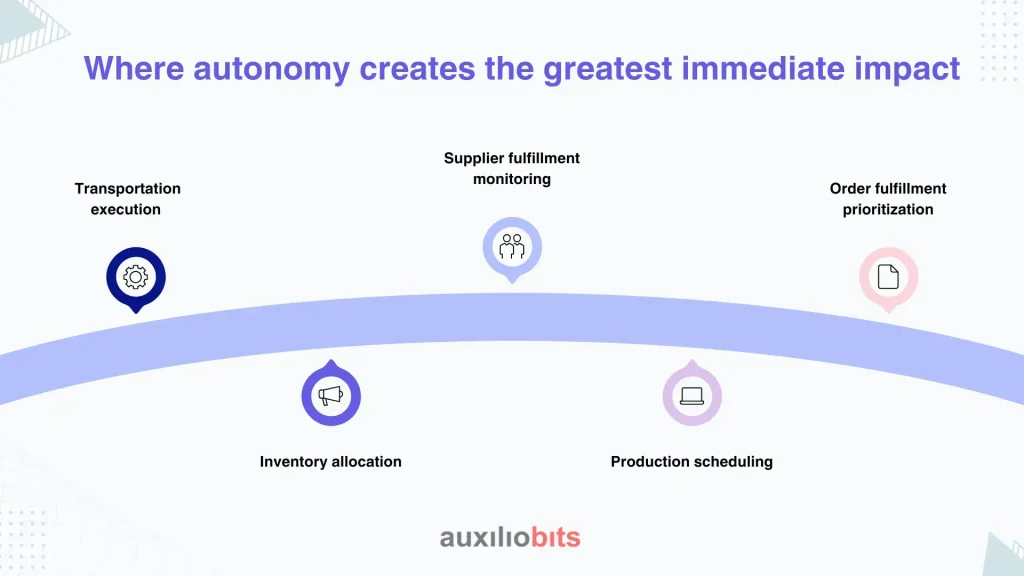
Transportation execution
Disruptions occur frequently and require rapid response.
Inventory allocation
Manual reallocation delays recovery.
Supplier fulfillment monitoring
Early detection prevents cascading failures.
Production scheduling
Rapid adjustment prevents line stoppages.
Order fulfillment prioritization
Dynamic reprioritization protects critical commitments.
These areas share one characteristic: rapid intervention dramatically improves outcomes.
Subtle organizational changes that enable autonomy
Technology alone doesn’t create autonomous supply chains. Operational mindset must evolve too.
Teams must accept that:
- Systems will make routine decisions independently
- Humans focus on strategic exceptions
- Continuous system learning is necessary
This transition can be uncomfortable. Planners accustomed to full control may initially distrust autonomous responses. Trust develops gradually.
Usually, trust develops when systems successfully prevent enough disruptions to demonstrate their value.
Why the autonomous supply chain isn’t optional anymore
Supply chains today operate under constant volatility. Supplier instability. Transportation variability. Demand unpredictability.
Manual response models cannot keep up. By the time humans react, optimal response windows often close. Autonomous supply chain systems compress response timelines dramatically.
From hours to minutes. Sometimes seconds. This speed difference determines whether disruptions remain manageable or escalate into operational crises.
And it’s not just about resilience. It’s about competitiveness. Companies with self-healing capabilities recover faster, operate more efficiently, and maintain higher service levels.
This benefit is not due to the disappearance of disruptions but rather to the acceleration of recovery.
Detection → Diagnosis → Action is the operational core
This cycle defines whether a supply chain remains reactive or becomes adaptive.
Detection identifies risk early. Diagnosis explains cause accurately. Action resolves disruption quickly.
Break any link, and recovery slows. Strengthen all three, and supply chains begin to heal themselves.
Not magically. Not perfectly. But reliably.
And in modern supply chain operations, reliability matters more than anything else.