

Key Takeaways
- OTIF improves when exception response becomes immediate, not manual. Most delivery failures happen because issues are detected too late. Hyperautomation reduces detection and response time, which directly improves fulfillment reliability.
- Inventory turns increase when uncertainty is reduced, not when inventory is aggressively cut. Automation improves demand visibility and supplier reliability insight, allowing safer inventory reduction without increasing stockouts.
- Exception resolution speed is one of the most important—but overlooked—supply chain automation KPIs. Faster response to disruptions prevents cascading failures that hurt both service levels and inventory efficiency.
- Hyperautomation improves coordination across ERP, WMS, suppliers, and logistics providers. It eliminates the manual handoffs and delays that traditionally degrade supply chain performance.
- The biggest gains come from automating decisions, not just tasks. Automating data entry saves time. Automating exception handling, allocation, and planning decisions improves OTIF, inventory turns, and overall operational stability.
There are dozens of metrics on supply chain dashboards. Some are decorative. These metrics quietly determine whether a business earns customer trust or depletes its working capital.
Two factors cut through the noise:
- OTIF (On-Time In-Full)
- Inventory Turns
Here’s the truth: most organisations obsessively track inventory turns but only make incremental improvements. Spreadsheets get prettier. BI dashboards get fancier. The numbers barely budge.
What actually changes these KPIs is not better reporting. It’s structural redesign — increasingly powered by hyperautomation.
This is where supply chain automation KPIs stop being vanity metrics and become operational levers.
Why OTIF and Inventory Turns Are So Difficult to Improve
Before talking about automation, it’s worth being blunt about why these two metrics are so stubborn.
OTIF looks simple. It isn’t
On-time, in-full delivery sounds binary. Either you delivered correctly, or you didn’t. But underneath that metric lives a chain of fragile dependencies:
- Forecast accuracy
- Order entry integrity
- Available-to-promise logic
- Production scheduling discipline
- Warehouse execution
- Carrier performance
- Documentation accuracy
Missing any one of these leads to a collapse in OTIF performance. The problem isn’t that companies lack systems. Most have ERP, WMS, TMS, and demand planning tools. The issue lies in coordinating these systems and managing the manual processes that connect them.
Inventory Turns are deceptively strategic
Inventory turns measure how many times inventory cycles through in a period. Increase turns, and you reduce working capital. Sounds straightforward.
Except:
- Cut inventory too aggressively → stockouts rise → OTIF drops.
- Hold too much buffer → turn declines → CFOs start asking pointed questions.
It’s a balancing act. And balancing acts don’t tolerate fragmented processes.
Also read: Coordinating Supply Chain Teams Using CrewAI Architecture
Where Hyperautomation Enters the Picture
perautomation isn’t just robotic process automation (RPA) pushing buttons in ERP screens. It’s the orchestration of:
- AI-driven forecasting
- Autonomous exception management
- Real-time integration between systems
- Intelligent document processing
- Event-driven workflow automation
Not to replace humans entirely—that narrative is exaggerated—but to eliminate the manual decision bottlenecks that quietly degrade performance.
Let’s examine how this specifically impacts OTIF and inventory velocity.
Improving OTIF Through Hyperautomation
1. Demand Signal Refinement Beyond Traditional Forecasting
Traditional forecasting systems often rely heavily on historical averages. Hyperautomation layers AI models that incorporate:
- Real-time POS data
- Promotion calendars
- Weather patterns
- Transportation disruptions
- Supplier reliability scores
When AI agents continuously recalibrate forecasts, planners don’t have to wait for a monthly S&OP cycle to adjust production.
2. Automated Available-to-Promise (ATP) Validation
The use of optimistic promise dates quietly undermines On-Time In-Full (OTIF) performance.
Sales commits based on system availability. Meanwhile:
- Production capacity constraints aren’t updated.
- Supplier delays aren’t reflected.
- Transit lead times are outdated.
Hyperautomation enables:
- Real-time capacity checks
- Cross-system validation (ERP + MES + supplier portals)
- Automated alerts when a commitment violates constraints
Instead of discovering fulfillment gaps days before shipment, exceptions surface at order confirmation.
That alone changes the trajectory of OTIF.
3. Exception Management That Doesn’t Wait for Humans
Here’s where things get interesting.
In many organizations,supply chain teams spend 40–60% of their time chasing exceptions:
- Late supplier shipments
- Inventory discrepancies
- Picking errors
- Incorrect shipping documentation
Hyperautomation platforms deploy AI agents that:
- Detect deviation from planned lead times
- Trigger supplier communication automatically
- Escalate based on risk scoring
- Reassign inventory dynamically
Not everything can be auto-resolved. But a surprising portion can.
If a shipment is at risk of delay, the system can:
- Re-route from alternate DC
- Split order intelligently
- Adjust carrier selection
It eliminates the need to wait for a planner to take notice.
OTIF improves not because people work harder but because response time compresses dramatically.
4. Intelligent Documentation and Compliance
A practical, less glamorous contributor to OTIF failure: paperwork errors.
In international shipping, incorrect Bills of Lading, missing HS codes, or invoice mismatches cause customs delays. Days lost. Sometimes weeks.
Hyperautomation can:
- Extract data from shipping documents using intelligent OCR
- Cross-check against ERP master data
- Validate compliance rules before dispatch
- Automatically generate corrected documentation
These aren’t headline-grabbing innovations. But they remove friction. And friction is what erodes delivery performance.
Inventory Turns and Hyperautomation
Improving inventory velocity is less about speed and more about precision.
1. Dynamic Safety Stock Calculation
Traditional safety stock formulas assume static variability.
Reality isn’t static.
Hyperautomation platforms continuously evaluate:
- Supplier reliability trends
- Transit variability
- Demand volatility
- Promotion lift effects
Safety stock levels adjust dynamically. Instead of holding conservative buffers everywhere, inventory is placed where risk actually exists.
2. Automated Slow-Moving Inventory Identification
Dead stock rarely announces itself.
It accumulates gradually. A SKU underperforms. Forecast adjustments lag. Purchase orders continue.
Hyperautomation systems can:
- Identify velocity decline patterns early
- Flag SKUs trending toward obsolescence
- Recommend markdown, transfer, or production pause
Instead of quarterly inventory reviews, these insights surface daily. And that frequency matters.
3. Intelligent Replenishment and Allocation
Inventory imbalance across locations quietly damages both OTIF and turns.
You’ve seen this:
- DC A overstocked
- DC B stocked out
- Emergency transfer required
Hyperautomation coordinates replenishment based on:
- Regional demand variability
- Transportation cost impact
- Fulfillment SLA requirements
Allocation becomes proactive rather than reactive. Inventory rotates more efficiently. Service levels stabilize.
4. Procurement Automation with Risk Awareness
Inventory turns often deteriorate because purchasing teams hedge against uncertainty.
They buy early. They buy extra. With AI-driven supplier performance scoring:
- Late delivery patterns are quantified
- Quality variance is modeled
- Alternate sourcing scenarios are simulated
Buyers don’t have to guess. They order with confidence — reducing excess buffer.
Other Supply Chain Automation KPIs That Move
While OTIF and inventory turns are the headline metrics, hyperautomation influences other supply chain automation KPIs as well:
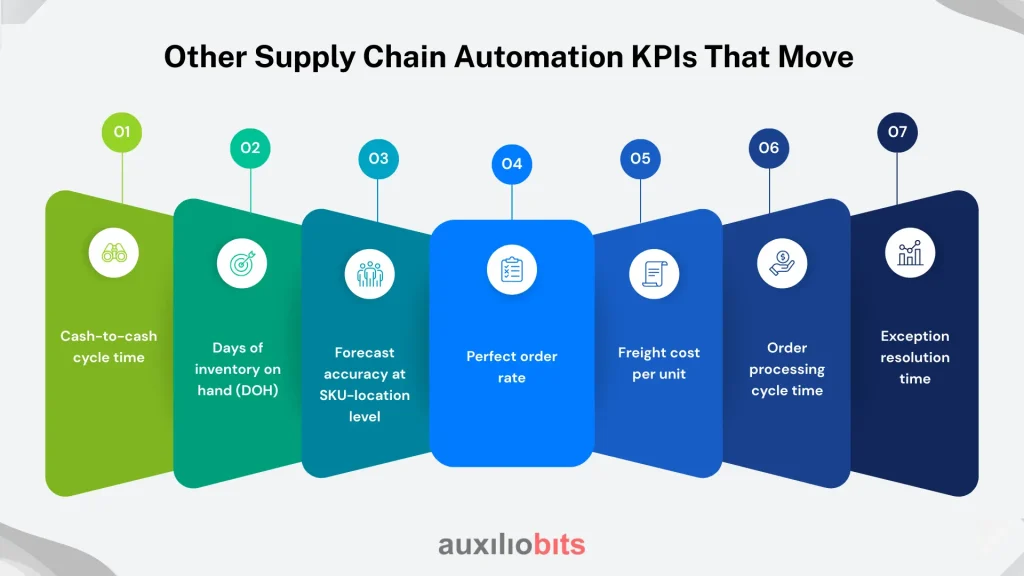
- Cash-to-cash cycle time
- Days of inventory on hand (DOH)
- Forecast accuracy at SKU-location level
- Perfect order rate
- Freight cost per unit
- Order processing cycle time
- Exception resolution time
Some of these improve indirectly. Others directly.
For example: Exception resolution time often drops 50–70% when automated triage systems are deployed. That improvement cascades into better OTIF.
Where Hyperautomation Fails
It’s not a silver bullet.
Hyperautomation fails when:
- Master data is unreliable
- Process ownership is unclear
- Departments have misaligned KPIs.
- Organizations automate broken workflows
If the sales team is incentivized purely on revenue and not fulfillment reliability, automation won’t fix misaligned commitments. If inventory accuracy is below 95%, AI recommendations become suspect.
A Real-World Pattern: What Changes
Across manufacturing, distribution, and even healthcare supply chains, I’ve observed a consistent pattern when hyperautomation is implemented well:
- Visibility improves first.
- Response time shrinks next.
- Human workload shifts from transactional to analytical.
- OTIF rises gradually — not instantly.
- Inventory turns improve after stabilization, not before.
There’s often an initial dip in perceived performance. Why? Transparency exposes previously hidden issues. Leaders sometimes panic during this phase.
However, if they persevere, systemic improvements ensue.
The Nuance Between Efficiency and Resilience
There’s a tension worth acknowledging. Increasing inventory turns aggressively can weaken resilience. Pushing OTIF targets unrealistically high can drive hidden costs (premium freight, overproduction).
Hyperautomation enables smarter trade-offs — not reckless optimization.
AI models can simulate:
- What happens to the service level if we reduce buffer stock by 10%?
- How does carrier consolidation affect OTIF variability?
- What’s the cost impact of multi-sourcing high-risk components?
Instead of static KPI targets, companies begin managing ranges. That’s a more mature posture.
The Cultural Shift That Often Gets Ignored
Hyperautomation changes workflows, yes. But it also changes accountability. When exceptions are visible instantly:
- Delays can’t hide.
- Inventory hoarding becomes transparent.
- Planning inaccuracies are measurable.
Some teams resist this exposure. Interestingly, the companies that improve OTIF and turns fastest are not necessarily the most technologically advanced. They are the most operationally honest.
Automation amplifies whatever culture already exists.
A Subtle but Critical KPI: Decision Latency
This one rarely appears on dashboards. Decision latency — the time between detecting an issue and taking corrective action.
Hyperautomation compresses this dramatically.
Consider:
- Supplier delay detected at 10:02 AM
- Alternate sourcing scenario simulated by 10:03
- Reallocation triggered by 10:05
- The customer is notified automatically
Compare that to manual review cycles. Decision latency is the invisible driver behind improved OTIF and healthier inventory rotation.
Hyperautomation Is Not About Removing Planners
There have been anxiety around AI-driven orchestration.
“Will planners become obsolete?”
In practice, the opposite happens.
Planners stop:
- Manually reconciling spreadsheets
- Sending repetitive supplier emails
- Re-keying system data
And start:
- Scenario modeling
- Strategic capacity planning
- Supplier relationship management
- Risk mitigation design
The KPI gains come from elevating human effort, not eliminating it.
The Compounding Effect
Here’s something subtle.
When OTIF improves:
- Customer trust increases
- Demand variability reduces
- Forecast accuracy improves
- Inventory buffers can be lowered safely
When inventory turns improve:
- Working capital is freed
- Cash reinvestment increases
- Operational flexibility improves
These KPIs reinforce each other. Hyperautomation accelerates this compounding effect because it reduces systemic friction.
Practical Starting Points
If an organization wants measurable improvements in OTIF and inventory turns, here’s where I’d realistically start:
- Automate order validation and ATP checks before touching forecasting models.
- Deploy AI-driven supplier performance scoring.
- Implement automated exception triage in fulfillment.
- Introduce dynamic safety stock adjustments for high-variability SKUs first.
- Measure exception resolution time as aggressively as service level.
Avoid overengineering initially. Pilot in one product family or region. Prove improvement. Expand.
Final Thought
Improving OTIF and inventory turns isn’t about chasing perfect numbers. It’s about reducing unpredictability.
Hyperautomation works because supply chains are no longer linear. They’re event-driven, volatile, and interdependent.
Manual coordination cannot keep pace.
When implemented thoughtfully, hyperautomation doesn’t just improve supply chain automation KPIs — it changes how decisions flow through the organization.
And that, more than any dashboard metric, is what separates operationally average companies from consistently reliable ones