






Key Takeaways
- AI agents enhance supplier master data by intelligently enriching incomplete records and integrating external insights.
- Duplicate detection using fuzzy logic and contextual reasoning can prevent millions in payment errors and reconciliation overhead.
- Governance frameworks remain essential; AI without accountability introduces risk.
- Successful implementation requires careful change management, reliable data sources, and human oversight.
- Continuous monitoring, retraining, and scaling are critical as suppliers and business contexts evolve.
Managing supplier master data has consistently been a crucial aspect of enterprise operations. For decades, organizations tolerated fragmented, incomplete, or outdated supplier records because fixing them required manual effort, cross-team coordination, and endless exception handling. But in today’s hyperconnected, regulation-heavy world, sloppy supplier data isn’t just inconvenient—it’s risky. Misapplied contracts, misdirected payments, and nightmare compliance audits become commonplace.
Enter AI agents. AI agents are not just automation scripts or rule-based bots, but autonomous systems that can reason across multiple datasets, detect anomalies, and maintain governance standards without constant human oversight. The shift isn’t about replacing humans—it’s about liberating them from repetitive verification tasks, so procurement and finance teams can focus on decisions, negotiations, and strategy.
Yet, the implementation isn’t straightforward. Many companies jump to AI thinking it will automatically “clean up” master data. Reality check: AI agents are only as good as the frameworks, rules, and governance structures around them.
Also read: Agentic AI for Supplier Onboarding and Risk Monitoring
Why Supplier Master Data Is So Tricky
Even the most sophisticated ERP systems struggle to keep supplier records accurate. The challenges are subtle:
- Multiple identifiers for the same supplier: One supplier might appear under slightly different names, addresses, or tax identifiers in various systems.
- Incomplete records: Phone numbers, payment terms, and bank details often live in spreadsheets or legacy systems.
- Dynamic supplier changes: Mergers, acquisitions, and relocations frequently render previously accurate data obsolete.
- Compliance pressure: Anti-bribery, anti-money laundering, and ESG reporting require verifiable, auditable records.
Without an intelligent system, organizations rely on manual reconciliations. Procurement teams spend hours cross-checking supplier details, finance teams struggle with payment errors, and audits always bring surprises.
This is precisely where AI agents demonstrate value: they don’t just automate—they reason. They can cross-reference multiple sources, identify inconsistencies, and even suggest corrections based on historical patterns and external datasets.
Data Enrichment: Going Beyond What You Already Have
It’s tempting to think that the internal ERP holds everything you need. Spoiler: it doesn’t. Supplier master data often lacks external context that can prevent operational errors or uncover hidden opportunities. AI agents excel in data enrichment, which essentially means “fill in the blanks intelligently.”
Consider the following real-world scenarios:
- Banking details verification: An AI agent can automatically validate supplier IBANs and SWIFT codes against official registries, reducing failed payments.
- Risk profiling: Agents can enrich supplier records with credit scores, ESG ratings, and regulatory watchlists, even pulling in public filings or news mentions.
- Geolocation data: Address standardization and geocoding prevent shipping errors and ensure correct tax jurisdiction applications.
Companies implementing AI-driven enrichment often notice surprising gaps. One mid-sized manufacturing firm discovered that nearly 15% of their active suppliers had missing tax IDs, and an AI agent suggested corrections that later saved weeks of manual follow-up. The catch? Agents need carefully curated external sources and validation rules. Garbage in, garbage out still applies.
Duplicate Detection: The Silent Killer of Accuracy
Duplicate supplier records are more than a nuisance—they can cost millions. Duplicate payments, conflicting contracts, misaligned purchase orders, and compliance violations are just the tip of the iceberg. Traditional deduplication methods often rely on exact matches. This works only until names differ slightly: “ACME Inc.” vs. “ACME Incorporated” or subtle typos in tax numbers.
AI agents tackle this problem differently:
- Fuzzy matching: They identify probable duplicates based on patterns in names, addresses, and contact points, not just exact text.
- Contextual reasoning: If two suppliers share an address and bank account but have slightly different names, the agent flags them for review.
- Continuous monitoring: Duplicates aren’t just cleaned once—they’re detected as new suppliers are added.
A practical example: An automotive supplier had 2,300 active supplier records but over 250 were duplicates. After deploying AI agents for duplicate detection, they eliminated errors in real-time, saving months of reconciliation effort and preventing redundant payments.
However, there’s nuance. Fuzzy matching can generate false positives. Some “duplicates” aren’t duplicates but related entities, like subsidiaries or regional offices. Here, human oversight still plays a role—AI agents don’t remove discretion; they augment it.
Governance: The Glue That Holds It Together
Even the most intelligent agents fail without governance. Governance isn’t just about rules—it’s about accountability, traceability, and ensuring decisions are defensible in audits. AI agents can enforce governance in ways traditional systems cannot:
- Rule enforcement: Agents automatically validate mandatory fields, ensuring records aren’t created with missing or inconsistent information.
- Approval workflows: When agents propose updates—like correcting a supplier’s tax ID or merging duplicates—they can trigger approval chains, keeping humans in the loop for critical decisions.
- Audit trails: Every action by an agent can be logged with timestamp, rationale, and data sources, making compliance audits far simpler.
- Policy adherence: Agents can check whether suppliers meet ESG or regulatory criteria before they’re onboarded or before payments are made.
Without governance, AI enrichment or deduplication could become a liability rather than an asset. Think about a scenario where an agent merges two records incorrectly and a payment goes astray—the blame isn’t just on AI; it’s on the governance framework that allowed it.
Implementation Challenges and Lessons Learned
Even with AI agents, supplier master data management isn’t plug-and-play. Companies frequently stumble in three areas:
- Source system complexity: ERPs, spreadsheets, procurement platforms—they all have slightly different supplier record structures. Agents need mappings and adapters.
- Data quality baseline: If your starting data is chaotic, agents spend more time “learning” patterns than delivering value. A short initial cleanup often pays huge dividends.
- Change management: Procurement and finance teams need to trust AI recommendations. If they override agents constantly—or ignore them—the system never realizes its potential.
Real-World Use Cases
A few examples help illustrate the potential:
- Global electronics distributor: AI agents enriched supplier records with real-time credit ratings and duplicate detection. Result: 18% reduction in payment errors within six months.
- Pharmaceutical manufacturer: Agents cross-referenced supplier ESG and regulatory data against internal records. High-risk suppliers were flagged before onboarding, preventing compliance violations and costly recalls.
- Industrial machinery company: Duplicate detection agents merged supplier records across ERP, procurement, and legacy systems, saving $2.5 million in redundant payments in one fiscal year.
These cases show that value comes not from the novelty of AI but from how it integrates with human judgment and governance frameworks.
Best Practices for Deploying AI Agents in Supplier MDM
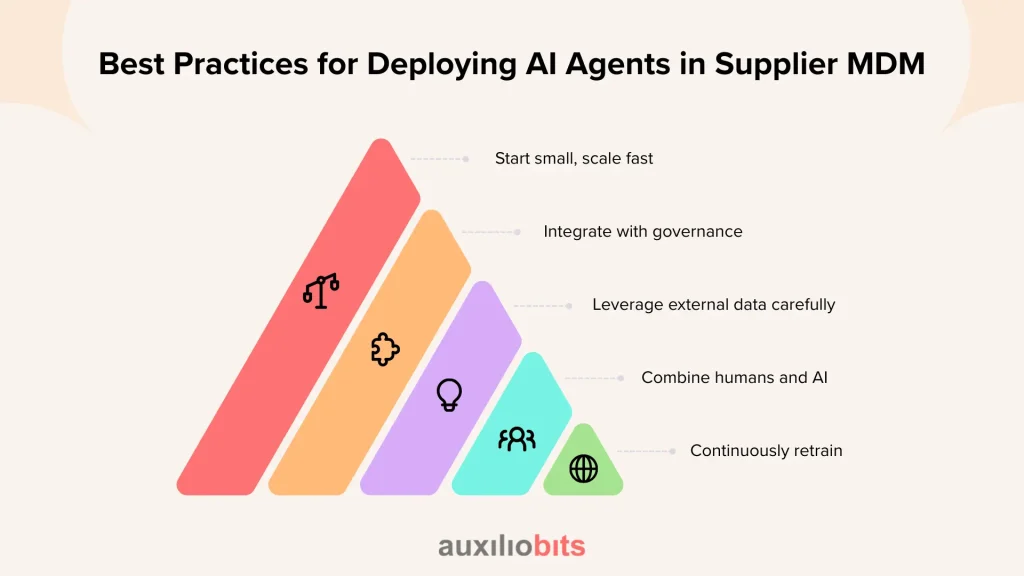
- Start small, scale fast: Focus on high-risk or high-value supplier categories first. Test enrichment and duplicate detection before rolling out to all suppliers.
- Integrate with governance: Make approvals, audit trails, and compliance checks central. Agents without accountability frameworks are risky.
- Leverage external data carefully: Credit reports, tax registries, ESG scores—they’re goldmines if verified, but errors propagate quickly if sources are unreliable.
- Combine humans and AI: Let AI do pattern recognition and data enrichment; let humans make final judgment calls on complex or sensitive cases.
- Continuously retrain: Supplier dynamics change, new naming conventions emerge, and regulations evolve. Agents must adapt or become obsolete.
The Bottom Line
Supplier master data management is deceptively complex. Errors don’t just inconvenience teams—they cost time, money, and compliance credibility. AI agents aren’t a magic wand, but they are a lever: they can enrich data, detect duplicates, and enforce governance faster and more consistently than manual processes ever could. Designing the system to reason, not just execute, and ensuring human involvement is crucial is the key.
Organizations that approach supplier MDM this way don’t just clean their records—they reclaim time, reduce risk, and make strategic decisions with confidence.