






- Reducing cycle time is the quickest way to increase revenue—hyperautomation eliminates hidden delays in quoting, approvals, and data transfers.
- Win rate improves when decisions become data-driven, not just experience-based.
- Sales KPIs automation works best end-to-end, not as isolated tools or bots.
- Data quality and adoption matter more than the technology itself—poor inputs limit outcomes.
- Hyperautomation shifts sales focus from admin to strategy, increasing both efficiency and deal success.
In manufacturing, sales leaders are obsessed with two numbers more than any others: cycle time and win rate. These aren’t just metrics on a dashboard—they dictate revenue velocity, production planning, and ultimately, whether the organization can meet ambitious growth targets. Yet, despite advanced CRM systems and analytics tools, many manufacturers still wrestle with inefficiencies that drag these KPIs down. Hyperautomation is the use of AI, robotic process automation (RPA), and advanced analytics to eliminate repetitive tasks, standardise processes, and provide useful insights.
Hyperautomation doesn’t just replace manual tasks—it reshapes how sales teams operate, subtly changing behavior, decision-making, and priorities. And when applied thoughtfully, it impacts metrics that matter most in manufacturing sales.
Why Cycle Time Still Haunts Manufacturing Sales
Cycle time—the duration from initial lead engagement to closed deal—is notoriously stubborn in industrial sectors. Several factors contribute:
- Complex product configurations: Unlike SaaS or retail, manufacturing products are rarely off-the-shelf. Each quote may involve dozens of SKUs, optional features, and compliance requirements.
- Multiple stakeholders: Engineers, procurement, finance, and even regulatory teams often weigh in before a sale can proceed.
- Manual data handoffs: Spreadsheets, emails, and disjointed CRMs introduce delays that compound across the sales funnel.
Traditional automation tools can help to some degree—pre-filling forms, sending reminder emails—but they rarely tackle the root causes. Sales KPIs automation in this context requires an end-to-end orchestration approach, not a patchwork of disconnected bots.
How Hyperautomation Cuts Cycle Time
When applied thoughtfully, hyperautomation shows measurable impact in real-world examples. Consider a mid-sized industrial equipment manufacturer struggling with a 75-day average cycle time for large orders. By integrating three layers—AI-driven lead scoring, RPA for quote generation, and analytics dashboards for real-time pipeline visibility—they cut cycle time by over 40%. Why? A few subtle mechanisms were at work:
- Automated document generation: Instead of engineers putting together technical specs and compliance documents by hand for each quote, RPA bots took data straight from PLM (Product Lifecycle Management) systems and filled out standard proposals.
- Intelligent approvals: AI agents learnt typical approval paths and flagged exceptions. Human managers were only involved when truly necessary. This avoided bottlenecks caused by waiting for multiple sign-offs.
- Predictive insights: Analytics identified leads likely to stall and suggested targeted interventions—like offering expedited shipping or bundling value-added services.
It’s worth noting, though, that automation alone doesn’t guarantee faster cycles. Without accurate master data, hyperautomation can exacerbate errors, generating incorrect quotes or sending proposals to the wrong contacts. In other words, cycle time reduction depends on both process orchestration and data integrity.
Win Rate: Beyond Luck and Gut Feeling
Cycle time is about speed; win rate is about effectiveness. In manufacturing sales, even the fastest sales team can’t hit targets if the conversion ratio lags. Win rate, defined as the percentage of qualified leads that result in a closed deal, is influenced by:
- Lead quality
- Timely engagement
- Accurate pricing and configuration
- Salesperson expertise and process adherence
Hyperautomation doesn’t make decisions for humans—it amplifies judgment with data.
Hyperautomation Tactics That Lift Win Rates
- AI-Driven Lead Prioritization: By analyzing historical deal data and external market signals, AI agents can flag leads with the highest probability of closing. For example, a robotics component supplier applied predictive lead scoring and noticed that leads originating from certain distributors closed 30% faster. Focusing the team’s energy there improved the overall win rate.
- Dynamic Quote Optimization: Instead of static pricing sheets, automation platforms now adjust quotes in real time based on material costs, client history, and competitive benchmarks. Sales reps armed with these dynamically optimized proposals close more confidently.
- Automated Follow-Ups and Nurturing: Hyperautomation ensures no opportunity falls through the cracks. Timely emails, reminders, and task assignments happen without human intervention—but intelligently. Too many touchpoints feel spammy; too few, and you lose deals. Hyperautomation can calibrate the cadence precisely.
- Embedded Coaching: Some systems monitor interactions and suggest scripts, pricing adjustments, or negotiation tactics mid-cycle. This technology subtly guides reps without replacing human creativity.
However, caution is warranted. In some organizations, over-automation can backfire: salespeople feel micromanaged, or clients perceive communications as robotic. Win rate improvement is not just a technological challenge—it’s a human one. Balancing automation with trust, discretion, and context is essential.
Also read: Quote-to-Order Automation in Complex Manufacturing
Where Manufacturing Sales KPIs Automation Truly Excels
The real leverage of hyperautomation isn’t in eliminating every task. It is by removing friction that humans add little value and by surfacing insights that they excel.
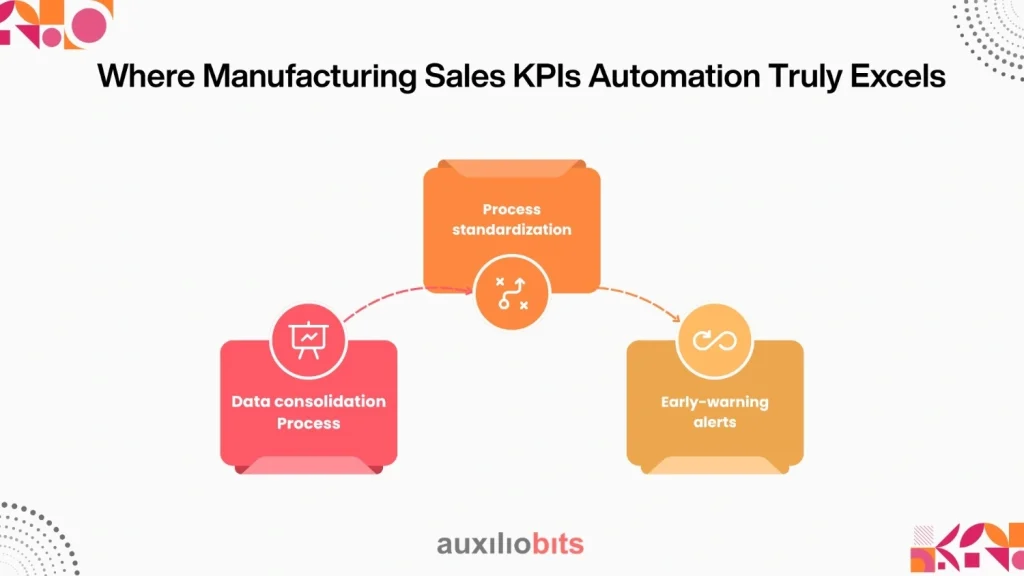
- Data consolidation: Manufacturing CRMs are often fragmented. Hyperautomation can automatically reconcile leads, contact info, product configurations, and pricing across systems. No more manual cross-checking that consumes hours of the sales week.
- Process standardization: Hyperautomation enforces best practices consistently. For instance, if contracts must include compliance clauses or specific delivery terms, bots ensure they’re always present. This reduces deal rework—a major hidden cost.
- Early-warning alerts: Analytics dashboards highlight stalled opportunities or missed follow-ups. Proactive intervention by sales managers is possible, rather than merely reacting after losing the deal.
Interestingly, while automation improves cycle time predictably, win rate gains are often non-linear. Some deals that looked “unlikely” suddenly close when AI suggests tailored negotiation strategies or highlights previously overlooked upsell potential.
Quantifying the Impact
It’s one thing to discuss benefits in abstract; numbers resonate. Manufacturing organizations that implement hyperautomation report:
| KPI | Pre-Hyperautomation | Post-Hyperautomation | Notes |
| Average cycle time | 70–90 days | 40–50 days | Includes quote generation, approvals, and document preparation |
| Win rate | 28–35% | 40–50% | Improved lead prioritization, quote accuracy, and timely engagement |
| Proposal errors | ~15% | <2% | Automation of document population and validation checks |
| Sales rep capacity | 100 deals/year | 140 deals/year | Time saved used for client engagement, not administrative tasks |
Numbers will vary by product complexity and organization maturity, but the trend is consistent: faster cycles and higher conversions.
Lessons from the Field
A few nuanced observations emerge from real deployments:
- Not all automation is equal: While simple workflow automation, such as sending follow-up emails, is beneficial, it does not significantly impact cycle time or win rate. The true impact comes when AI and RPA are integrated end-to-end.
- Human expertise is still critical: Complex negotiations, strategic deals, and relationship management cannot—and should not—be fully automated. The technology augments rather than replaces.
- Data hygiene is non-negotiable: Poorly structured CRM data or inconsistent product master files can make automation counterproductive. Think of it as teaching a robot to dance in a messy room—it trips every time.
- Behavioral change matters: Sales teams need to trust automation outputs. Adoption is often the limiting factor, not technology capability.
Take, for instance, a manufacturer of industrial pumps. They deployed RPA to handle pricing and compliance checks and AI to prioritize opportunities. Initial adoption was slow—sales reps resisted, fearing the “bot would replace them.” After a few months, the team noticed clear efficiency gains, fewer proposal errors, and more time for strategic client interactions. Trusting the system became the hidden KPI that actually drove both cycle time reduction and win rate improvement.
Sales KPIs Automation: A Strategic Lever
The conversation around automation often centers on efficiency or cost reduction. In manufacturing sales, we must initiate the conversation with the relevant metrics: the speed of deal closure and the number of deals won. Hyperautomation acts as a lever on these KPIs by:
- Removing low-value administrative tasks that consume disproportionate time
- Standardizing and validating critical information to reduce errors and rework
- Enhancing data-driven decision-making with predictive insights
- Enabling more precise, timely, and contextually appropriate customer engagement
It’s tempting to chase flashy dashboards or AI predictions, but the real value shows up in how quickly a quote moves through approvals and how often it converts. Focusing hyperautomation on these tangible bottlenecks produces measurable, high-impact outcomes.
Implementation Considerations
For organizations considering this journey, several practical points stand out:
- Start with the bottleneck: Identify the stages where sales cycles tend to slow down—such as quote generation, approvals, or follow-up—and prioritise automating those first.
- Integrate, don’t silo: AI, RPA, and analytics must talk to each other. Disconnected bots can create more work, not less.
- Monitor continuously: Hyperautomation is not “set it and forget it.” Continuous monitoring, tuning, and data validation are essential.
- Train teams: Invest in change management. A bot that sits idle because reps don’t trust it is wasted capital.
In practice, companies that follow these guidelines see sustained improvements in sales KPIs that manufacturing teams care about most: shorter cycle times, higher win rates, fewer errors, and better utilization of human expertise.
The Last Thoughts
teams operate. By tackling the bottlenecks that prolong cycle time and refining the actions that influence win rate, it allows teams to focus on strategy, relationship-building, and value creation rather than repetitive admin work. The real power lies in combining speed with precision: faster cycles, fewer errors, and smarter decisions that directly improve revenue outcomes. For manufacturers aiming to stay competitive, embracing Sales KPIs Automation isn’t just a tool upgrade—it’s a strategic move that turns operational efficiency into measurable business advantage.