




Key Takeaways
- Early warning systems in risk automation are about detecting meaningful patterns—not just isolated anomalies.
- Most operational risk automation efforts fail because they focus on reporting, not proactive signal detection.
- Context-rich alerts (not just notifications) are critical for real adoption on the shop floor.
- Data quality and integration across systems quietly determine whether early warning systems succeed or fail.
- Automation works best when it augments human decision-making—not when it tries to replace it.
Manufacturing leaders typically don’t worry about the risks they are already aware of. It’s the ones that arrive quietly—buried in production logs, supplier emails, machine telemetry, or finance anomalies—that cause real damage. By the time they surface, the window for mitigation has already narrowed.
This is where risk automation stops being a reporting tool and starts acting like a sensing system. Not dashboards. The focus should be on providing early warnings, not just alerts without any purpose. But early warnings are signals that something is drifting off course before it becomes visible in KPIs.
And yet, most operational risk automation initiatives fail to deliver that. They automate reporting cycles, not detection. They flag issues after they’ve already materialized.
There’s a gap here. And it’s worth unpacking.
Why Traditional Risk Management Falls Short in Manufacturing
Manufacturing environments are inherently complex—multiple plants, varying supplier dependencies, fluctuating demand, and deeply interconnected processes. Risk doesn’t sit in one system. It moves.
But traditional approaches still assume a fairly static structure:
- Monthly risk reviews
- Manual incident logging
- Static thresholds for alerts
- Compliance-driven reporting
It’s not that these are useless—they’re necessary for governance. But they’re backward-looking. A plant manager doesn’t need a report saying downtime increased last month. They already felt it. A signal two days earlier indicating a shift in vibration patterns or a quiet skip in maintenance cycles was what they needed.
The issue isn’t lack of data. It’s the absence of understandable signals.
Also read: Why Manufacturing Plants Need Cognitive Control Towers
Early Warning Systems: What They Really Mean in Practice
“Early warning” is often used loosely. In practice, it’s not just about detecting anomalies—it’s about identifying meaningful deviations that correlate with risk outcomes.
There’s a subtle difference.
For example:
- A temperature spike in a machine might be noise
- A pattern of temperature spikes combined with delayed maintenance logs and increased cycle times—that’s risk
Effective risk automation systems don’t just monitor single variables. They correlate across process layers.
What Early Warning Systems Actually Do
- Detect weak signals before they escalate
- Connect operational data with financial or compliance impact
- Prioritize risks dynamically (not all alerts are equal)
- Provide context, not just notifications
And importantly—they don’t overwhelm users. If your system produces 200 alerts a day, it’s not an early warning system. It’s background noise.
Where Early Warnings Matter Most in Manufacturing
Not all processes benefit equally from automation. Some are already tightly controlled. Others—usually the messy, cross-functional ones—are where early warning systems create disproportionate value.
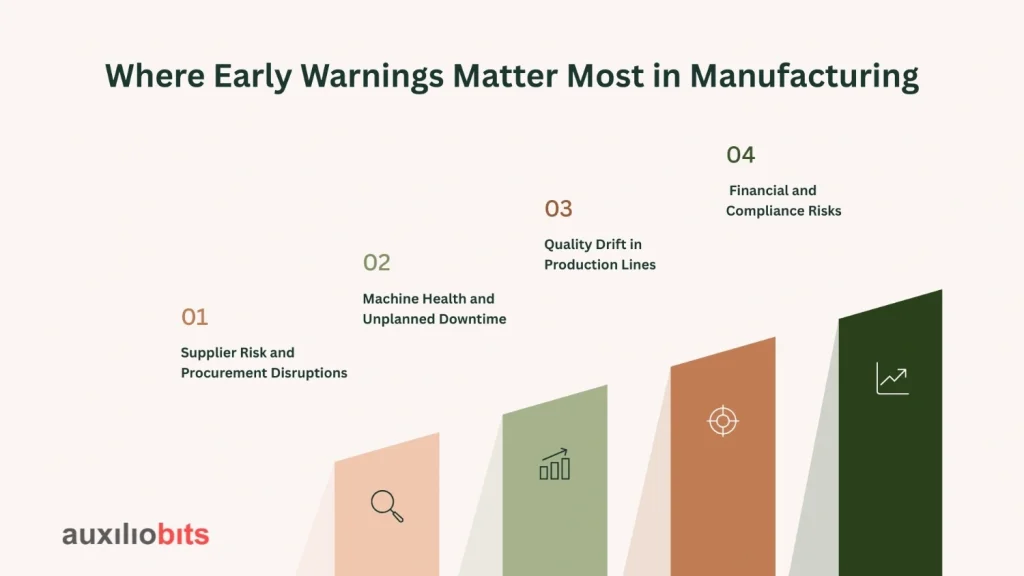
1. Supplier Risk and Procurement Disruptions
Supplier delays usually build over time. There are usually early indicators:
- Slower response times to RFQs
- Minor deviations in delivery schedules
- Increasing quality defects (even within tolerance)
An automated system can pick up on these patterns and flag “supplier reliability drift” before it turns into a missed production deadline. Interestingly, many organizations already have this data—but it sits across ERP, email threads, and quality systems. No one connects it in time.
2. Machine Health and Unplanned Downtime
Predictive maintenance has been around for years, but most implementations stop at anomaly detection.
That’s not enough.
Early warning requires:
- Historical context (what patterns led to failure before?)
- Operational context (is the machine under unusual load?)
- Maintenance behavior (are inspections being skipped?)
Without this, you get false positives—or worse, missed failures.
A real-world example: In one automotive plant, vibration anomalies were flagged repeatedly but ignored because they didn’t cross predefined thresholds. Weeks later, a critical machine failed. Post-analysis showed that the pattern of anomalies—not the magnitude—was the real signal.
3. Quality Drift in Production Lines
Quality issues often emerge gradually. Small deviations accumulate before crossing specification limits.
Early warning systems can track:
- Micro-variations in output measurements
- Changes in operator behavior
- Environmental factors (humidity, temperature)
But here’s the catch—over-sensitivity can shut down production unnecessarily.
So the system needs to distinguish between the following:
- Acceptable variability
- Meaningful drift
This is where operational risk automation needs domain-specific tuning. Generic anomaly detection models usually require customisation.
4. Financial and Compliance Risks
Operational issues often have financial implications—but the connection isn’t always immediate.
For example:
- Delayed shipments → revenue recognition delays
- Quality issues → warranty claims
- Supplier disruptions → expedited shipping costs
An early warning system that integrates operational and financial data can flag risks like:
- Margin erosion trends
- Unexpected cost spikes tied to operational inefficiencies
Most finance teams see the impact after the fact. Automation can bridge that gap—but only if systems are integrated.
Designing Risk Automation That Doesn’t Fail After Deployment
There’s a pattern that has been noticed repeatedly. Companies invest in risk automation, build dashboards, and set thresholds—and then adoption drops off after a few months.
Why?
The system fails to align with the actual decision-making process on the ground.
1. Static Thresholds Don’t Reflect Reality
Manufacturing environments are dynamic. What’s “normal” changes based on:
- Production volume
- Product mix
- Seasonal factors
Static thresholds quickly become irrelevant.
Better approach:
- Use adaptive baselines
- Incorporate contextual variables
- Allow thresholds to evolve
Otherwise, users start ignoring alerts—and once that happens, trust is difficult to rebuild.
2. Alerts Without Context Create Friction
An alert that says “Machine anomaly detected” is not actionable.
An effective early warning should answer:
- What changed?
- Why does it matter?
- What should be done next?
This task requires combining multiple data sources and presenting them in a way that’s immediately understandable. It’s more difficult than it sounds. But it’s where most systems fall short.
3. Over-Automation Can Backfire
There’s a temptation to automate everything—detection, decision-making, even response actions.
That doesn’t always work. In high-risk scenarios, operators want control. They don’t want a system shutting down production automatically based on a probabilistic model.
A more balanced approach:
- Automate detection and prioritization
- Keep humans in the loop for critical decisions
Full autonomy sounds appealing, but in manufacturing, it can introduce new risks.
4. Data Quality Is the Quiet Bottleneck
No early warning system works without reliable data. And manufacturing data is often messy:
- Inconsistent logging practices
- Missing maintenance records
- Manual overrides not captured in systems
You can build the most sophisticated model, but if the input data is flawed, the output won’t be trusted. This is usually underestimated during implementation.
The Role of AI in Operational Risk Automation
AI receives a lot of attention in this space—and for good reason. It enables:
- Pattern recognition across large datasets
- Predictive modeling of failure scenarios
- Dynamic risk scoring
However, it is not a guaranteed solution.
Where AI Works Well
- Identifying non-obvious correlations
- Learning from historical failure patterns
- Continuously improving detection accuracy
Where It Struggles
- Interpreting incomplete or inconsistent data
- Explaining decisions in a way users trust
- Adapting to sudden process changes (e.g., new product lines)
There’s also a tendency to overcomplicate solutions. Occasionally, a well-designed rule-based system with effective data integration outperforms a complex AI model. It depends on the use case.
Building a Practical Early Warning Framework
If you strip away the complexity, effective risk automation in manufacturing comes down to a few key design principles.
1. Start with Risk Scenarios, Not Data
Instead of asking, “What data do we have?”, ask:
- What risks actually matter?
- What are the early indicators of those risks?
This shifts the focus from data collection to risk understanding.
2. Combine Multiple Signal Types
Single-point monitoring rarely works. Combine:
- Sensor data
- Process logs
- Human inputs (operator notes, maintenance logs)
- External data (supplier performance, market conditions)
The value comes from correlation, not isolation.
3. Prioritize Signal-to-Noise Ratio
More alerts don’t mean better risk management.
Focus on:
- Reducing false positives
- Ranking alerts by impact
- Filtering out low-value signals
If users trust the alerts, they’ll act on them. If not, the system becomes irrelevant.
4. Integrate with Existing Workflows
An early warning system should fit into how teams already operate.
For example:
- Maintenance alerts integrated into CMMS systems
- Supplier risk alerts embedded in procurement workflows
- Financial risk signals visible in ERP dashboards
If users have to switch systems to act on alerts, adoption drops.
A Real-World Observation: Why Early Warnings Are Ignored
Even when early warning systems are implemented, they’re often underutilized. Not because they’re wrong, but because they’re inconvenient.
In one manufacturing setup, a system flagged potential supplier delays based on communication patterns and shipment history. The signals were accurate. But procurement teams ignored them.
Why?
Because acting on those alerts required:
- Escalating issues early
- Potentially disrupting existing supplier relationships
- Taking responsibility for decisions that might not materialize
There’s a human factor here. Early warnings create uncertainty. And not everyone is comfortable acting on probabilities. This is where change management becomes as important as technology.
Where This Is Heading
Manufacturing risk management is moving toward continuous monitoring—less about periodic reviews, more about real-time sensing.
But the shift isn’t just technological. It’s cultural.
Organizations that succeed with operational risk automation tend to:
- Treat risk as a dynamic variable, not a compliance checkbox
- Invest in data quality (even when it’s tedious)
- Accept that not every alert will be perfect
- Encourage proactive decision-making
And perhaps most importantly—they don’t expect automation to replace judgment. They use it to augment it.
Closing Thought
Early warning systems are uncomfortable by design. They surface issues before they’re fully visible, which means acting on them requires a degree of trust—in the system, in the data, and in the decision-making process.
That’s where most implementations struggle. The challenge lies not in detection, but in taking action. Because spotting a risk early is one thing. Doing something about it—before it becomes obvious—that’s the harder part.