


Instead of worrying about “digital transformations”, most manufacturing plant heads are preoccupied with very tangible problems that affect their bottom lines. If you ask them what truly keeps them up, you’re more likely to hear concerns like, “Why is Line 3 still struggling with first-pass yield?” or “Why does rework always spike after a small engineering change?”
Quality KPIs aren’t abstract boardroom metrics. They’re operational stress signals. And if we’re honest, many organizations measure them more rigorously than they actually manage them.
Among all the indicators that matter, two consistently determine whether a plant runs smoothly or constantly fights fires:
- First-pass yield (FPY)
- Rework reduction
These aren’t glamorous metrics. They don’t trend on LinkedIn. But they quietly determine margins, throughput stability, customer trust, and employee morale.
Now here’s where it gets intriguing. Traditional automation methods such as scripts, rule-based bots, and hard-coded alerts only slightly improve the situation. But when organizations adopt agentic automation, meaning systems that perceive, reason, decide, and coordinate across processes, something shifts. The improvement in Quality KPIs isn’t incremental. It becomes structural.
Let’s unpack why.
First-Pass Yield: The KPI Everyone Tracks, Few Truly Control
First-pass yield measures the percentage of units that pass through a process without requiring rework or repair. Simple definition. Brutal implications.
A 92% FPY sounds respectable—until you realize that 8% of output is consuming:
- Extra labor hours
- Additional inspection cycles
- Spare parts and materials
- Unplanned machine time
- Administrative handling
And more subtly: cognitive bandwidth.
In high-mix manufacturing environments—automotive components, electronics assemblies, precision machining—the real damage isn’t just cost. It’s instability. Variability compounds.
Also read: How Agentic Automation Detects Procurement Anomalies Before Posting
Where Traditional Approaches Fall Short
Most plants attempt to improve FPY through:
- Root cause analysis after defects occur
- Control charts reviewed daily
- Static SPC thresholds
- Operator training refreshers
- Kaizen events
These work. To a point. But they are reactive or episodic. They don’t adapt in real time. They rely heavily on human vigilance. And human vigilance is finite.
What Agentic Automation Changes
Agentic systems are not just dashboards. They are decision-making agents embedded across the workflow.
Instead of merely reporting that FPY dropped below 90%, an agent:
- Correlates defect types with specific tooling batches
- Detects that ambient humidity crossed tolerance earlier in the shift
- Flags that a newly onboarded operator is assigned to a sensitive station
- Adjusts inspection frequency dynamically
- Notifies maintenance before drift becomes visible scrap
That coordination layer is what transforms Quality KPIs.
It’s not magic. It’s structured autonomy.
Mechanisms That Improve First-Pass Yield
1. Context-Aware Process Monitoring
Traditional monitoring systems treat every defect event independently. Agentic systems treat them as connected signals.
Instead of: “Defect rate exceeded 3%.”
You get: “Defect rate increased 2.4% in assemblies produced with Tool ID 47, following the last calibration delay. Similar pattern observed 11 weeks ago.”
That kind of contextual memory changes intervention timing. nd timing matters more than sophistication.
2. Real-Time Adaptive Controls
Static control limits are blunt instruments.
Agentic frameworks can:
- Adjust inspection sampling rates when micro-variations are detected
- Trigger predictive maintenance based on combined sensor + quality trends
- Sequence production differently if incoming material quality fluctuates
This is where first-pass yield really moves. This is not due to improved reporting, but rather to the implementation of micro-corrections prior to the propagation of defects.
3. Cross-Functional Coordination Without Meetings
Most quality escapes happen in the gaps:
- Engineering modifies tolerances
- Production isn’t fully briefed
- QA updates inspection criteria later
- ERP reflects change after the first batch runs
There is no denying that agentic automation can synchronize:
- Engineering change notifications
- Updated inspection parameters
- Production routing adjustments
- Quality documentation workflows
No email chains. No lag.
FPY improves when alignment improves.
Rework Reduction: The Hidden Capacity Multiplier
Rework is often treated as “contained waste”. It’s better than scrap, right?
Not really.
Rework:
- Consumes skilled labor
- Disrupts scheduling
- Introduces secondary defects
- Obscures true capacity planning
- Distorts OEE metrics
And perhaps most dangerously—it normalizes imperfection.
Plants that tolerate excessive rework become culturally tolerant of inconsistency.
Reducing rework directly strengthens Quality KPIs, but it also changes behavior. That’s harder to quantify. And more powerful.
Why Rework Persists
Let’s be candid.
Rework thrives because:
- Inspection is siloed from production
- Data exists but isn’t interpreted in time
- Root cause loops take days, not minutes
- Operators lack contextual guidance
- Systems optimize throughput, not quality
Traditional automation focuses on task efficiency. Agentic automation focuses on outcome coherence.
That difference is subtle. But it shows up clearly in rework numbers.
How Agentic Automation Drives Rework Down
1. Pattern Recognition Beyond Single Stations
Defects are rarely isolated.
An agent can correlate:
- Surface finish defects at machining
- Assembly torque variation downstream
- Final functional test anomalies
When systems see horizontally across processes—not vertically within one station—rework prevention becomes systemic.
2. Intelligent Work Instructions
Static SOPs don’t adapt.
Agentic systems can:
- Adjust on-screen guidance based on defect history
- Highlight high-risk parameters for new operators
- Require confirmation steps when anomaly probability rises
Some argue this reduces operator autonomy. When designed well, it reduces cognitive overload and prevents avoidable errors.
3. Closed-Loop Feedback to Upstream Processes
Consider this flow:
- inal inspection flags repeated alignment issues
- Agent detects clustering around one fixture
- Maintenance receives automated ticket
- Production schedule temporarily reroutes volume
- Engineering notified for fixture redesign
This is all done to prevent the rework backlog from exploding.
That’s what improved Quality KPIs look like in practice. Not a prettier dashboard. A faster loop.
Quantifiable Impact on Core Quality KPIs
When agentic automation is implemented thoughtfully (and that qualifier matters), organizations typically see:
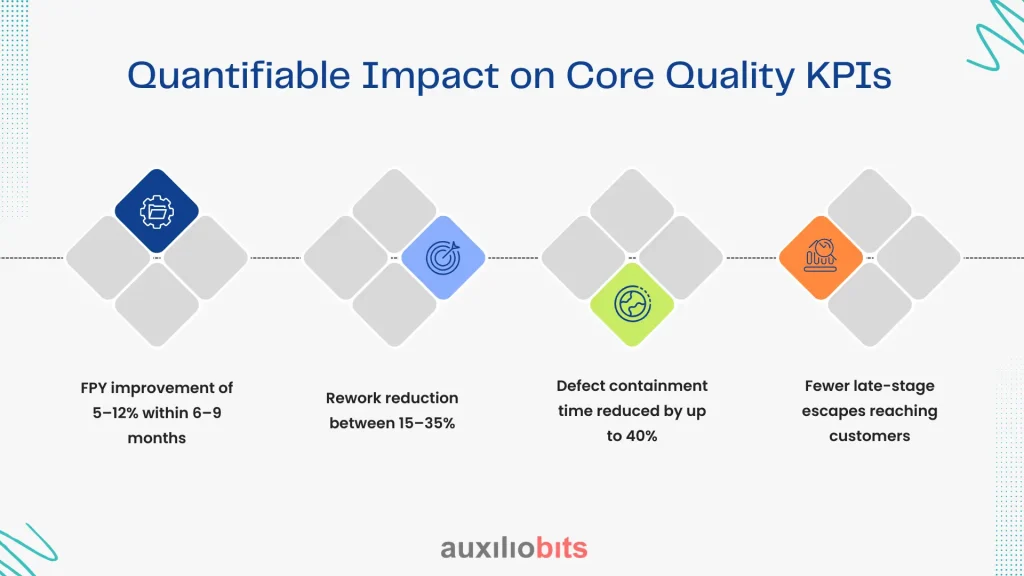
- FPY improvement of 5–12% within 6–9 months
- Rework reduction between 15–35%
- Defect containment time reduced by up to 40%
- Fewer late-stage escapes reaching customers
But there’s nuance here. If your baseline data is unreliable, automation amplifies noise. If your processes are fundamentally unstable, autonomy cannot compensate for poor engineering discipline.
Technology accelerates maturity. It doesn’t replace it.
Where Agentic Systems Fail
This is not a solution-focused discussion.
Agentic automation underperforms when:
- Data streams are incomplete or poorly integrated
- There is no ownership clarity between QA and production
- Management expects instant ROI without process redesign
- Operators distrust system recommendations
Cultural readiness often determines whether Quality KPIs move meaningfully.
Overlooked Improvements
Beyond headline FPY and rework numbers, agentic automation improves secondary indicators that indirectly strengthen Quality KPIs:
- Faster CAPA cycle times
- More consistent audit trails
- Reduced variance between shifts
- Higher confidence in compliance documentation
- Fewer emergency production halts
These improvements accumulate. They stabilize operations. And stability improves quality almost automatically.
A Real-World Scenario: Automotive Subassembly Plant
A Tier-1 supplier producing steering assemblies struggled with inconsistent FPY hovering at 89–91%. Rework teams were permanently staffed. The assumption? “Complex product, tight tolerances.”
After deploying agentic automation across inspection, torque validation, and maintenance signals:
- Early drift in torque tools was identified before final test failures
- Operator assignment patterns revealed skill-based variability
- Environmental data correlated with seasonal defect spikes
Six months later:
- FPY reached 96%
- Rework labor hours dropped by 28%
- Customer complaints declined measurably
Interestingly, no new inspection stations were added. In fact, sampling frequency decreased because confidence increased.
That’s a counterintuitive effect: better intelligence can reduce over-inspection.
Strategic Considerations for Improving Quality KPIs
If you’re considering agentic automation specifically to improve quality metrics, a few practical realities:
- Start where defect cost is highest—not where data is easiest to collect
- Integrate maintenance signals with quality data early
- Avoid building isolated “AI islands”
- Give operators visibility into why decisions are made
- Measure leading indicators, not just end-of-line failures
And one more—don’t chase perfection.
Chasing 100% FPY often results in diminishing returns. Focus on predictability and stability. The economics matter.
The Bigger Picture
Quality KPIs are sometimes treated as lagging indicators. In agentic environments, they become active control levers.
First-pass yield improves because defects are anticipated, not merely recorded.
Rework declines because systems coordinate, not just alert.
Operational noise reduces because data is interpreted continuously, not periodically.
And something subtle happens in the culture.
When teams see defects prevented instead of just corrected, quality stops feeling punitive and starts feeling collaborative.
That shift isn’t simple to quantify in a spreadsheet. But it shows up in fewer crisis meetings, fewer late-night escalation calls, and fewer awkward conversations with customers.
If you’ve spent enough time on shop floors, you know—that’s a KPI worth improving.