






Key Takeaways
- Most ESG failures are operational, not ideological—caused by delayed signals, fragmented systems, and controls that react after risk has already materialized.
- Continuous agent surveillance replaces episodic ESG checks with persistent observation, enabling early detection of drift before compliance issues become reputational crises.
- Agent-based ESG works best when embedded inside workflows, forming closed-loop controls that observe, reason, act, and learn continuously—not just report outcomes.
- Agents are great at spotting measurable trends and changes in the law, but they should not replace human judgement, especially when it comes to making decisions that are subjective or moral.
- Operationalized ESG doesn’t eliminate risk or discomfort, but it reduces surprise—turning ESG from a reporting obligation into a living risk management capability.
Most ESG strategies look solid on paper. Frameworks are aligned, materiality assessments are documented, and dashboards glow reassuringly green during quarterly reviews. Yet talk to sustainability leads off the record, and a different picture emerges. Data arrives late. Assumptions age badly. Controls function effectively—until they fail. And by the time an issue surfaces, it’s already a reputational problem rather than an operational one.
This gap between stated ESG ambition and day-to-day execution is not ideological. It’s structural. ESG today depends on fragmented signals: supplier disclosures, energy meters, HR systems, audit reports, and policy attestations. Humans are still expected to reconcile all of the data periodically and somehow notice patterns before regulators, investors, or journalists do.
That model is quietly breaking.
What’s replacing it isn’t another dashboard or reporting framework. It’s continuous agent surveillance: autonomous, purpose-built software agents that observe ESG-relevant activity across systems, reason over changes, and intervene when signals drift outside acceptable bounds. Such surveillance is not a futuristic concept. This concept is grounded in a practical and somewhat chaotic enterprise context.
Why ESG Fails in Operations
ESG programs struggle not because companies don’t care, but because ESG cuts across operational layers that were never designed to speak to one another.
Consider a manufacturing firm with a public emissions-reduction target. Energy usage data lives in plant systems. Procurement decisions sit in ERP. Supplier emissions data arrives via PDFs once a year. Logistics emissions are estimated, not measured. Finance wants monthly rollups. Sustainability wants narratives. Legal wants defensibility.
Now add real life:
- A plant manager overrides a process to meet a delivery deadline.
- A supplier changes subcontractors mid-year.
- Energy prices spike, shifting load patterns.
- A regional regulation tightens reporting thresholds quietly, without fanfare.
None of these events violate policy in isolation. Together, they can derail an ESG commitment. Traditional controls don’t see these events because they’re episodic. They check compliance after behavior occurs.
Continuous surveillance flips that sequence.
What “Continuous Agent Surveillance” Means
This is where terminology matters. Surveillance doesn’t mean spying on employees or scraping everything indiscriminately. It means persistent observation of defined ESG signals by autonomous agents with limited, explicit mandates.
An ESG surveillance agent typically has:
- A scope: emissions intensity for a product line, supplier labor practices, DEI hiring ratios, policy adherence
- Signal access: APIs, logs, documents, transactional data, third-party feeds.
- Reasoning logic: thresholds, trend detection, contextual rules, sometimes probabilistic models.
- Action pathways: alerts, recommendations, workflow triggers, or escalation.
Think of them less as “AI models” and more as tireless compliance analysts who never wait for quarter-end.
ESG Is a Moving Target. Agents Are Built for That.
ESG risk is rarely static. What was acceptable last year may be insufficient this year. Sometimes the target moves because regulations change. Stakeholder expectations may shift at times.
Humans adapt slowly to moving targets, especially across silos. Agents don’t.
Continuous surveillance agents can:
- Track regulatory updates and map them to internal controls.
- Re-evaluate historical data against new thresholds.
- Notice gradual drift rather than binary violations.
This matters more than it sounds.
From ESG Reporting to ESG Control Loops
Most ESG technology investments still focus on reporting. Better data ingestion. Better visualization. Faster audits.
Reporting is necessary. It’s not sufficient.
Operationalizing ESG requires control loops—to observe, reason, act, and learn—embedded in business processes.
Agents enable this by sitting inside workflows rather than outside them.
For example:
- Procurement: An agent evaluates supplier bids not only on price and delivery, but on dynamic ESG risk scores informed by real-time signals. When risk rises, approvals slow or additional checks trigger automatically.
- Facilities & Operations: Energy optimization agents monitor consumption patterns against production schedules. If emissions intensity creeps upward during certain shifts, the agent proposes operational adjustments, not just reports the variance.
- HR & Social Metrics: DEI agents observe hiring, promotion, and attrition patterns over time. They don’t accuse. They surface trends early, when course correction is still possible.
This isn’t about automation for its own sake. It’s about ensuring that our policies align with what actually happens in practice.
Where Agent Surveillance Works Well
There’s a temptation to assume agents can “solve ESG.” They can’t. And pretending otherwise creates new risks.
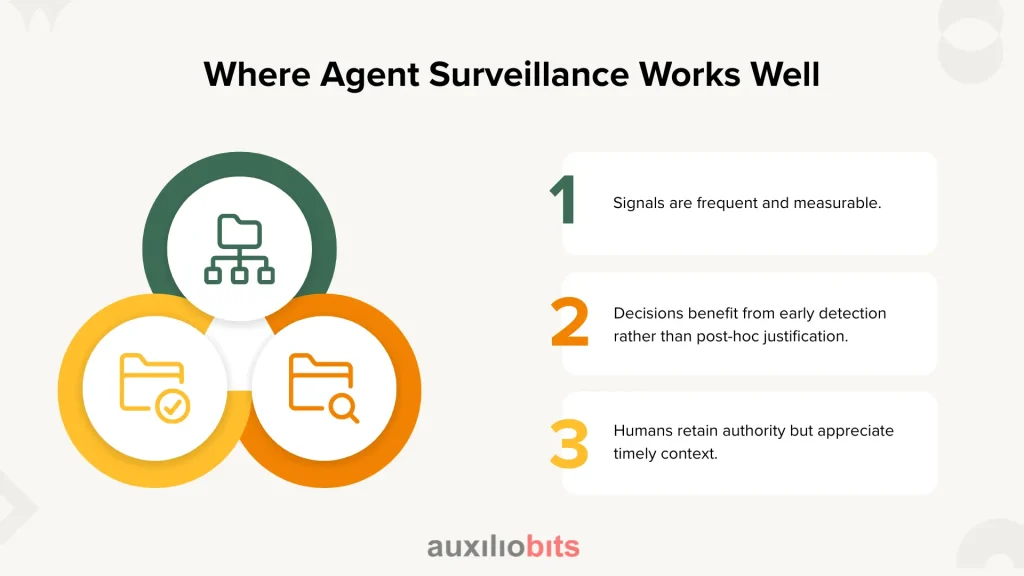
They work best when:
- Signals are frequent and measurable.
- Decisions benefit from early detection rather than post-hoc justification.
- Humans retain authority but appreciate timely context.
Emissions monitoring, supplier risk surveillance, and safety trend analysis—these are strong candidates.
They struggle when:
- Metrics are inherently subjective.
- Data is sparse or heavily lagged.
- Ethical judgement, not pattern recognition, is central.
An agent can flag that whistleblower reports dropped sharply in one region. It cannot explain why. Over-automating interpretation here would be irresponsible.
There’s also the risk of false confidence. If leadership assumes “the agents have it covered”, governance can weaken. Surveillance should augment accountability, not replace it.
Some organizations treat ESG as a narrative exercise. Others treat it as a risk management function. The most mature ones treat it as an operational discipline.
Agent-based surveillance nudges companies toward the third category. This is not due to its fashionable nature but rather because it aligns with the operational processes of modern enterprises, which involve systems, signals, and feedback loops.
Will it surface uncomfortable truths? Probably. Will it occasionally flag things that turn out to be nothing? Almost certainly.
But silence is worse.
ESG failures rarely come from dramatic violations. They emerge from small deviations, repeated quietly, until someone outside the organization notices first. Continuous surveillance doesn’t guarantee virtue. It does, however, reduce surprise. And in today’s environment, fewer surprises might be the most practical ESG outcome of all.