







Key Takeaways
- Evidence—not transactions—is the real bottleneck in multi-entity finance automation, especially during audits and compliance checks.
- Traditional automation improves speed but weakens traceability, often shifting effort from operations to audit preparation.
- Fragmented evidence across systems, emails, and spreadsheets creates systemic risk, particularly in intercompany and cross-entity processes.
- Evidence automation embeds validation, approvals, and documentation directly into workflows, eliminating the need for post-facto reconstruction.
- Agentic AI adds adaptability to evidence handling, but without governance and structured standards, it can introduce new layers of opacity.
Manufacturing finance teams rarely operate in a clean, single-entity world. There are subsidiaries across regions, plants operating under different compliance regimes, shared service centers trying to standardize chaos, and ERP instances that—despite best intentions—don’t quite speak the same language.
On paper, multi-entity finance looks like a scaling problem. In practice, it’s an evidence problem.
Most organizations don’t struggle to process transactions anymore. They struggle to prove them.
And that distinction is where finance automation multi-entity strategies often succeed—or quietly fail.
The Hidden Complexity Behind Multi-Entity Finance
Ask any finance controller managing 5+ legal entities what slows down month-end, and you’ll hear familiar answers: intercompany reconciliations, consolidation adjustments, and and compliance checks. But dig a little deeper and a different pattern emerges.
It’s not just the transactions. It’s the trail behind them.
A simple inventory valuation adjustment in a single entity is manageable. Now multiply that across:
- Different cost accounting methods (standard vs. actual)
- Region-specific tax treatments
- Currency fluctuations
- Local compliance documentation requirements
Suddenly, you’re not validating numbers—you’re validating evidence chains. And those chains are messy.
Some parts live in ERP systems. Others sit in email approvals. A few exist as Excel files saved on someone’s desktop (usually with “final_v3_latest” in the name). When auditors arrive, finance teams don’t just retrieve data—they reconstruct narratives.
That reconstruction effort is where automation often underdelivers.
Also read: Revenue Leakage in Manufacturing—and How Automation Fixes It
Where Traditional Automation Falls Short
Most automation initiatives in manufacturing finance focus on throughput:
- Faster invoice processing
- Automated journal entries
- Scheduled reconciliations
- Standardized reporting
All useful. All necessary. But not sufficient. Because in multi-entity finance, speed without traceability creates a new kind of risk.
Here’s a pattern that has been noticed more than once: A global manufacturer automates intercompany postings across 12 entities. Transactions flow smoothly. Month-end closes faster by 30%.
Then audit season arrives.
And suddenly, questions like these start surfacing:
- Why was this allocation split 60/40 between Entity A and B?
- Who approved this cost reclassification?
- What supporting document justifies this adjustment?
The system has the numbers. It doesn’t have the context. So the finance team scrambles—digging through emails, Slack messages, and and shared drives. The efficiency gained earlier gets quietly reversed during audit preparation.
It’s a familiar irony: automation reduces effort in operations but increases effort in validation.
Evidence Fragmentation: The Real Challenge
At the heart of finance automation multi-entity challenges is fragmentation—not just of systems, but of evidence.
Consider a typical multi-entity process like intercompany reconciliation:
- The transaction originates in Entity A’s ERP
- Counter-entry recorded in Entity B’s system
- Supporting agreement stored in a contract repository
- Approval captured via email or workflow tool
- Currency adjustment calculated in Excel
- Final reconciliation signed off manually
Each step produces evidence. But none of it is unified. This process leads to three persistent issues:
1. Inconsistent Evidence Standards
Different entities maintain different levels of documentation rigor. One subsidiary attaches detailed backup files; another relies on implicit approvals.
From a consolidation perspective, this inconsistency is a liability.
2. Manual Evidence Assembly
During audits, finance teams manually compile evidence packets:
- Download transaction logs
- Attach supporting documents
- Reconstruct approval trails
- Cross-reference numbers across systems
Teams often spend 40–60% of audit preparation time just assembling evidence, not analyzing it.
3. Lack of Real-Time Traceability
Most systems can tell you what happened. Few can explain why it happened—especially across entities.
This gap becomes critical when regulators or auditors expect near-instant traceability.
Evidence Automation: A Different Lens on Finance Transformation
This scenario is where evidence automation shifts the conversation.
Instead of asking, “How do we automate transactions?” the question becomes: “How do we automate the creation, capture, and validation of evidence alongside every transaction?”
It sounds subtle. It isn’t. Because evidence automation changes how processes are designed—not just how they’re executed.
What Evidence Automation Looks Like
There’s a tendency to treat evidence as an afterthought—something to be attached once a process is complete. That mindset doesn’t hold in multi-entity finance.
Evidence has to be generated as part of the process itself.
A few practical examples:
1. Intercompany Transactions
Instead of:
- Posting entries
- Later attaching agreements and approvals
Evidence automation would:
- Validate intercompany rules before posting
- Automatically link agreements from contract systems
- Capture approval metadata at the moment of decision
- Generate a traceable audit log tied to both entities
2. Inventory Adjustments
Rather than relying on manual justifications:
- System triggers validation rules based on variance thresholds
- Pulls supporting production or procurement data
- Captures user rationale in structured formats (not free-text emails)
- Stores everything as a single evidence object
3. Journal Entries Across Entities
Instead of post-facto documentation:
- Enforce evidence requirements at entry creation
- Automatically tag entries with source system references
- Maintain version history of adjustments
- Link approvals directly to transaction IDs
The difference is subtle but important: evidence is no longer collected. It’s produced.
Why Multi-Entity Environments Amplify the Problem
In a single entity, poor evidence practices are inconvenient. In multi-entity setups, they become systemic risks.
A few reasons why:
1. Regulatory Diversity
Different jurisdictions expect different levels of documentation. What passes in one region may fail in another.
Without standardized evidence automation, compliance becomes uneven.
2. Intercompany Dependencies
One entity’s transaction is another’s counterparty. If evidence is missing on one side, reconciliation breaks down.
3. Consolidation Pressure
Group-level reporting requires consistent, auditable data across all entities. Any weak link introduces delays and audit flags.
4. Scale Effects
Manual evidence handling doesn’t scale linearly. It grows exponentially with the number of entities and transactions.
At 3 entities, you can manage them. At 15, it starts breaking. At 30+, it becomes unsustainable.
Designing Finance Automation with Evidence at the Core
If there’s one shift that makes a difference in multi-entity finance automation multi entity, it’s this: designing processes where evidence is a first-class citizen. That doesn’t mean adding more documentation steps. It means embedding evidence into the workflow itself.
Some design principles that tend to work:
1. Treat Evidence as Structured Data
Avoid unstructured formats wherever possible.
- Replace email approvals with system-captured decisions
- Use standardized fields for justification
- Tag documents with metadata linked to transactions
2. Automate Evidence Capture at Source
Don’t rely on downstream collection.
- Capture approvals at the moment of action
- Link supporting documents automatically
- Generate logs in real time
3. Enforce Evidence Policies Across Entities
Standardization matters.
- Define minimum evidence requirements
- Apply validation rules consistently
- Flag exceptions automatically
4. Build Cross-Entity Traceability
Transactions shouldn’t exist in isolation.
- Link intercompany entries across entities
- Maintain shared audit trails
- Enable drill-down from consolidated reports to source evidence
Where Things Still Go Wrong
Even with evidence automation, there are pitfalls.
A few that show up repeatedly:
- Over-engineering workflows: Teams sometimes create overly rigid processes that slow down operations. Evidence automation should support workflows, not choke them.
- Ignoring edge cases: Not every transaction fits standard rules. Exceptions need flexible handling without breaking traceability.
- Assuming ERP alone is enough: Most ERP systems weren’t designed for cross-entity evidence orchestration. Additional layers are often necessary.
- Underestimating change management: Finance teams are used to informal processes (emails, spreadsheets). Moving to structured evidence capture requires behavioral shifts.
The Role of Agentic AI in Evidence Automation
This is where things get interesting—and a bit nuanced. Traditional automation tools follow predefined rules. They’re good at structured processes but struggle with variability.
Agentic AI, when applied carefully, introduces adaptability.
In the context of multi-entity finance, it can:
- Interpret unstructured inputs (contracts, emails, notes)
- Extract relevant evidence automatically
- Validate transactions against dynamic rules
- Flag anomalies with contextual reasoning
However, it’s crucial to note that AI is not a panacea.
AI can assist in evidence generation and validation, but it still needs the following:
- Clear governance frameworks
- Defined evidence standards
- Human oversight for critical decisions
Otherwise, you risk replacing one form of opacity with another.
What Finance Leaders Should Prioritize
If you’re leading finance transformation across multiple entities, it’s tempting to focus on speed and cost savings. Those matter. However, they do not encompass the entire picture.
A more grounded approach might look like this:
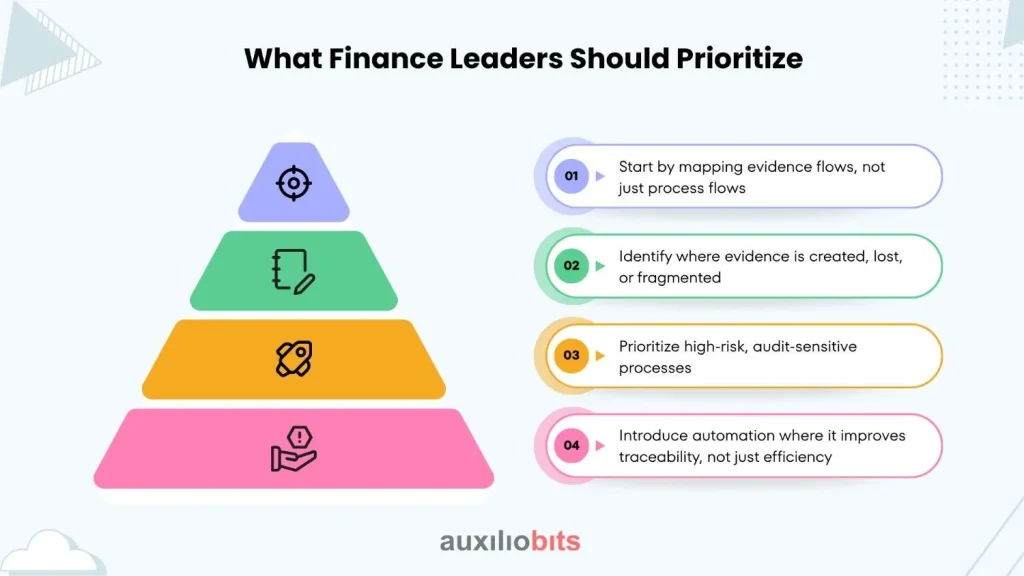
- Start by mapping evidence flows, not just process flows
- Identify where evidence is created, lost, or fragmented
- Prioritize high-risk, audit-sensitive processes
- Introduce automation where it improves traceability, not just efficiency
And perhaps most importantly—accept that not everything needs to be fully automated. Some processes benefit from human judgment. The goal isn’t to eliminate people; it’s to eliminate ambiguity.
A Note on Implementation Philosophy
There’s a tendency in large organizations to chase system replacement as the solution—new ERP, new platforms, full-scale digitization.
In reality, most manufacturing firms already have the systems they need.
The gaps exist in the manual layers around those systems:
- Data movement between tools
- Approval workflows outside core platforms
- Evidence scattered across informal channels
That’s where targeted automation—especially evidence-focused automation—delivers disproportionate value. It’s less about rebuilding the house and more about fixing the wiring that nobody sees until something shorts.
Closing Thought
Multi-entity finance isn’t getting simpler. If anything, regulatory pressure and operational complexity are increasing.
Automation will continue to evolve. Tools will improve. AI will become more capable.
However, if evidence does not play a central role in the design of finance processes, the same issues will continue to exist, albeit at a faster pace.
And faster problems are still problems.