

Key Takeaways
- Account-level intelligence matters more than lead scoring. In long B2B cycles, buying signals come from multiple stakeholders within the same company—not from a single lead.
- Long Sales Cycle Automation should guide accounts, not push emails. Automation works best when it supports different roles like engineers, procurement teams, and executives with tailored insights.
- Content acts as progressive education. Manufacturing buyers move slowly through research, validation, and technical evaluation stages, and automation must support each step.
- Timing determines effectiveness. Sales engagement becomes powerful when automation detects coordinated interest from multiple contacts within the same account.
- Manufacturing sales automation works when marketing and sales share visibility. Automation insights must feed directly into CRM workflows so sales teams can act on real account behavior.
Manufacturing sales rarely behave like typical B2B transactions. A single deal might take nine months—or eighteen. Sometimes longer. Multiple stakeholders appear and disappear during the process: procurement, operations leaders, engineering teams, and sometimes even plant managers who suddenly have veto power.
Marketing teams entering this environment often try to apply standard automation playbooks built for faster-moving industries. Lead scoring, nurture emails, and a few webinar campaigns.
And then they wonder why nothing converts.
The problem isn’t that automation doesn’t work. It absolutely does. The problem is that traditional marketing automation was designed for short buying journeys, while manufacturing deals are fundamentally account-driven, multi-stage, and slow-moving.
When automation is redesigned around account-level intelligence instead of individual leads, something interesting happens. Marketing stops chasing downloads and starts influencing real buying committees. That shift—toward Long Sales Cycle Automation driven by account insights—is where manufacturing sales automation actually begins to create pipeline impact.
Why Manufacturing Sales Cycles Are Structurally Different
Anyone who has worked with manufacturing clients knows this already: the buying process is rarely linear.
A plant expansion might trigger a need for new machinery. That machinery might require new suppliers. Procurement might run a tender. Meanwhile, engineering teams review specifications for weeks.
By the time a purchase decision happens, dozens of interactions may have occurred.
Typical patterns in manufacturing deals include:
This complexity is precisely why long sales cycle automation must operate at the account level, not the individual lead level.
Consider a typical scenario: An engineer downloads a whitepaper about predictive maintenance sensors. Marketing marks them as a “qualified lead”. Sales reaches out immediately. But the engineer isn’t buying anything. They’re just researching. The actual buyer might be the operations director, who hasn’t interacted with marketing yet.
Without account-level visibility, marketing automation misreads the entire situation.
The Limits of Traditional Lead-Based Automation
Most marketing automation platforms still revolve around individual leads:
- Someone fills a form
- They receive nurture emails
- Their behavior increases a lead score
- Sales gets notified when a threshold is reached
For manufacturing companies, this approach creates two problems. First, it fragments account intelligence. If five people from the same company interact with content, those signals often remain isolated.
Second, lead scores rarely represent buying readiness. Someone who downloads three technical PDFs might still be months away from influencing a purchase. This is why many manufacturing marketing teams quietly admit something: Their automation platform sends emails, but it doesn’t really influence revenue. Real manufacturing sales automation requires a deeper shift—toward account-level behavioral insight.
Account-Based Insights Change the Automation Equation
Account-based marketing has been discussed for years, but its impact becomes especially clear in long sales cycles. Instead of asking, “Which leads are engaged?”, the more useful question becomes, “Which accounts are showing buying signals?”
That subtle change reshapes automation strategies entirely.
Account insight models typically combine signals such as:
- Multiple contacts from the same company interacting with content
- Repeat visits to solution pages over several weeks
- Engagement with technical documentation or product specifications
- Webinar attendance from engineering or operations roles
- Competitor comparison searches
Individually, these signals mean very little. But together? They start to reveal something valuable: organizational intent. Marketing automation systems that aggregate these signals can detect early buying cycles—even before sales teams hear about them.
What Long Sales Cycle Automation Looks Like
Redesigning automation around accounts rather than leads makes its behaviour more strategic. Instead of pushing content to individuals, the system begins orchestrating engagement across multiple stakeholders.
Typical automation patterns include:
1. Account intelligence triggers
- Detect when multiple contacts from the same company engage with product content
- Monitor repeat visits from engineering teams
- Surface account-level engagement spikes to sales
2. Role-specific nurture sequences
Different stakeholders receive different information.
Engineering teams might see:
- Technical whitepapers
- Integration guides
- Product specifications
Procurement contacts might see:
- Cost models
- ROI calculators
- Supply reliability case studies
Executives often receive:
- Strategic industry insights
- Market outlook reports
- Competitive advantage analysis
This multi-role nurturing is critical for manufacturing sales automation, because buying committees evaluate solutions through very different lenses.
The Quiet Role of Content in Manufacturing Automation
Manufacturing often misunderstands content marketing. People assume it’s about brand awareness or SEO traffic. But in long sales cycles, content plays a different role: progressive education. Manufacturing buyers rarely make impulsive decisions. They move through stages of understanding.
Early-stage questions often look like:
- Are we solving the right problem?
- What technologies exist to address this?
- Which vendors specialize in our use case?
Later stages become far more practical:
- How will this integrate with our systems?
- What operational changes will be required?
- Can our existing infrastructure support this?
Effective long sales cycle automation aligns content to these evolving questions. Some content accelerates awareness. Other pieces quietly support late-stage validation. The trick is knowing when to surface which content—and that’s where account insights become invaluable.
Automation Doesn’t Replace Sales — It Prepares Them
There’s a misconception that automation reduces the need for sales engagement. In manufacturing, the opposite is often true. Automation doesn’t close deals. It prepares the battlefield.
By the time sales contacts a prospect, several things should already be true:
- The account understands the problem space
- Key stakeholders have encountered the vendor’s perspective
- The solution category feels familiar
- Trust has started forming
Without this groundwork, sales conversations stall quickly. Many manufacturing buyers simply aren’t ready to talk when they first encounter a brand. Automation bridges that gap.
Signals That Matter in Manufacturing Buying Journeys
Not all engagement signals carry equal weight. Some are surprisingly predictive. From experience, these tend to matter most:
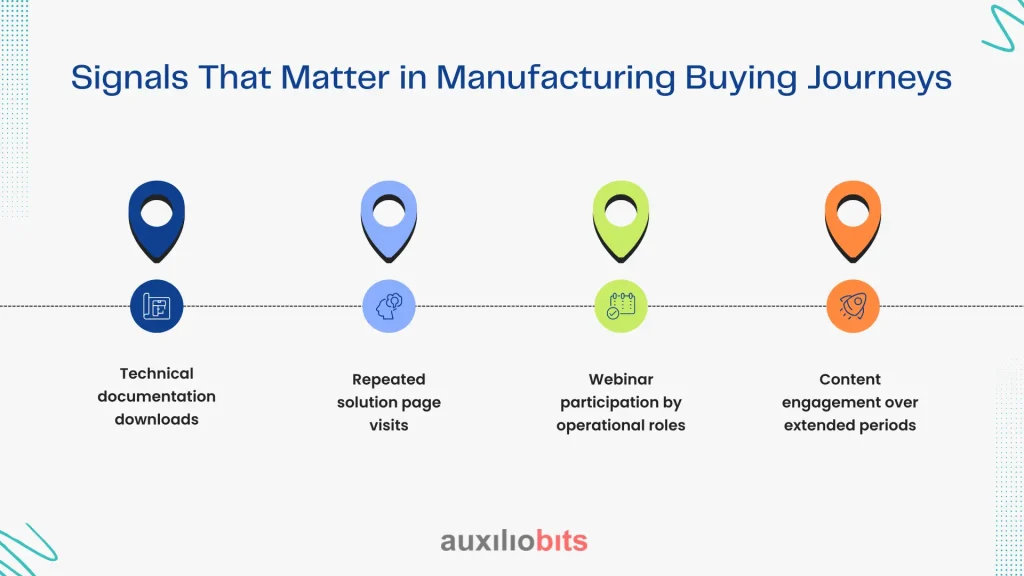
1. Technical documentation downloads
Engineers rarely download product specs casually.
2. Repeated solution page visits
Especially if multiple users from the same company appear.
3. Webinar participation by operational roles
Operations leaders joining technical webinars often indicates active evaluation.
4. Content engagement over extended periods
One interaction means little. Six interactions across three months? That’s different.
Effective sales automation systems for manufacturing signals into account timelines. Sales teams then see the story of engagement, not isolated activities.
Where Marketing Automation Often Fails
Even well-designed automation strategies fail occasionally. Three common issues appear repeatedly.
1. Over-automation
Some teams automate everything. Emails trigger emails; workflows cascade endlessly. Eventually, contacts receive messages that feel mechanical and irrelevant. Automation works best when intervention points remain available.
2. Lack of sales alignment
If marketing and sales teams disagree on account priorities, automation loses impact quickly. Automation insights must flow into sales workflows—CRM alerts, account dashboards, and pipeline discussions. Otherwise they sit unused.
3. Content fatigue
Manufacturing audiences are highly technical. They quickly detect shallow marketing content. Automation magnifies this issue because weak content gets delivered repeatedly. Quality matters more than quantity.
Practical Components of Manufacturing Sales Automation
A realistic automation framework for long manufacturing cycles usually includes several layers.
1. Account intelligence layer
- Identifies account engagement patterns
- Aggregates activity across contacts
- Highlights buying signals
2. Behavior-based workflows
Automation triggered by account behavior rather than form submissions.
3. Sales visibility tools
CRM dashboards that reveal account engagement timelines.
4. Content alignment
Material mapped to specific stakeholder roles and buying stages.
A few specific activities often prove effective:
- Trigger alerts when engineering teams download integration documentation
- Send targeted ROI case studies to procurement contacts
- Surface competitor comparison content when accounts research alternatives
- Introduce solution engineers into conversations when technical interest spikes
These actions combine into long sales cycle automation that quietly nudges accounts forward.
The Value of Timing
Timing is one of the most underrated elements of automation. Too early, and outreach feels intrusive. Too late, and competitors have already shaped the conversation. Account insights help identify the middle ground.
For instance: If several employees from a manufacturer begin researching robotics integration within a two-week window, that suggests internal discussions are happening. Reaching out then—armed with context—can be incredibly effective. Automation doesn’t replace intuition here. It enhances it.
The Role of AI in Account-Based Automation
Artificial intelligence is starting to influence manufacturing sales automation, particularly in identifying account intent signals.
AI systems now analyze patterns like:
- Engagement velocity across contacts
- Cross-channel activity (website, email, webinars)
- Behavioral similarities with past closed deals
These models predict which accounts are likely entering buying cycles. Still, AI isn’t magic. If the underlying data is fragmented—or if sales teams ignore the signals—predictions don’t translate into pipeline. Technology helps. Alignment matters more.
Why Many Manufacturing Firms Still Struggle
DSignals That Matter in Manufacturing Buying Journeysespite the tools available, many manufacturers continue running basic email campaigns rather than account-driven automation.
Several reasons appear repeatedly:
- Marketing data scattered across systems
- CRM adoption gaps within sales teams
- Lack of technical content to support long nurture journeys
- Organizational resistance to new marketing approaches
Ironically, the companies that succeed with long sales cycle automation tend to start small. They pick a limited set of strategic accounts and build automation workflows around those first. Once success becomes visible, scaling becomes easier.
Also read: How Manufacturing Leaders Are Building Autonomous Operations
The Real Goal: Influence Before Procurement Appears
If there’s one principle that defines effective manufacturing sales automation, it’s this: Influence must occur before procurement formalizes the buying process.
Once an RFP is issued, most decisions have already been shaped. Automation helps vendors enter the conversation earlier. Through account-level insights, targeted education, and stakeholder-specific engagement, marketing begins influencing decisions long before sales conversations happen.
And in manufacturing—where deals take months or years—that early influence often determines the outcome. Not always. But more often than most teams realize.