






Key Takeaways
- Inbound automation succeeds when it reduces uncertainty, not just manual effort.
- Outbound logistics breaks down fastest when exceptions are automated without accountability.
- Reverse logistics automation is less about speed and more about correct classification.
- Visibility without execution logic creates work instead of eliminating it.
- The most effective logistics automation feels boring—because problems stop escalating
Manufacturing leaders rarely wake up envisioning “logistics automation” as a tidy, comprehensive program. Manufacturing leaders often awaken to the sight of a delayed truck at the gate, a shortage of a specific fastener that unexpectedly disrupts a line, or a stack of returns in a corner, unclear about their ownership. Planning and execution blur quickly on the shop floor—and logistics is usually where that blur becomes expensive.
Automation, when it works, doesn’t magically simplify logistics. What it does is remove the parts that never should have depended on human memory, email threads, or tribal knowledge in the first place. And that matters most in three places: inbound flows, outbound movements, and reverse logistics—the last one everyone pretends is “edge” until it eats margin.
This isn’t a platform pitch or a vision statement. It’s a grounded look at how logistics automation actually shows up in manufacturing environments, where it delivers value, where it breaks, and why execution matters more than architecture diagrams.
Planning vs. Execution: Where Logistics Really Breaks
Most manufacturers plan logistics reasonably well on paper. MRP runs. Demand forecasts exist. Carrier contracts are signed. The problems start after that.
Plans assume:
- Suppliers ship what they promise
- Carriers arrive when scheduled
- Documentation is accurate
- Exceptions are rare
Reality does not cooperate.
Execution lives in:
- Dock scheduling spreadsheets
- Emails with “URGENT” in the subject line
- WhatsApp messages from transporters
- Manual GRNs created hours late
- Return material authorizations that never close
Automation only pays off when it sits directly inside execution—not as a dashboard, but as an active participant in decisions and handoffs. That distinction becomes clearer when you look at each logistics stream separately.
Also read: Smart freight matching: agent orchestration between logistics partners and carriers
Inbound Logistics Automation: Where Variability Starts
Inbound logistics is where manufacturing first feels the consequences of external uncertainty. Raw materials, components, packaging—none of them arrive as cleanly as purchase orders suggest.
What Typically Goes Wrong
Even mature plants struggle with:
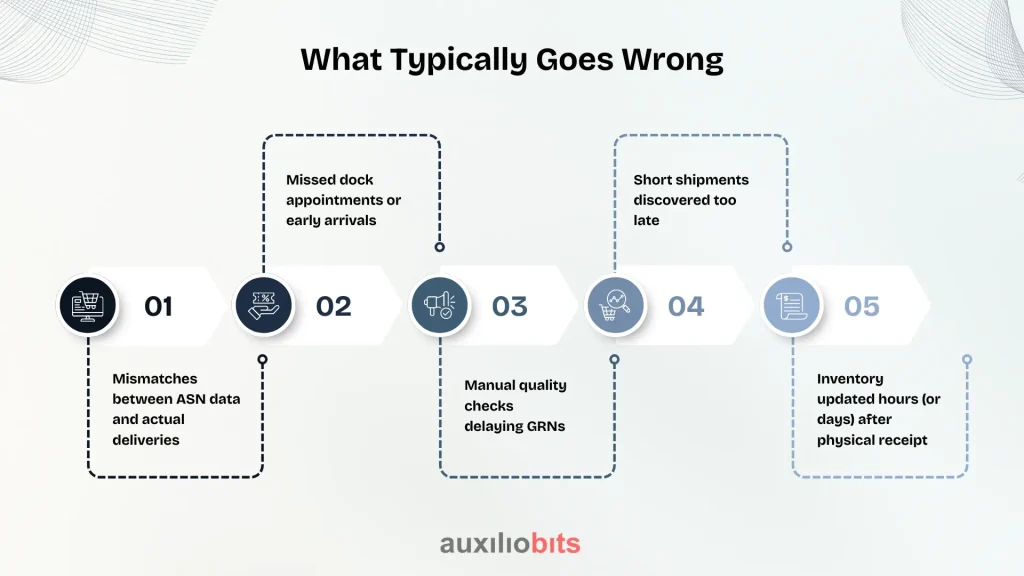
- Mismatches between ASN data and actual deliveries
- Missed dock appointments or early arrivals
- Manual quality checks delaying GRNs
- Short shipments discovered too late
- Inventory updated hours (or days) after physical receipt
None of this is exotic. It’s operational friction. And friction compounds.
A Tier-2 automotive supplier once described inbound delays this way: “We don’t run out of material. We run out of certainty.” That’s accurate.
Where Automation Helps
Inbound automation works best when it focuses on events, not transactions.
Practical examples:
- Automated appointment scheduling that reacts to supplier confirmations and carrier GPS signals, not static time slots
- ASN validation bots that compare supplier documents, PO data, and historical shipment patterns before the truck even arrives
- Gate-in automation using OCR and RFID to log vehicle entry without manual registers
- GRN pre-processing, where data is staged and validated before quality clears the material
When It Fails
Inbound automation collapses when:
- Supplier data quality is ignored (“We’ll fix it later”)
- Exceptions are routed to shared inboxes
- ERP updates are treated as the end goal
If a system can’t answer why a delivery is late, not just that it is late, you’re automating noise.
Outbound Logistics Automation: Precision Under Pressure
Outbound logistics feels more controlled than inbound. After all, the plant decides when to ship. In practice, outbound is where customer expectations, transportation variability, and documentation collide.
The Execution Reality
Outbound teams juggle:
- Multiple carriers with different SLAs
- Last-minute order changes
- Manual packing list and invoice preparation
- Compliance documentation (especially cross-border)
- Proof of delivery chasing
What Automation Looks Like on the Ground
Effective outbound automation focuses on orchestration, not speed.
Common patterns:
- Dynamic load planning that adapts to order mix, not fixed routes
- Automated document generation (BOL, invoices, export docs) triggered by shipment events
- Carrier selection logic based on cost, service history, and destination risk—not just rate cards
- Real-time shipment visibility that feeds customer communication automatically
Some plants now use agents that flag “risky” shipments before dispatch—late orders, partial loads, or lanes with recent disruptions. Not to stop them, but to escalate intelligently.
A Note on Over-Automation
Outbound is where over-automation hurts fastest. If:
- Exceptions are auto-resolved without human review
- Customer commitments are changed silently
- Carrier failures are hidden behind green dashboards
Reverse Logistics: The Quiet Margin Killer
Reverse logistics rarely gets budget priority. It should.
Returns, repairs, recalls, reusable packaging, scrap movements—these flows are fragmented, under-measured, and often manually reconciled weeks later. This is why finance teams dislike these processes.
Why Reverse Is Different
Reverse logistics breaks most linear assumptions:
- Direction of flow changes
- Ownership isn’t always clear
- Quality status is uncertain
- Financial impact is delayed
A returned component might be scrap, refurbishable, or resellable. Until it’s inspected, it sits in limbo. Automation here isn’t about speed—it’s about classification.
Where Automation Makes a Real Difference
High-impact reverse automation usually includes:
- Automated RMA validation against warranty terms and shipment history
- Return routing logic (repair center vs. scrap vs. supplier return)
- Condition-based workflows triggered by inspection results
- Financial reconciliation automation tying physical outcomes to credits, write-offs, or rework costs
Reverse logistics exposes bad upstream behavior. Poor packaging. Inaccurate shipments. Weak quality controls. Automation doesn’t hide that—it surfaces it. Which is why some organizations avoid it.
Connecting Planning to Execution: The Missing Layer
Most logistics automation discussions jump from planning systems (ERP, APS) straight to execution tools (WMS, TMS). What’s missing is the connective tissue—the logic that interprets reality as it unfolds.
This is where event-driven automation and agent-based decisioning are gaining traction:
- Monitoring signals (GPS, scans, delays)
- Interpreting context (customer priority, inventory buffers)
- Triggering actions (reschedule, notify, reroute)
Not everything needs to be autonomous. But everything should be intentional.
A planner once said, half-jokingly: “If the system tells me what already happened, it’s useless. Tell me what’s about to go wrong.” That’s the bar.
Real-World Nuances No One Mentions
Some hard-earned lessons from manufacturing floors:
- Automating inbound without fixing supplier behavior just moves chaos earlier
- Outbound visibility without customer communication automation increases workload
- Reverse logistics metrics improve only when finance is involved early
- Bots need escalation paths, not just rules
- Perfect data is not a prerequisite—but ignored data is fatal
And yes, sometimes a manual workaround is faster. The goal isn’t purity. It’s resilience.
What Mature Logistics Automation Feels Like
In plants where logistics automation has settled in—not pilot mode, not slideware—it feels boring. That’s a compliment.
- Fewer “Where is this shipment?” calls
- Less firefighting at docks
- More predictable inventory accuracy
- Returns that close themselves financially
People still intervene. But they intervene for reasons that matter.
Logistics automation in manufacturing succeeds when technology is ready. It fails because organizations confuse visibility with control and control with intelligence.
Inbound, outbound, and reverse flows each demand different automation philosophies. Treat them the same, and you’ll automate the wrong problems.
Execution is where logistics lives. Planning just gives it a map.