

Key Takeaways
- Accurate data capture is the single most important prerequisite for OEE improvement automation. Without reliable event-level data, even advanced AI cannot produce meaningful insights.
- Most OEE losses hide in micro-stoppages, changeover inefficiencies, and performance drift—not major breakdowns. Automation makes these previously invisible losses measurable.
- AI agents are most valuable when they identify patterns and root causes, not when they simply display performance metrics. Insight—not visibility—drives improvement.
- OEE improvement should focus on constraint assets and economically critical lines. Improving the wrong asset may raise OEE but not increase throughput or profitability.
- The most effective systems combine automated intelligence with structured human input. Operators and AI agents working together consistently outperform fully automated or entirely manual approaches.
Manufacturers talk about OEE the way finance teams talk about EBITDA. Everyone tracks it. Everyone reports it. And yet, most organisations are truly unsatisfied with it.
Overall Equipment Effectiveness has been around since the early TPM days at Toyota, and the formula itself hasn’t changed much: Availability × Performance × Quality. What has changed—dramatically—is the complexity of modern production environments. Mixed-model lines. High variability in demand. Contract manufacturing. Aging equipment retrofitted with IoT sensors. And increasingly, disconnected data sources that don’t agree with each other.
That’s where OEE improvement automation becomes more than a buzz phrase. It becomes a discipline.
But here’s the uncomfortable truth: most OEE programs fail not because of bad math—but because of bad data capture and shallow root cause analysis. Let’s talk about both.
The Real Problem: OEE Without Trustworthy Data
Walk into many plants and you’ll still see operators manually entering downtime codes at the end of a shift. Sometimes they fill them in hours later. Sometimes they batch-enter multiple events. Sometimes they choose the “closest” reason because the correct one isn’t even in the dropdown.
And we expect strategic decisions from that?
When availability is calculated off semi-accurate timestamps, when performance assumes ideal cycle times that haven’t been validated in years, and when quality data lags actual production by a shift or more—OEE becomes an estimate. Not an operational lever.
Automation in this context doesn’t start with AI. It starts with disciplined, contextual data capture.
Data Capture: Where OEE Improvement Automation Begins
If you don’t trust your data, your AI agent is just a quick guesser.
Effective OEE improvement automation focuses on three layers of capture:
1. Machine-State Intelligence
Basic machine connectivity, from PLC to SCADA to MES, is essential. But raw signals—“running,” “stopped,” “faulted”—aren’t enough.
What matters:
- Timestamp precision down to seconds, not minutes
- Automatic micro-stop detection (sub-2-minute events often ignored)
- Cycle-time variability tracking instead of relying on theoretical standards
- Auto-classification of repetitive faults
2. Contextual Production Data
Machine signals alone can’t explain why something happened.
You need contextual layers:
- SKU-level production mapping
- Tooling IDs
- Shift and crew association
- Maintenance intervention logs
- Environmental variables (temperature and humidity in sensitive processes)
AI agents become powerful only when they can correlate across these layers. Without context, a downtime spike is just noise.
3. Human Input—Structured, Not Optional
Here’s a nuance many automation evangelists ignore: operators often know the root cause before the system does.
But their knowledge is rarely structured.
Instead of removing humans from the equation, modern systems prompt contextual input at the moment of disruption:
- Short guided input after unplanned downtime
- Voice-to-text annotations
- Quick-select reason codes dynamically filtered by asset and fault type
Notice the shift: automation doesn’t eliminate human knowledge. It captures it more intelligently.
Also read: Raw Material Price Monitoring with AI Agents
Why Traditional OEE Dashboards Plateau
Most dashboards show:
- Availability trend lines
- Pareto charts of downtime
- First-pass yield percentages
Useful? Yes. Transformative? Rarely. The issue is static reporting. You see what happened. You may infer why. Then a weekly meeting debates corrective actions. By the time a decision is implemented, the production mix has changed.
AI agents fundamentally alter this loop. Instead of retrospective reporting, they enable pattern recognition in near real time. And that’s where root cause insights mature.
Root Cause Insights: From Symptoms to Causality
Improving OEE is not about identifying the biggest loss bucket. It’s about identifying the most economically impactful, repeatable cause of that loss.
There’s a difference.
Moving Beyond Simple Pareto
A downtime Pareto might show:
- 30%: Material jams
- 20%: Changeover delays
- 15%: Sensor faults
But what if material jams only occur during the second shift? Does it only happen when a specific resin batch is being run? Or only when ambient humidity crosses 70%?
You won’t see that in a standard Pareto. AI-driven analysis layers statistical correlation and anomaly detection across production variables.
Instead of asking, “What is our biggest loss category?” You begin asking, “Under what specific conditions does this loss consistently emerge?”
That’s a more operationally useful question.
Practical Example: Packaging Line Instability
A consumer goods manufacturer struggled with erratic performance on a high-speed packaging line. OEE hovered at 62–65%. The assumption was mechanical wear.
But deeper automated data capture revealed:
- Cycle time degradation occurred primarily after minor cleaning interventions
- Performance dips correlated with specific operators
- Micro-stops clustered within 30 minutes of SKU transitions
An AI agent flagged a recurring sequence pattern:
- Changeover completed
- Line restart
- Increased micro-jams
- Manual speed reductions
- Gradual stabilization
The real issue wasn’t hardware—it was suboptimal setup calibration during changeovers. Maintenance teams weren’t realigning guide rails with enough precision for certain SKUs.
Once standardized setup verification was automated (digital checklist + torque validation logging), OEE improved to 74% within three months.
This improvement was not due to a capital investment. The data ultimately provided the complete picture.
AI Agents in OEE Improvement Automation
AI agents in manufacturing aren’t mystical. They perform specific tasks:
- Monitor multi-variable deviations
- Flag emerging performance drift
- Recommend probable root causes
- Trigger escalation workflows
But their value depends entirely on the quality of input streams.
Where They Excel
- Identifying non-obvious correlations across datasets
- Detecting slow performance decay that humans overlook
- Simulating impact of proposed changes
- Predicting downtime probability based on historical patterns
Where They Struggle
- Sparse or inconsistent data
- Incorrect baseline standards
- Unstructured or contradictory operator inputs
- Environments with extreme variability and low repetition
It’s worth saying: AI doesn’t fix broken processes. It amplifies whatever system exists. If the underlying data capture discipline is weak, the intelligence layer collapses.
From Reactive to Proactive: The Shift in Operational Behavior
In traditional environments, OEE conversations happen after the shift ends. Occasionally, these conversations occur after the conclusion of the workweek.
With automation and AI-driven insight:
- Real-time alerts surface abnormal speed degradation
- Escalation workflows trigger when repeated micro-stops exceed threshold
- Maintenance scheduling adjusts dynamically based on drift patterns
That shift reduces firefighting. But it also creates cultural friction.
Operators may feel monitored. Maintenance may resist algorithm-driven suggestions. Production supervisors may question model outputs.
This issue isn’t a technology problem—it’s a governance one.
When OEE Improvement Automation Fails
It fails when:
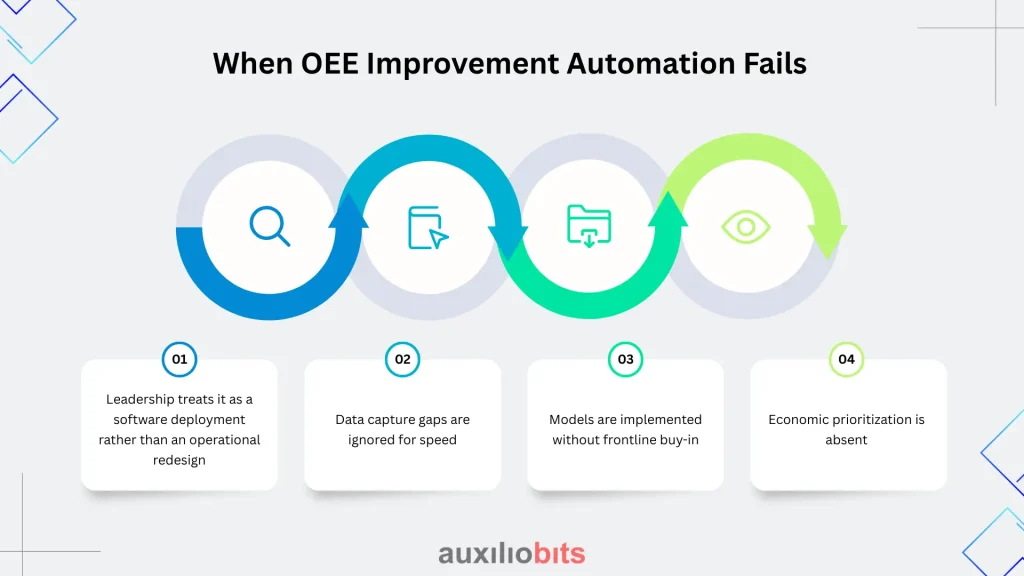
- Leadership treats it as a software deployment rather than an operational redesign
- Data capture gaps are ignored for speed
- Models are implemented without frontline buy-in
- Economic prioritization is absent
And occasionally, it fails because expectations are unrealistic. Not every plant jumps from 60% to 85% OEE in a year. Sometimes the ceiling is structural—legacy equipment, high product mix variability, labor constraints.
Automation can reveal those constraints clearly. That clarity itself has value.
The Practical Path Forward
For organizations serious about OEE improvement automation:
- Audit data capture accuracy before deploying AI.
- Instrument micro-events. They hide more loss than major breakdowns.
- Standardize event definitions across systems.
- Deploy AI agents gradually—start with one constraint asset.
- Tie insights to structured escalation workflows.
- Review economic impact, not just percentage improvement.
Start narrow. Prove value. Expand.
A Final Thought
OEE has always been a deceptively simple metric. Its power lies not in the percentage itself, but in what it forces you to confront about operational discipline.
Automation and AI agents don’t replace that discipline. They expose where it’s weak—and strengthen it when applied thoughtfully.
The organizations seeing meaningful performance gains aren’t those with the flashiest dashboards. They’re the ones that treat data capture as sacred, root cause analysis as a daily habit, and AI as a tool for operational clarity—not a substitute for it.
This distinction is crucial.