

Key Takeaways
- Automation maturity is not measured by bot count. Manufacturing organizations plateau when automation remains fragmented and ownership ends at task completion.
- End-to-end orchestration changes how work survives exceptions. Processes that retain context and state recover faster than those stitched together with emails and manual handoffs.
- Operational speed is the absence of waiting. Faster resolution of exceptions often delivers more value than higher transaction throughput.
- Resilience comes from expecting instability, not designing for perfection. Hyperautomation works when systems are built to adapt to supplier, demand, and regulatory volatility.
- Scalability is about absorbing variation, not enforcing uniformity. Orchestrated processes scale across regions, plants, and acquisitions without collapsing under local differences.
Walk through most large manufacturing organizations today and you’ll hear the same story told in different accents. Finance teams talk about invoice matching bots. Supply chain leaders mention automated reorder points. IT proudly points to dashboards showing hundreds of “automated tasks” live in production. On paper, it looks impressive.
Yet when something unexpected happens—a supplier misses a shipment, a machine goes down, a customer changes demand at the last minute—the same emails, calls, spreadsheets, and human escalations reappear. Automation exists. Flow does not.
That gap is where hyperautomation actually lives. Not in the number of bots deployed, but in how work moves, adapts, and recovers when reality refuses to follow the happy path.
The Truth About “Automation Maturity
Manufacturing has spent the last decade automating fragments of work. That made sense. Start small. Prove ROI. Reduce obvious manual effort. The problem is that many organisations have only implemented basic automation.
Task-level automation delivers quick wins:
- GRN matching
- Master data updates
- Report generation
- Simple approvals
But these isolated automations behave like well-trained workers who refuse to talk to each other. They do their job perfectly and then wait. The handoff is still manual. The context is still lost. Exceptions still bounce between departments.
Hyperautomation, when done properly, changes the unit of value. The focus shifts from “automated tasks” to orchestrated outcomes.
That sounds like marketing language until you see what breaks without orchestration.
Also read: ROI of HyperAutomation in Finance and Supply Chain Operations
From task automation to end-to-end orchestration
Consider a common scenario: supplier onboarding in a mid-sized manufacturing enterprise.
Most companies already have:
- A form submission workflow
- Some validation scripts
- ERP master data creation automated via RPA
- Email notifications for approvals
Individually, these pieces work. Collectively, they fail under pressure.
Why? This is due to the non-linear nature of the onboarding process. Documents arrive incomplete. Compliance requirements change by region. A supplier might be approved for indirect materials but not direct spend. Finance may approve credit terms that procurement never sees.
End-to-end orchestration does something fundamentally different:
- It maintains process state, not just task completion
- It reasons about dependencies, not just sequences
- It adapts the flow based on context, not static rules
In practical terms, orchestration means the system knows why something is happening, not just what to execute next.
A well-orchestrated onboarding flow can:
- Pause automatically when compliance documents are missing
- Route exceptions differently based on supplier risk tier
- Trigger alternative approval paths when thresholds change
- Resume without restarting the entire process
That’s not “more automation.” It’s different automation.
Speed: why orchestration beats brute-force automation
Manufacturing leaders often equate speed with throughput: more transactions per hour, more lines processed per day. Hyperautomation challenges that narrow view.
True operational speed shows up elsewhere:
- Faster recovery from disruption
- Shorter decision cycles
- Reduced latency between signal and action
In a global manufacturing company, invoice processing was already 90 percent automated. Bots handled volume efficiently. Yet month-end close kept slipping.
The culprit wasn’t processing speed. It was exception handling.
Invoices blocked due to price mismatches, missing POs, or tax issues sat in queues waiting for humans to triage them. No system owned the exception end-to-end. Each function optimized its own step and blamed the next.
Once orchestration was introduced:
- Exceptions were classified automatically, not dumped into a single bucket
- Context from procurement, contracts, and receiving flowed with the invoice
- Resolution paths were dynamically assigned based on root cause, not org chart
The result wasn’t marginal. Cycle time dropped by weeks, not hours.
Speed, in hyperautomation terms, is the absence of unnecessary waiting.
Resilience: automation that bends instead of breaks
Manufacturing environments are hostile to rigid systems. Demand swings. Suppliers fail. Regulations shift. Plants run differently despite shared templates. Any automation that assumes stability will eventually become technical debt.
Traditional task automation breaks quietly. Bots fail. Scripts time out. Data mismatches increase. Humans step in and normalize the workaround. The system “works,” but only because people absorb the chaos.
Hyperautomation surfaces fragility instead of hiding it.
Resilient orchestration layers are designed to:
- Detect anomalies early
- Escalate intelligently
- Offer multiple recovery paths
Take production planning. Many manufacturers rely on automated MRP runs tied to ERP logic that assumes clean master data and predictable lead times. When a key supplier slips, planners override recommendations manually.
An orchestrated approach can:
- Combine real-time supplier signals with planning logic
- Simulate downstream impact before changing schedules
- Trigger coordinated actions across procurement, production, and logistics
This doesn’t eliminate human judgment. It supports it. There’s a difference.
Resilience comes from distributed intelligence, not centralized control.
Scalability is not about volume alone
Ask a CIO what scalability means and you’ll hear about transaction counts, bot licenses, infrastructure capacity. Those matter. But manufacturing scalability fails in subtler ways.
Consider geographic expansion.
A process automated in North America often collapses when rolled out in APAC or LATAM:
- Different tax structures
- Local compliance nuances
- Supplier maturity variations
- Language and document format differences
Task automation scales poorly across variability. Orchestration scales with variability.
Because orchestration frameworks separate:
- What must happen (outcome)
- From how it happens (execution)
- And why it happens (business intent)
This separation allows localized adaptation without rewriting the entire automation stack.
Scalability also shows up during acquisitions. Newly acquired plants rarely follow the same processes. Hyperautomation lets you onboard process diversity first, then rationalize later. That’s politically and operationally easier than enforcing standardization upfront.
When hyperautomation fails (and why it often does)
t’s worth saying this plainly: hyperautomation initiatives fail regularly.
Common reasons:
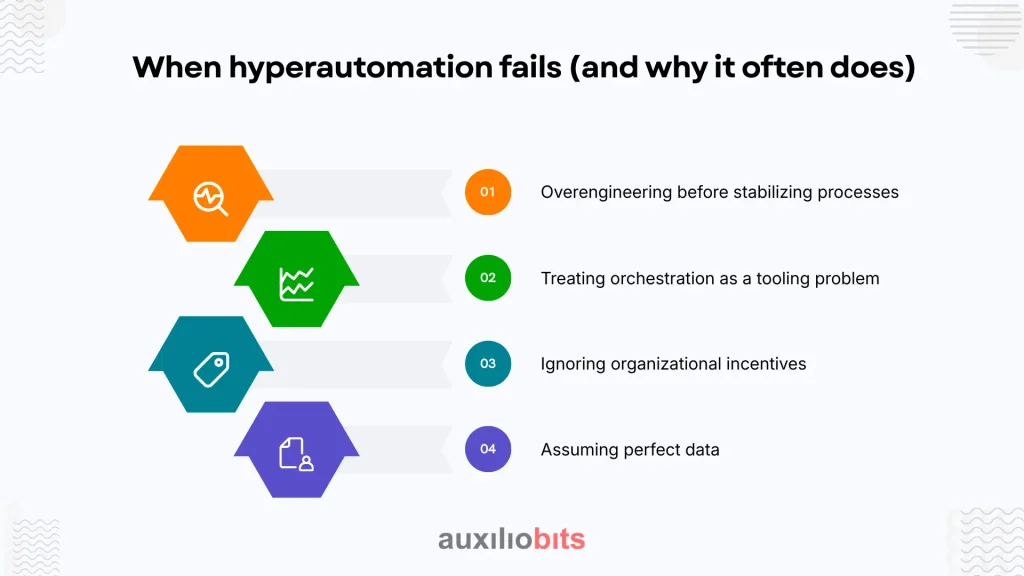
- Overengineering before stabilizing processes
- Treating orchestration as a tooling problem
- Ignoring organizational incentives
- Assuming perfect data
There have been manufacturers investing heavily in orchestration platforms only to recreate brittle flows with prettier diagrams. The mindset didn’t change. The governance didn’t change. The ownership didn’t change.
Hyperautomation requires:
- Clear process ownership beyond functional silos
- Agreement on exception handling principles
- Willingness to expose inefficiencies instead of masking them
It also demands patience. End-to-end orchestration rarely shows immediate ROI in the first few weeks. The payoff comes as exception volumes drop and decision quality improves.
If leadership expects instant savings, the initiative will be pushed back into task automation territory. That’s not always wrong. It’s just limited.
Real-world value beyond cost reduction
Cost reduction is the easiest metric to justify. It’s also the least interesting.
Manufacturers adopting hyperautomation seriously report value elsewhere:
- Improved OTIF due to faster coordination
- Lower working capital through tighter process coupling
- Reduced dependency on tribal knowledge
- Better auditability without manual reporting overhead
One automotive supplier used orchestration to link quality deviations with supplier performance and corrective actions. The system didn’t just log non-conformances. It followed them until resolution, across plants and vendors.
Quality incidents dropped. More importantly, response time shrank. That’s competitive advantage, not just efficiency.
What actually changes on the ground
Hyperautomation alters daily work in ways that don’t show up neatly in dashboards.
Planners spend less time chasing status. Procurement teams argue less about responsibility. Finance stops being the cleanup crew for upstream chaos.
Some tangible shifts:
- Decisions move closer to real time
- Exceptions become signals, not nuisances
- Process discussions shift from blame to design
It’s not utopian. There are still failures. But they’re visible, traceable, and fixable.
A practical way to think about the journey
Not every process needs orchestration. Not every task deserves intelligence. Maturity matters.
A pragmatic progression looks like this:
- Stabilize high-volume transactional automation first
- Identify processes where exceptions dominate effort
- Introduce orchestration selectively around those flows
- Expand intelligence where human judgment is repeatedly applied
Bulletproofing everything is a mistake. So is underestimating complexity.
Hyperautomation works best when applied with restraint and intent.
Final Thought
Manufacturing doesn’t need more bots. It needs systems that understand work the way humans do, without inheriting human inconsistency.
Hyperautomation, at its best, doesn’t replace people. It gives them back time, context, and leverage. At its worst, it’s just expensive automation theatre.
The difference lies in whether organizations are willing to move beyond tasks and start designing for flow.